There was a brief period of time when Cristobal Jofre was looking ahead to college with the intention of studying law. Then he experienced what it was like to drive fast.
“It wasn’t until maybe 2021, when I was really deep into watching Formula One and started doing go-karts, that I thought, ‘Nah, I’m going into engineering,’” says Jofre, who is 20 and lives in Imperial, Pennsylvania.
It wasn’t just the thrill of being strapped into a vehicle and going full throttle, says Jofre, now a junior engineering major at Penn State University. After joining a local go-kart league, he quickly discovered how little he actually knew about the science of going fast—the importance of track surface, tire grip, aerodynamics, weight distribution, and braking technique, and the psychology of knowing how to push a machine to its limit while confronting his own fears.
“It’s really interesting to go down through the technical points, the whole science behind racing,” he says.
They are concepts that visitors to Kamin Science Center now can discover for themselves with the opening of its most ambitious, immersive exhibition in years—Science of Speed, Powered by Lenovo.
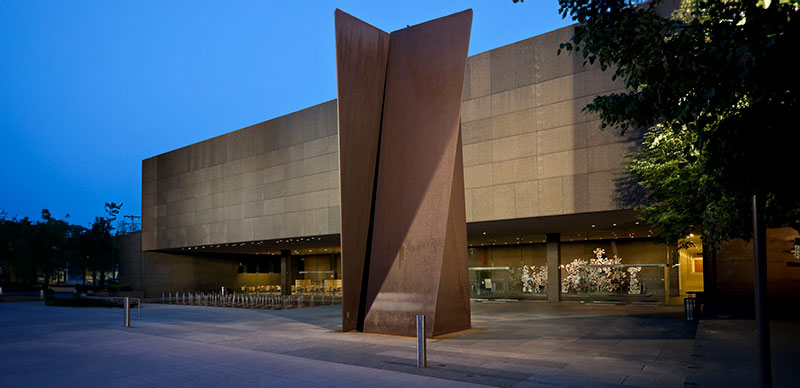
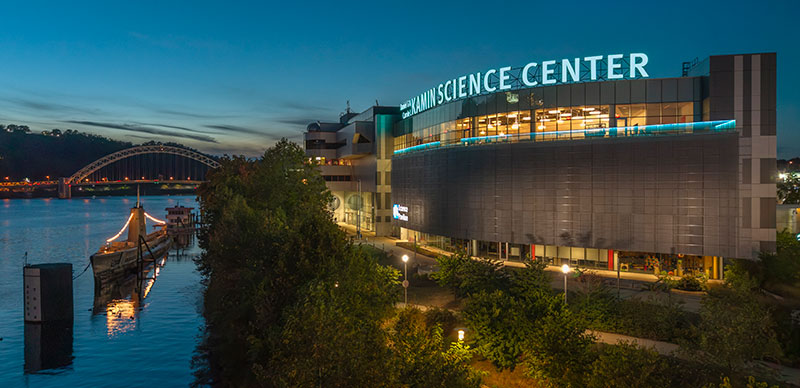
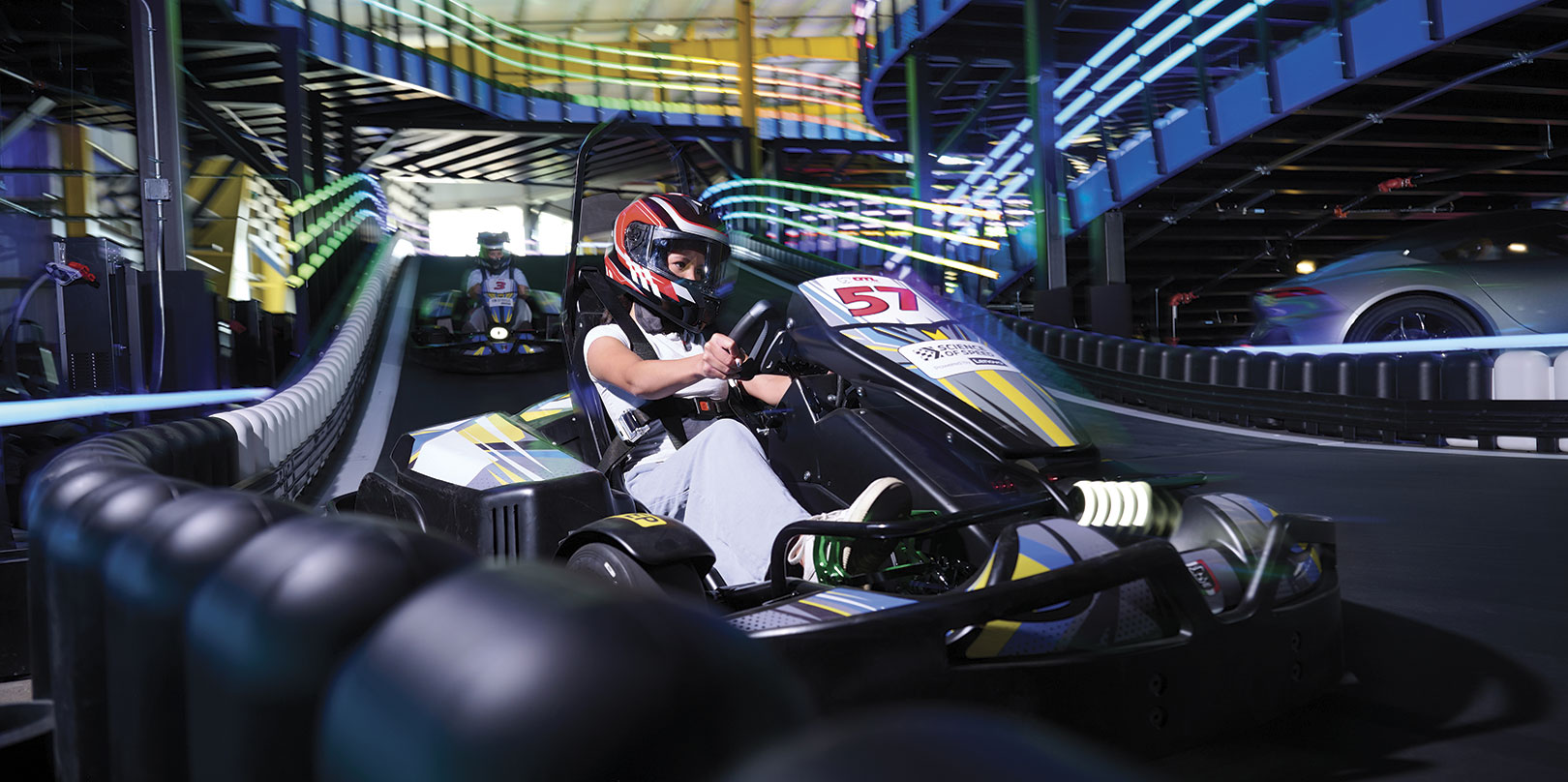
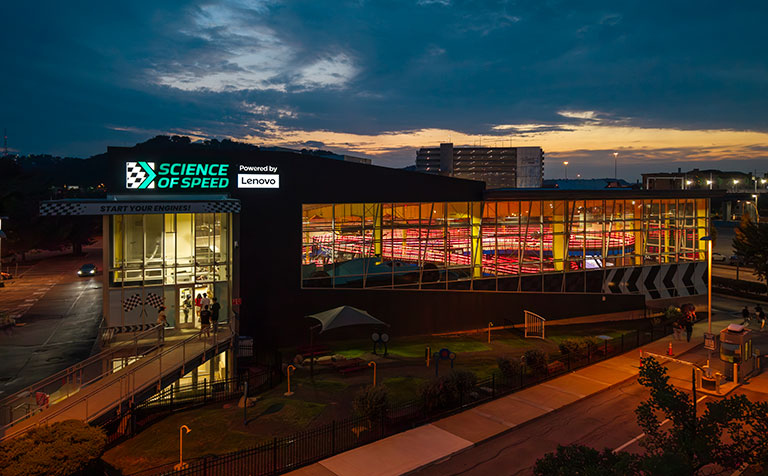
Located in the former SportsWorks building, Science of Speed offers an experience unlike any other museum offering in the country, says Jason Brown, Henry Buhl, Jr., director of Kamin Science Center and vice president of Carnegie Museums. Featuring a multilevel indoor go-kart track with all-electric vehicles that can approach 40 miles per hour, the exhibition dives into the science of racing through on-track competition, driving simulators, educational exhibits, and artifacts from the racing industry.
 Phot: Joshua Franzos
offers an evening experience for adult racers.
To appeal to adult adventure seekers, the Science Center for the first time is offering an after-hours experience just for grown-ups. On Thursday, Friday, and Saturday evenings, adult racing enthusiasts 18 and older will have the opportunity to drive high-performance karts turned up to faster speeds than during the day, or simply relax and watch others race while enjoying light bites, craft cocktails, and local beers from the “Pit Stop” lounge.
At its core, Science of Speed is an opportunity to engage with concepts and technology that are applicable not only to world-class racers in Formula One, MotoGP, or other leagues, but also to anyone behind the wheel or looking forward to being there.
“It’s this continuous improvement process that is being driven, no pun intended, by the racing industry in their quest to just shave thousands of a second off of a lap or get another half a mile per hour on their top speed,” Brown explains. “The innovations born from this process are then showing up in our everyday lives. The car that I drive is electric, and probably three-quarters of the technology came about because, at some point in the past, some racer, a driver, an engineer, a team was like, ‘We need to try and do this.’”
Experiential Science
Kamin Science Center has long connected scientific concepts with tangible, experiential exhibits. But Science of Speed aims to reach a broader audience that includes teens and adults who want to test their mettle in high-speed electric cars.
The vehicles are centrally controlled and set differently for drivers aged 13+ during the regular daytime hours. But at night, things get faster for adults 18+ for a more competitive experience.
“The car that I drive is electric, and probably three-quarters of the technology came about because, at some point in the past, some racer, a driver, an engineer, a team was like, ‘We need to try and do this.’”
Jason Brown, Henry Buhl, Jr., Director of Kamin Science Center
Adult drivers who have been behind the wheel for decades might think they understand concepts like the interplay of friction and velocity, but learning by doing is often the best method.
“I think in many people’s cases, the more physically engaged you can be with a topic, the better, as it moves from abstraction to actual putting into practice,” Brown says. “Suddenly it becomes real. You can read about the absorption of a crash barrier for a car, but then when you’re in a go-kart and you smash into a wall at 30 miles per hour, you experience what that means.”
Craig Thomas recalls the sensation he had when he first began racing high-performance go-karts a decade ago. A professional mechanic who raced competitive motocross bikes in his youth, he discovered go-karts when applying for a mechanics job at a go-kart track in Monroeville.
When he first saw the karts, he mistakenly assumed they were the kind “like when you go to Myrtle Beach, and they’d go 10 to 12 miles per hour, just putting around.”
Then he climbed inside one and took it on a test lap.
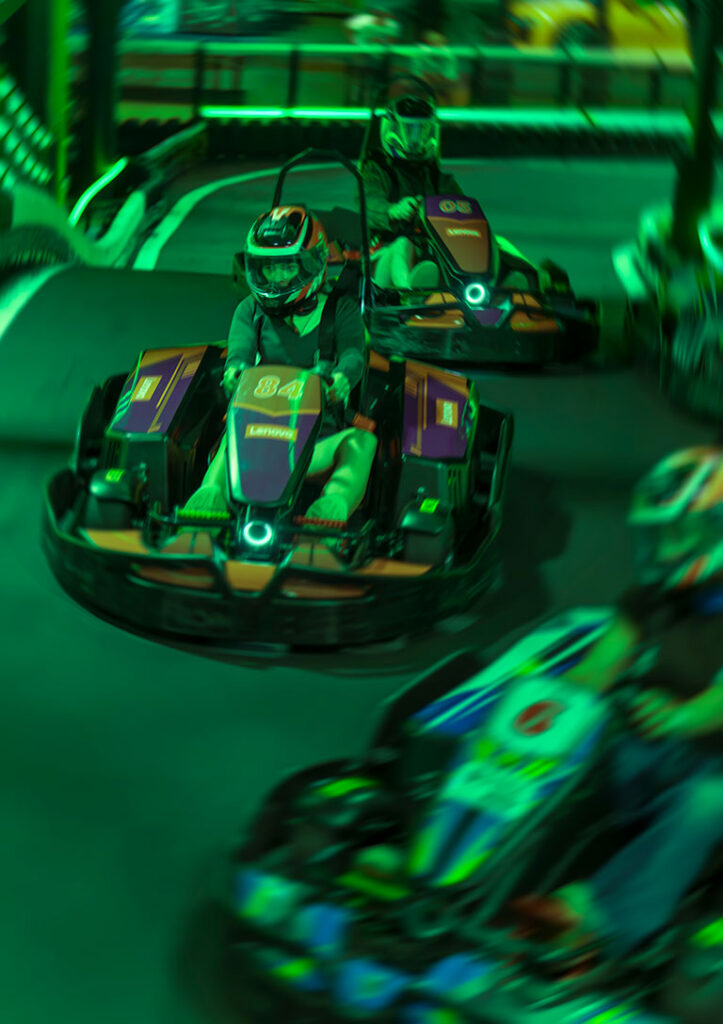 Photo: Joshua Franzos
“They were so much faster than I thought they were,” recalls Thomas, who is now general manager of Three Rivers Karting Entertainment Park in Leetsdale, Pennsylvania. “The level of skill that I needed to be fast caught me by surprise. It was exhilarating. It reawakened my thrill for speed and going fast.”
He learned early on that going fast requires more than mashing the throttle to the floor and sliding around corners.
Counterintuitively, if you want to go fast, you need to learn how to brake.
“Braking is far more important than you’d think,” he says. “The release of the brake is probably the most important thing. In order to be fast, you have to be gradual and not treat it like an on-and-off switch.”
Effective braking relies on an understanding of friction, tire wear, weight distribution, and track surface. Knowing how and where to let up on the throttle and gradually apply the brakes, depending on severity of the turn or camber of the track, is essential. All of these concepts are not only explained through informative displays but also can be tested and analyzed at the Science Center’s newest experience.
Lessons in Performance
“There’s quite a bit of technology in the track,” Brown says.
Lessons in materials science are an important part of Science of Speed. The track surface has an epoxy coating that performs differently than the paved asphalt more familiar to everyday drivers, requiring even the most experienced racers to adjust their approach on turns as they search for grip.
“As cars drive on it, the rubber will actually come off the tires and start to create a more adhesive surface,” Brown explains. “The idea is that the kart will stick to it enough that it won’t slide and lose that energy as it goes around the corners, allowing it to go as fast as possible while maintaining its forward momentum.”
Visitors will also learn about the physical fitness required to negotiate a real race. The all-electric go-karts handle quite differently than modern automobiles, and interactive exhibits will give visitors a sense of the strength required to steer a race car.
“There’s no power steering,” Brown explains. “So, you have to be able to turn the wheel of a car that’s hurtling along and keep it on the road.”
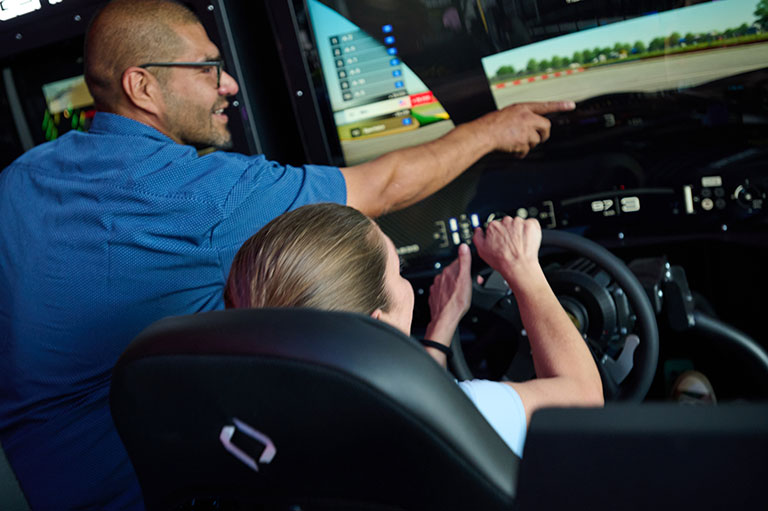
Drivers will also be able to analyze data about their own driving. Science Center visitors who sign up for a turn on the track will create a racer profile that records their performance data, including lap times and top speeds. They can then track their progress as they hone their skills on repeat attempts.
“Drivers will have the data from their own races to be able to study what they were doing and what they weren’t,” Brown says.
Data analysis is how Rick Shank is hoping to improve his own track performance. The 46-year-old IT professional has been racing for over two decades and currently competes in a league at Three Rivers Karting. He collects as much data as he can, matching lap times to the different karts he drives every week to figure out how to maximize his performance on each machine. And he’s relishing the opportunity to expand his dataset on the Science Center’s track.
“I am looking for consistency. I’m looking for which karts are working for me, which ones come up to speed fast,” he says. “How do I crack this nut, from a math side? I look at the data.”
Off-Track Learning
Shank understands that racing is as much about mental preparation as it is the mech-anics of the kart. That’s the component that he believes he needs to improve on the most.
“Honestly, what holds me back a lot is the psychology component of racing,” he says.
He took the pole position in one recent race with the fastest lap time, but halfway through the 10-lap competition he went from first to worst.
“This was 100% race craft,” he says. “I left a lane open. People behind me realized and capitalized on it.”
But you don’t have to join the action on track to learn about the mental side of racing in Science of Speed. These concepts can also be tested in five fully immersive simulators.
“They were so much faster than I thought they were. The level of skill that I needed to be fast caught me by surprise. It was exhilarating. It reawakened my thrill for speed and going fast.”
Craig Thomas, general manager of Three Rivers Karting Entertainment Park
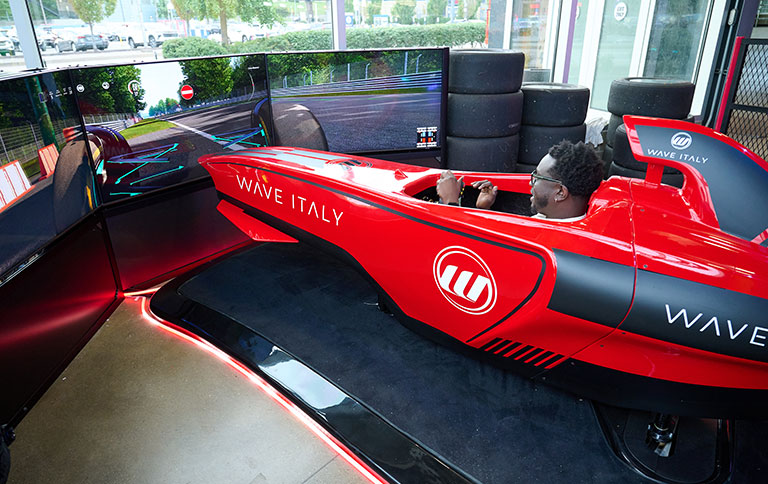
One simulator is dedicated to Formula One, giving users a virtual sensation of what it’s like to take hot laps on famous circuits around the world. Meanwhile, four other simulators are interconnected so visitors can go head-to-head in competition and learn more about the craft of executing a pass or defending against someone coming up behind them. Each simulator turns lessons about external forces, control, and decision-making into a visceral, real-time test of speed and skill.
“Every part of this experience is designed to turn concepts in science, technology, engineering, and mathematics into something physical, competitive, exciting—and, most importantly, unforgettable,” Brown says.
Science of Speed offers plenty of other off-track experiences for anyone not interested in the thrill of competition. A “wind-tunnel” exhibit allows users to examine the aerodynamics of differently shaped vehicles, comparing the streamline of an SUV, for example, to an open-wheel race car or a motorcycle.
“As you turn the wind up, you’ll be able to understand how the aerodynamics work with the way the air moves around the object, but also how it creates downforce to keep the car on the road,” Brown says.
Gearheads will get to explore the mechanics of an internal combustion engine by way of a marquee attraction that will be familiar to fans of Marvel movies: the high-performance, orange Audi R8 famously driven by Iron Man Tony Stark, with an “exploded” engine so that each component is visible.
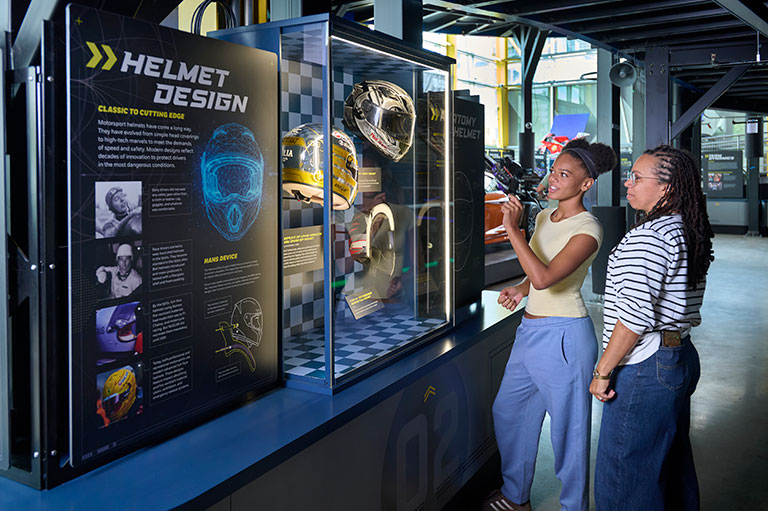
Memorabilia from racing history is also part of Science of Speed. A lemon-colored 1959 race car known as “Ol’ Yaller,” built by California hot rod legend Max Balchowsky, is on display, as well as a signed racing suit from reigning MotoGP world champion Marc Marquez, a Ducati racing motorcycle, and racing helmets donated by the exhibition sponsor Lenovo.
And finally, those who are more interested in watching the action on track can relax in the Pit Stop lounge. Located in an open mezzanine overlooking the exhibition, the lounge introduces an entirely new type of social experience at the Science Center—one that connects it with the other entertainment venues on the North Shore, says Megan McKenzie, director of marketing for the Science Center.
“We’re in this unique entertainment hub,” McKenzie says. “We have the casino on one side, Acrisure Stadium, PNC Park, Stage AE, and so many other major attractions right around us. We want to be part of that energy and be a place people think about visiting when they’re coming into Pittsburgh for a big event.”
The facility’s dynamic, nighttime look reflects that, with an exterior illuminated by three rails of ever-changing LED lights serving as a beacon to visitors.
“I think it’s going to be its own best advertisement,” Brown professes.
For local race fans, the attraction is the concept itself. Brown says that Science of Speed will invite competitive karting leagues to race there, opening up opportunities to bring the region’s racing community into the heart of the city. Nothing else like this exists so close to downtown.
“I love the idea that it becomes more accessible to more people,” says Shank. “Anytime I can get some additional practice on a different style of track, it not only benefits the region but, personally, I’ll enjoy that a lot.”
For Jofre, the Penn State engineering student, Science of Speed is the perfect marriage of his personal passion and career ambition: a place where he can test the theories of fluid dynamics, the friction coefficient, and other lessons he’s learning in class as he prepares (hopefully) to build cars professionally for a racing team.
Sure, racing is fun. But it’s also serious science.
Science of Speed is Powered by Lenovo, with support from Racing Partner: PPG.