 Photo: Joashua Franzos
Natural history museums have long sought to tell the stories of people from around the world, but in recent years there’s been a shift in how they go about telling them.
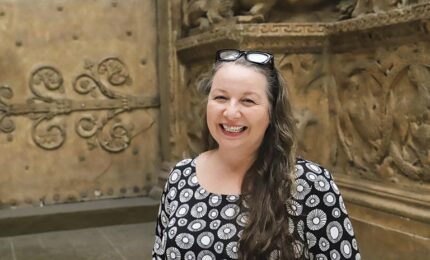
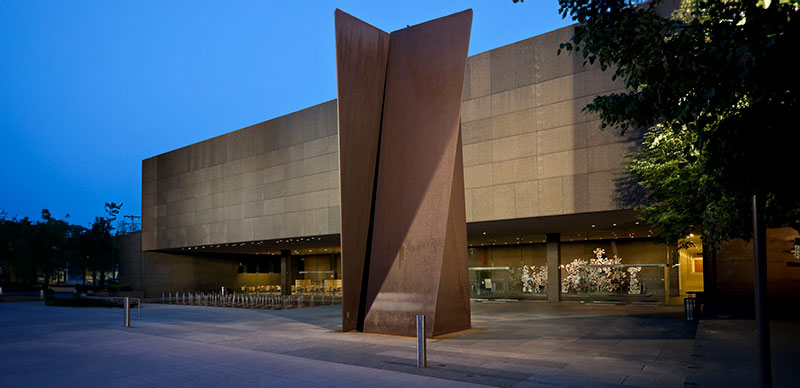
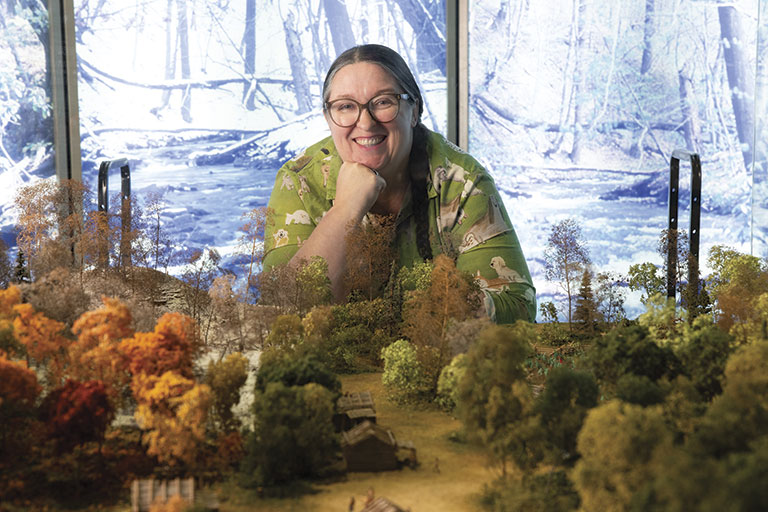
Today, Carnegie Museum of Natural History and many of its peers aim to share authority with the communities they portray while caring for cultural artifacts in the museum collections. Amy Covell-Murthy, the museum’s collection manager of archaeology, is helping the institution do that.
In her 19 years at the the museum, Covell-Murthy has carefully built close relationships with Indigenous communities. She continues to repatriate sacred objects and artifacts with human remains that are contained in the museum’s collections—as required under the Native American Graves Protection and Repatriation Act—and consults with tribal members on how best to care for the items that remain in the museum’s care. She also worked with members of the Quapaw Nation to co-develop the Keeping Traditions Alive exhibition in the Alcoa Foundation Hall of American Indians.
Holding a bachelor’s degree in anthropology and master’s in museum studies, Covell-Murthy is still learning how museums can build more equitable relationships with communities from around the globe. In June, she returned from a trip to England, where over the course of eight weeks she learned about the University of Oxford’s community-led museum practices as part of the William T. Hillman Visiting Fellowship program, a new collaboration between Oxford’s Gardens, Libraries, and Museums and Carnegie Museums.
Sharing authority with outside groups is delicate and challenging work, she notes, but ultimately helps the institution be a better steward of the objects in its care, as well as the human stories it presents.
“Having a person-first mentality rather than an object-first mentality has been really important,” Covell-Murthy says.
Q: What did you learn at Oxford that you want to bring back to the museum?
A: I’d say, when working on completely community-driven programming, it’s OK to not have a really clear end goal. You can have a perfectly wonderful program that just starts out with everyone brainstorming and figuring out along the way what something’s going to look like in the end.
Q: When did you first become aware of issues around repatriation in museum collections?
A: Twenty years ago, people didn’t really talk about human remains in museum collections because everyone was worried that they would get in trouble. At some point, I realized that it was something that shouldn’t be hidden and that we all should be talking about it. That’s when I switched the focus of my career from objects to people, reminding myself that the people in our care, the human remains in our care, are people with cultural and family ties.
Q: Partnering with Indigenous communities is a critical part of this work. How do you ensure that it’s a genuine partnership?
A: How to make relationships not extractive and sustainable is something that we’re constantly trying to do better. We’ve worked with multiple Indigenous communities—the Quapaw and the Fort Peck tribes, for example—in a reciprocal way in which we co-curate exhibits with them, and people are paid for their time. We have started asking the question, “What do you want the people of Pittsburgh to know about your community?” instead of the other way around. We are also in the habit now of going out into the communities instead of always asking them to come here.
Q: You’ve noted that in anthropology, the aim is to allow communities to tell authentic personal stories. How does a museum do that?
A: In the past, an exhibit would have a goal to teach visitors something. Now, the goal of authentic stories and first-person stories is to bring people together, to make it so that you can see the similarities and the differences between our cultures and not see these people as others or outsiders. We all have a lot in common. I think that it’s easier to reach people on a personal level than it is when we have an exhibit that’s not focused on the human experience.
Q: How do you collect those personal stories?
A: The Keeping Traditions Alive exhibit is the first-person account of two Quapaw elders who were able to choose the theme of the exhibit. Betty, one of the elders who’s featured, made the dress and the ceramics that are featured in the exhibit. We purchased those items from her after asking what she thought would fit in the collection in Pittsburgh the best. Those were the things that she chose for us to purchase from her. The purpose was to give people in Pittsburgh a glimpse into the community that these Quapaw elders are a part of.
Q: What lessons have you learned doing this work?
A: You can’t expect everyone to function on your timeline. You have to be able to go with the flow and the tone that they set. My biggest thing is that we’re gonna make a lot of mistakes, and we have to own up to those mistakes and always do better.