When scientists announce the discovery of a new species, people often imagine adventurers wading through swamps or clinging to the side of a mountain. But sometimes—in fact, a lot of the time—the remains of a creature no one has ever seen before aren’t waiting to be discovered at the end of the world. They’re sitting in a jar of preservative, tucked inside a museum drawer, surrounded by specimens that haven’t moved in decades.
That is, until someone like Valerie Warhol or Amy Bianco comes along.
Warhol (no relation to Andy) is an informatics assistant and Bianco a part-time volunteer at Carnegie Museum of Natural History. Though their work together may seem mundane to some, they serve an absolutely critical purpose.
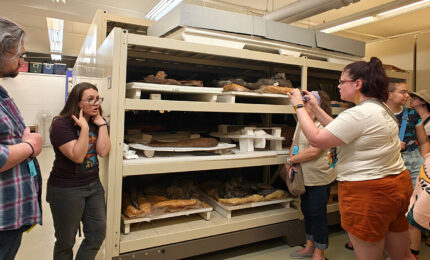
“We’re mostly just trying to go through specimens that nobody’s looked at and identify as much old stuff as possible and get it digitized and cataloged,” says Warhol, who specializes in arachnids.
Digitizing natural history collections is vital for advancing research. By digging into museum cabinets and converting physical specimens and their labels into high-resolution images and data, Bianco and Warhol are helping to make parts of the collections accessible to researchers around the world, potentially leading to new scientific insights and discoveries. The task is enormous, as the museum is home to 18 million invertebrate specimens alone, which makes the collection one of the largest in the country.
“And only about 1% is digitized,” Warhol explains.
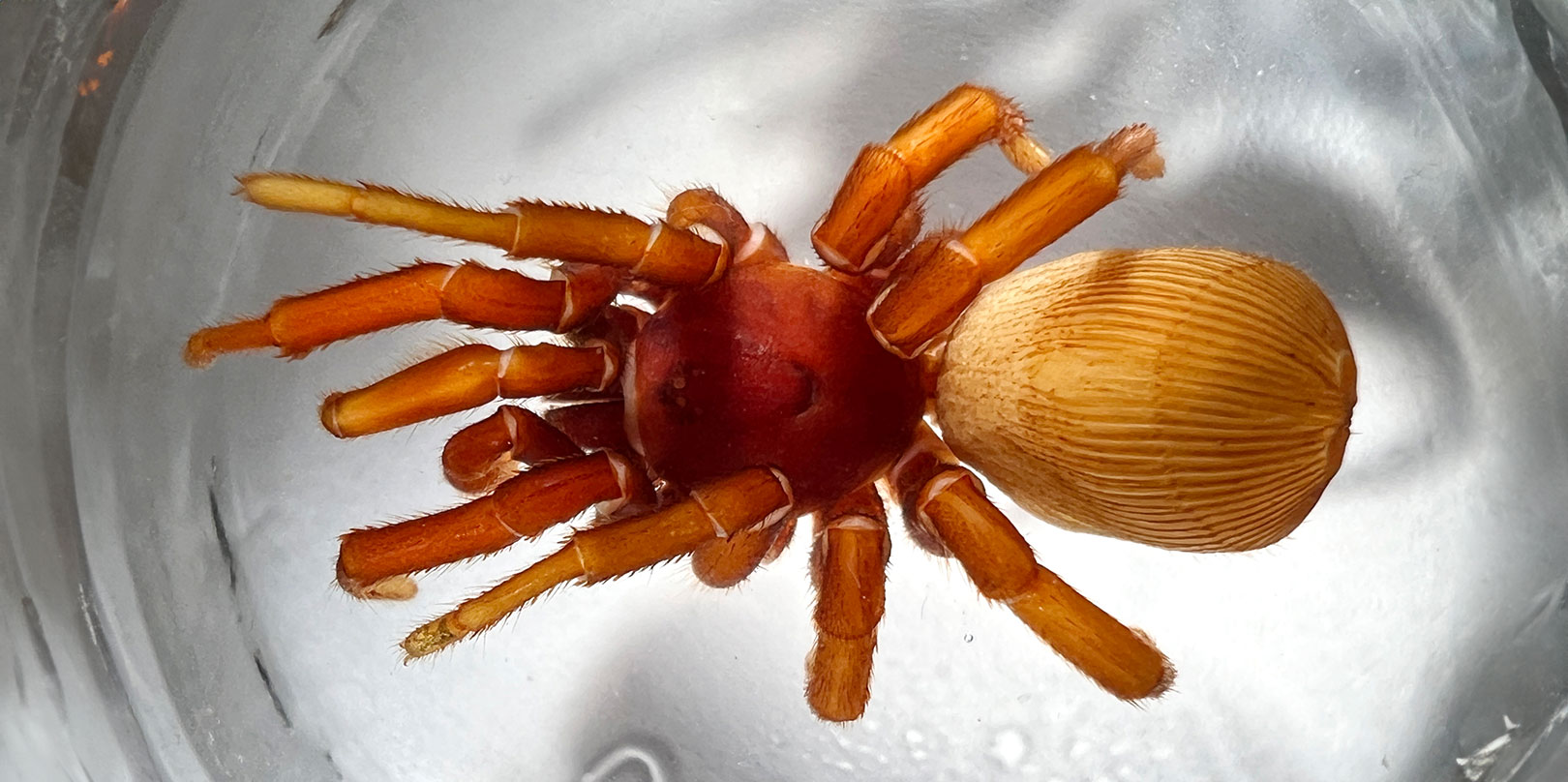
And so it was in spring 2025 that Warhol and Bianco were going through the arachnid collection, identifying specimens one by one, when they landed on a jar with four rusty-orange trapdoor spiders curled up inside.
“We thought, either it’s a major range extension for one of the known species, or it’s something that nobody knows about yet.”
Amy Bianco, part-time volunteer at Carnegie Museum of Natural History
Bianco remembers being particularly excited because it was a type of spider she’d never seen outside of a field guide. Sometimes called Oreo cookie spiders, these types of trapdoor spiders have a large, flattened rump full of ridges that can be used to prevent predators from attacking them in the tunnels they inhabit.
When Bianco used a taxonomic key to determine the mystery spider’s genus, Cyclocosmia, she realized that the species on record were only known to be from Mexico and the American South. However, the specimen in hand was caught in West Virginia in 1994.
“And so we thought, either it’s a major range extension for one of the known species, or it’s something that nobody knows about yet,” says Bianco, a lifelong spider enthusiast who also writes a blog on the subject and leads community workshops about arachnids in western Pennsylvania.
What’s more, when Warhol used another key to try to advance the identification from genus to species, something that required painstaking counting of the rump ridges under magnification, they learned that the count didn’t sync up with any known species of Cyclocosmia.
Bianco and Warhol knew they needed backup, so they reached out to Danniella Sherwood, a biologist with the Arachnology Research Association in the United Kingdom. Sherwood had recently described a new species of trapdoor spider in Vietnam, which meant she was more familiar with the genus than most experts. Fortunately, Sherwood knew what feature to look at next.
“According to Dr. Sherwood, there was a little knob on the pedipalps that appeared to be distinct for the species,” says Bianco.
In spiders, pedipalps appear as two tiny legs near the mouth, and they’re useful for manipulating food.
“They’re also very commonly used as windshield wipers,” says Bianco. “A lot of times they have like little brushes on them that they use to clean their eyes, which is so cute!”
Interestingly, when male spiders reach sexual maturity, their pedipalps transform into reproductive structures that assist in the transfer of sperm. Best of all, a male’s pedipalps are often unique to its species, like keys that only fit into a special kind of lock. And, using ultramagnified photographs provided by Bianco and Warhol, Sherwood was able to confirm that the orange spider’s palps were unlike any other trapdoor spider’s on record. Given the locale where the new critters were found, she suggested naming the species after the late, great John Denver.
Cyclocosmia johndenveri became an official species at the publication of its official description in the science journal Natura Somogyiensis, with Bianco and Warhol even included as co-authors on the paper. And yet, some mystery about the specimen still remains.
“We still don’t have a female for the species,” says Warhol. “There isn’t a ton of spider research going on in West Virginia, so we’re hoping someday someone will take a picture of one and put it on iNaturalist. You never know, you could be contributing something valuable to science or leading to a new discovery!”
Jason Bittel is a National Geographic Explorer and author of Grizzled: Love Letters to 50 of North America’s Least Understood Animals (National Geographic Books 2026).