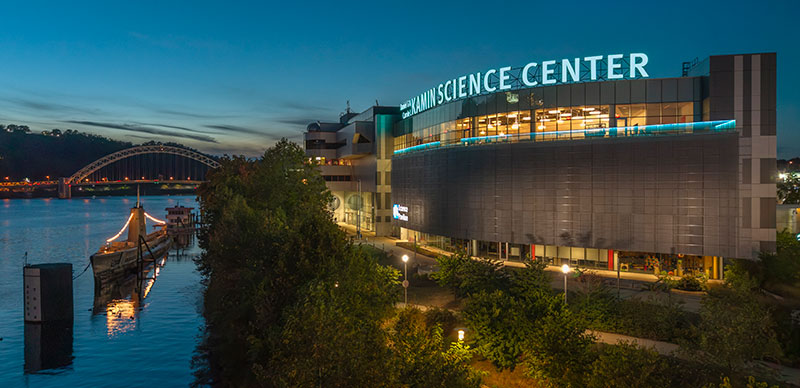
 Photo: Becky Thurner
On a bitterly cold Thursday afternoon in February 2021, 40 socially distanced visitors gathered at the Buhl Planetarium to watch space history.
They were viewing a live feed as NASA’s newest rover made its descent toward the Mars surface. Named “Perseverance,” the rover was the “most advanced robotic explorer ever sent to the red planet,” according to NASA, but its safe landing was far from certain. After 7 minutes of anxious silence, the group of strangers rejoiced—jumping up and down and cheering. Perseverance’s wheels were set on Martian soil, where it would join its older rover companion, Curiosity.
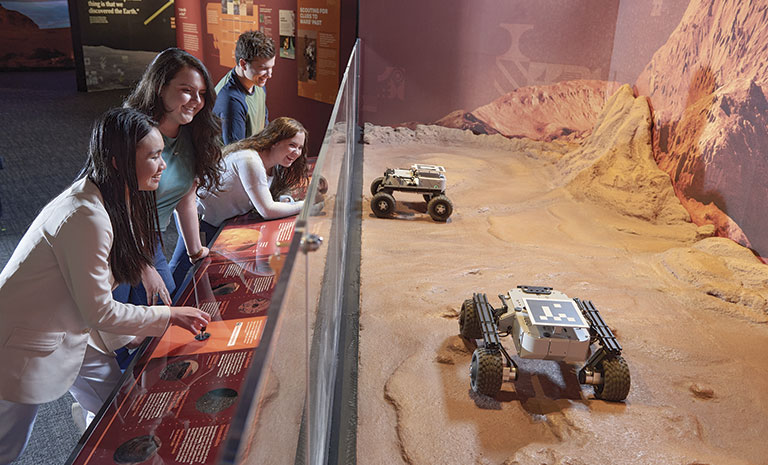
The following year, guests would be able to pilot their own two rovers across the red planet’s rocky terrain as part of Mars: The Next Giant Leap at Kamin Science Center, giving visitors in Pittsburgh just a taste of the challenge that the NASA rovers had ahead of them. The mission for both the real-life Mars rovers and those at the Science Center was the same: to find underground water sources and evidence of ancient life.
“It’s similar to paleontology, but rover-style,” says Jessi Sedon, associate director of exhibits support and digital experiences at Kamin Science Center.
Several billion years ago, the dusty and cold red desert was once much warmer and covered in flowing bodies of water, according to NASA. Rovers scan the terrain below using X-ray fluorescence, environmental sensors, and ground-penetrating radar to uncover what remains. Their findings report underground ice as Mars’ only water form, and the possibility of organic molecules, the chemical foundation of life.
The aim of the Science Center’s rovers is to model the process vital to human life on Mars: exploration. The two vehicles operate wirelessly, just like the pair on Mars. Using a joystick mounted on the exhibit’s information display, users search the rocky, ruddy surface for tiny spots that represent organic molecules. The challenge of keeping the rovers from crashing into each other demonstrates the difficulty of navigating the Mars terrain.
“Trying to get them to move and function and work around each other demonstrates how hard it can be,” Sedon says. “I couldn’t imagine doing this with an actual rover on Mars.”
As Sedon troubleshoots technology challenges with the Science Center rovers, NASA continues to do the same with the real-life Perseverance. Just last year, NASA announced it had discovered a rock containing potential biosignatures—clues that suggest past life may have been present 200 million miles away from planet Earth.