G. Peter Jemison was still a young painter developing his practice when, in 1975, he packed up his cargo van and took off to upstate New York in search of artistic community.
A citizen of the Seneca Nation whose goal as an artist was “to help people see,” Jemison sensed that he, too, had more to see. As he drove around the lands of the Haudenosaunee Confederacy, which includes much of what is today upstate New York, he visited reservations of the Mohawk, Onondaga, and Tuscarora. He met fellow artists and established new connections. At each stop he borrowed artworks to take on tour. Along with his own studies of the natural world, he gathered works made by painters and basketmakers alike. An Onondaga man loaned him a rattle made from a turtle shell. Everywhere he went, Jemison sought opportunities to present his touring exhibition and share these artists’ work—at schools and meeting houses, anywhere he could open people’s eyes and teach them something.
“Wherever there was a facility where I could put the show up, I took it there,” Jemison says.
Five decades later, Jemison is back on the road, recreating his traveling exhibition by visiting new Indigenous artists and communities for his contribution to the 59th Carnegie International, which runs at Carnegie Museum of Art until Jan. 3, 2027. This time, he drove the work he collected to Pittsburgh in a 1968 Chevy minivan that he recently spotted for sale on a lawn near Buffalo, New York—now on view at the museum’s Forbes Avenue entrance. Its exterior is wrapped with a print of one of his landscapes, Ganondagan Autumn. The works from seven other artists, as well as recent paintings he describes as “an excavation of my youth,” are on view inside the museum.
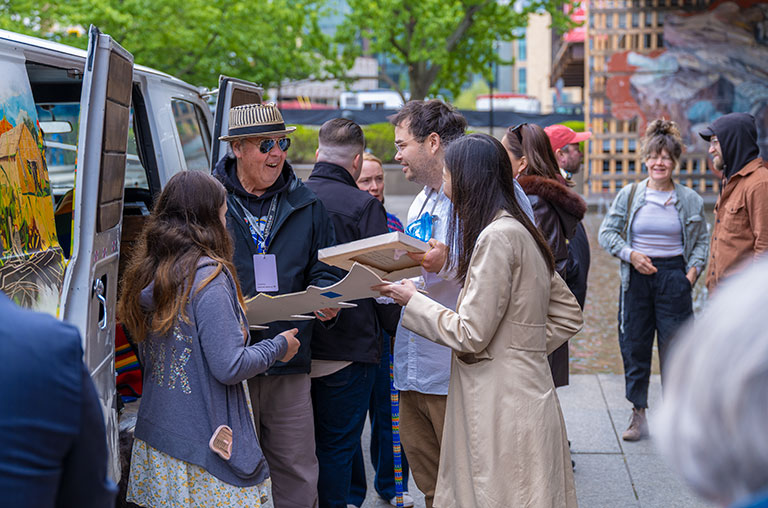
When the exhibition’s co-curators—Liz Park, Ryan Inouye, and Danielle A. Jackson—invited Jemison to participate in the longest-running presentation of international art in North America, he knew immediately he wanted to revisit his 1975 tour. Walking through the Museum of Art, he felt the dearth of Indigenous artists in the collection—an absence he wanted to address. “Whenever I’ve had the opportunity and the door opens a crack,” he says, “I think other people ought to come in with me.”
In that way, Jemison’s contribution to the International reflects the central themes of the broader exhibition. Its title, If the word we, encourages visitors to contemplate the meaning of community and plurality in a world riven by isolation and atomization.
“[Jemison’s] vehicle is carrying more than objects. It is more than the artwork,” says Park, the museum’s Richard Armstrong Curator of Contemporary Art. “What Peter is bringing to the exhibition is relationships, and ideas, and his sense of community, and his advocacy for the artists that he is in relationship with.”
Among those artists are Hayden Haynes, whose antler carvings are informed by a centuries-old practice; Katsitsionni Fox, a filmmaker and potter whose ceramics showcase Haudenosaunee techniques; Craig Marvin, a craftsman who contributed a gustoweh, the traditional Mohawk headdress; and the late painter Jay Carrier, who contributed a sculpture for the exhibition.
Jemison’s request to bring other artists along with him resonated with the ideas the curators sought to explore in the International. “Artists, as individuals, are always part of larger communities and conversations,” Park says.
Creating a Space for Listening
The process of developing the 59th Carnegie International underscores its emphasis on relationships that are built over time. In seeking to broaden their perspective for an international presentation, the curators leaned on “thought partners,” Park explains, who helped sharpen and broaden their thinking about the state of contemporary art.
Christian Nyampeta, whose charcoal drawings were included in the 58th International, welcomed the curators on research trips over the last few years to Dakar, Senegal, and Lubumbashi, in the Democratic Republic of Congo. Those visits introduced the curators to Sarah Ndele, a painter and installation artist featured in this year’s exhibition, and Kivu Ruhorahoza, a filmmaker and artist based in Rwanda whom they invited to organize a film series. In the years leading up to the exhibition, the curators also visited Norway, Brazil, South Korea, and points in between, bringing back a deeper sense of the conversations unfolding in the art world today—and work from 61 artists and collectives, most of which was newly commissioned for the exhibition.
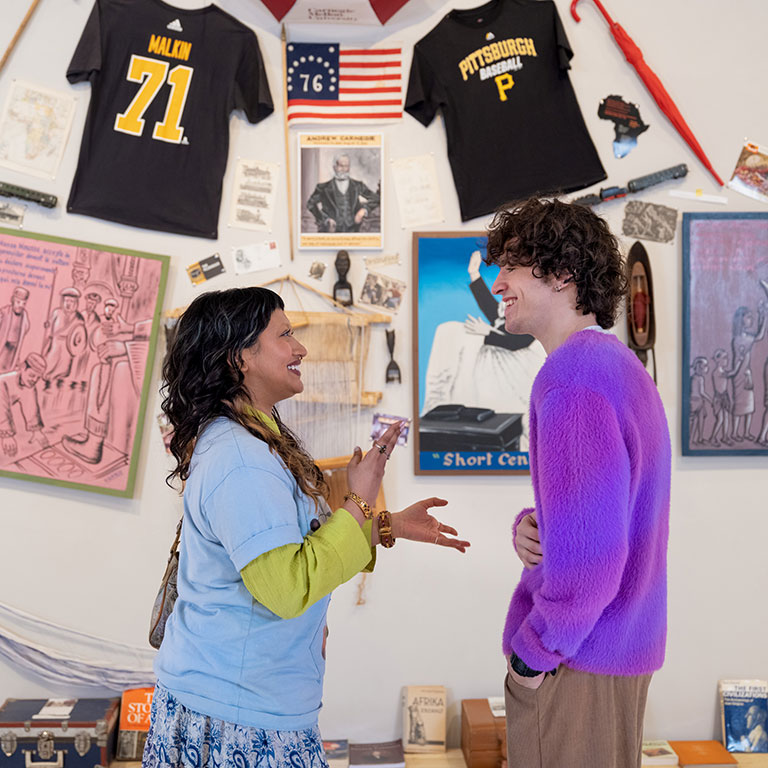
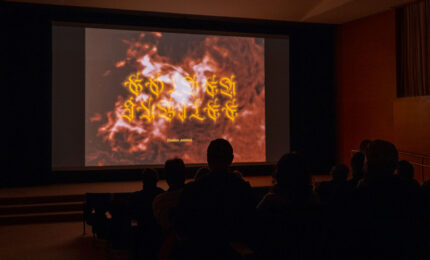
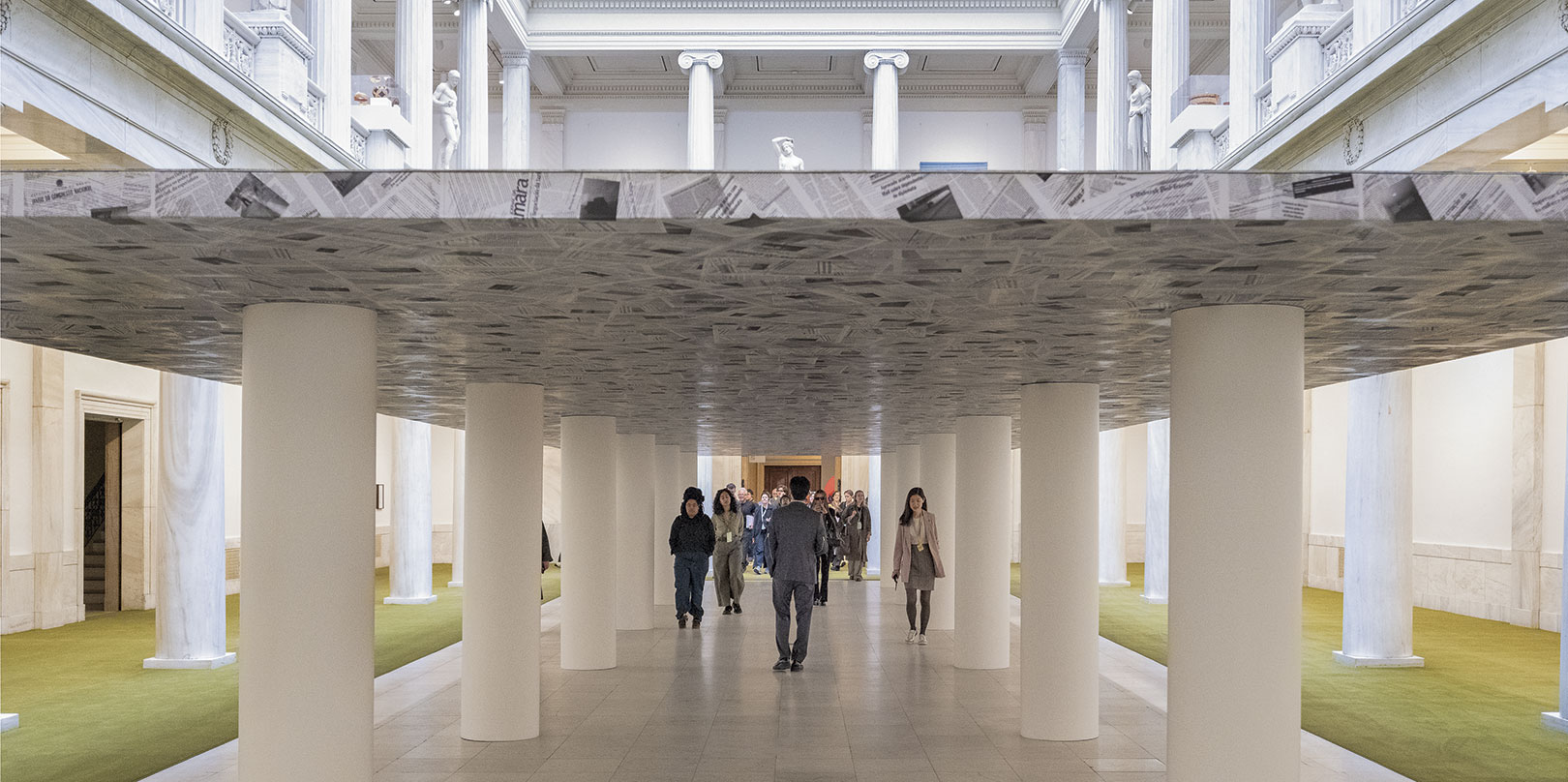
(May 2, 2026–Jan. 3, 2027); photo: Zachary Riggleman / © Carnegie Museum of Art, Pittsburgh
All told, the International features artists from five continents whose work spans a range of media: painting, photography, sculpture, installation, video, dance, theater, and more. And it reaches beyond the museum’s walls for a series of artist projects developed in partnership with institutions across Pittsburgh, including Children’s Museum of Pittsburgh, Mattress Factory, and Thelma Lovette YMCA.
In addition to Nyampeta, the curators’ thought partners included Brooklyn-based curator and educator kimi hanauer; Marianne Nicolson, a First Nations artist, linguist, and cultural historian; Korean-born, Berlin-based artist Haegue Yang; and Haytham el-Wardany, an Egyptian writer who began a series of conversations with the curators in 2023 that ultimately led to an essay that gave the International its title.
The idea of collectivity was already on the curators’ minds when el-Wardany told them he wanted to write about possible counterweights to the emergence of fascism and isolationism in civil society. In a commissioned catalog essay on “the voice of a collective,” titled “What if the word we,” he helped give shape to what had emerged from years of curation, forming a discursive center for the International. As he wrote, “we”—the first-person plural—“must first be forged … in order to speak.” El-Wardany’s inquiry into collective possibility felt like just the right prompt for the exhibition, according to the curators.
“In this particular moment, I’m really interested in how an exhibition can create a safe space for strangers—people you don’t know but also people you know—to come together and make meaning together, to decide what something means.”
Ryan Inouye, Curator
“In this particular moment, I’m really interested in how an exhibition can create a safe space for strangers—people you don’t know but also people you know—to come together and make meaning together, to decide what something means,” Inouye says. “And everyone hopefully takes away something a little different that is specific to them.”
Although the works featured in the exhibition were developed separately, el-Wardany’s essay—and its investigation of what “we” can mean and what it can accomplish—became an organizing ethos.
“It’s an invitation to empower ourselves as viewers and visitors to complete the sentence, because it is a conditional. If the word we starts as an open-ended proposition,” Park notes. “It is a great opportunity for all of us to think about this process of calling any group of people a collectivity or referring to any group of people as a ‘we.’”
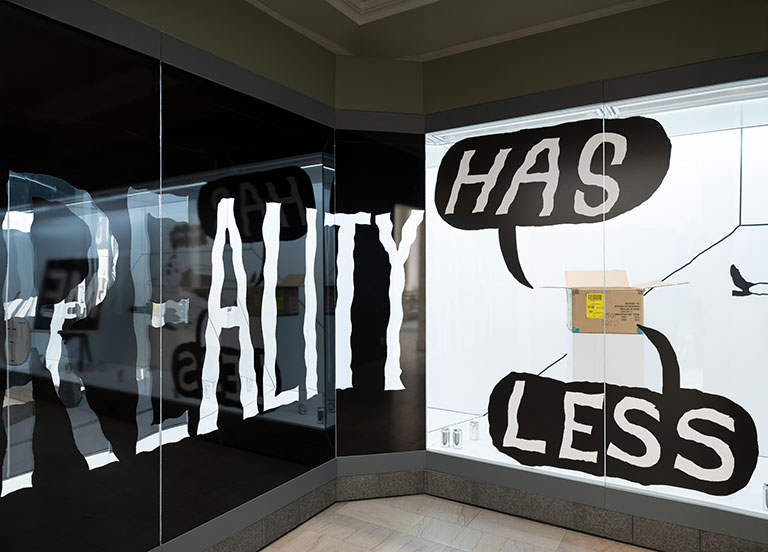
In a moment of great polarization, when both literal and figurative boundaries are being entrenched, it’s more important than ever to think about the fragile process of joining together in the plural, Park says. In his essay, el-Wardany writes about the role the ear plays in hearing. He references the musician John Coltrane, who once said of those listening to jazz and blues: “The audience heard ‘we’ even if the singer said ‘I.’” The full sentence from which the International’s title was drawn follows that thought into the future: “What if the word we becomes a space for listening?” el-Wardany writes.
As Park says, “Listening as a practice is the first step in engaging in a conversation.”
So, what do the International’s curators hope people might hear if they listen to the exhibition?
“It’s simple,” Inouye says. “Each other.”
Artistic Connections
The breadth of work featured in the International gives visitors ample opportunity to find a point of connection—or to see in new ways, in Jemison’s vernacular.
On the museum landing outside the Heinz Galleries, audiences encounter a large-scale installation of ikebana, the Japanese art of flower composition, presented by the Sogetsu Foundation, an experimental school formed in 1927 by the late Sofu Teshigahara that has more than 120 branches, including a Pittsburgh study group. Teshigahara described each ikebana arrangement as having a front and a back, Inouye says: “The front is self-explanatory. It’s what you see. But the back is actually what’s inside of you—what you don’t see.”
“It’s an invitation to empower ourselves as viewers and visitors to complete the sentence, because it is a conditional. If the word we starts as an open-ended proposition.”
Liz Park, Curator
Like the contemporary artists in the exhibition, Teshigahara was working at a moment of transformation, surrounded by Japan’s modernization. The Sogetsu method infused ikebana with unconventional materials and approaches, in conversation with other art forms rather than separate from them. The ikebana installation will be accompanied by Teshigahara’s paintings, sculptures, ceramics, and calligraphy, offering a wider view of his influence for the first time at a U.S. museum.
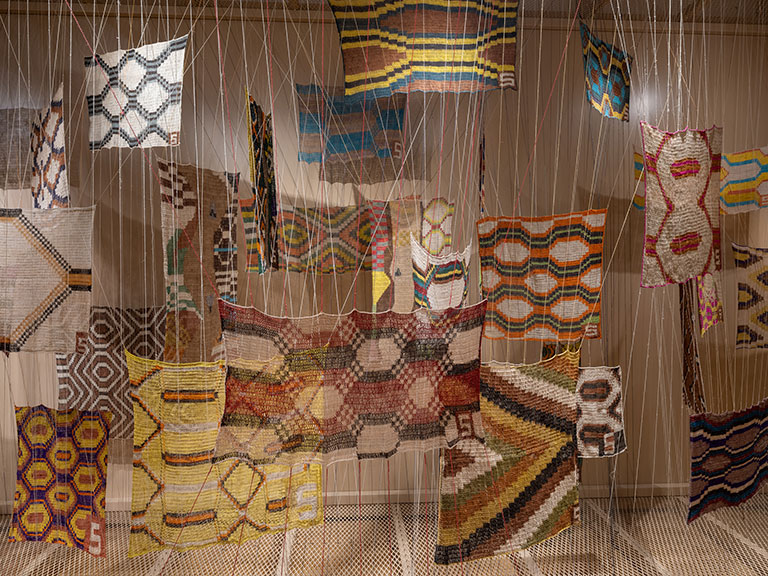
Silät, a collective of women weavers, brings another communal lens to the International. The group formed in 2023, led by Claudia Alarcón, and features 100 members of the Wichí, an Indigenous people who live in the forests of northern Argentina. Fittingly, they asked the curators if they could make a forest of their weavings, so museum staff have created an armature that can bring the tapestries to three-dimensional life. “They’re not just paintings on the wall,” Inouye says. “You’ll walk through the space and be able to see the layers.”
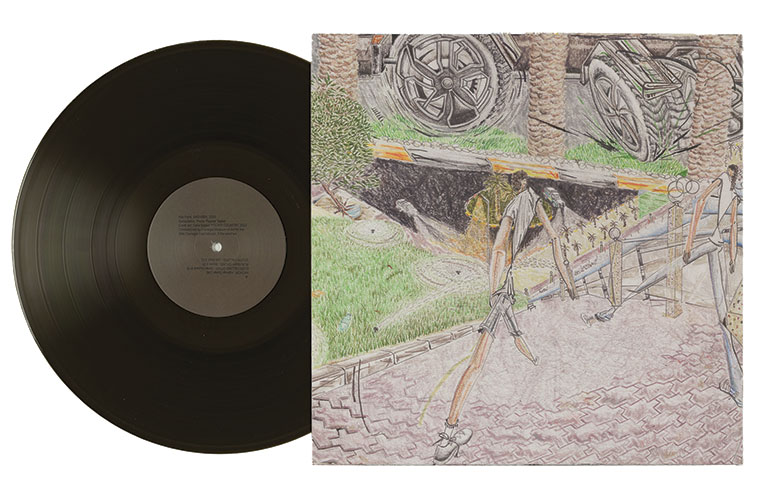
In the spirit of new encounters, Alia Farid, a Kuwaiti and Puerto Rican artist, has produced a record that brings the International into the aural realm. Farid’s work often carries her to southern Iraq and the marshlands surrounding the Shatt Al Arab, a river formed at the confluence of the Tigris and Euphrates rivers that has long been degraded and polluted. With help from Pittsburgh record manufacturer Hellbender Vinyl, Farid produced an album with two distinct sides. One side includes field recordings she’s collected from around southern Iraq; the other features collaborators and musicians performing khashaba, a music genre unique to the region. The record was pressed from discarded plastic that pollutes the marshlands, Inouye says, and museum visitors can hear it in the form of an outdoor sound installation synced to Shatt Al Arab time.
The International’s reach into the museum’s exterior grounds includes Pittsburgh artist Ginger Brooks Takahashi’s Perilla People’s Garden outside at the Forbes Avenue entrance. The multi-sensory installation is organized around a plant with deep roots in a range of Asian cultures. Perilla is an intensely aromatic herb in the mint family. “This leaf is considered an irreplaceable flavor in both Japanese and Korean cuisine,” Takahashi says. Through years of studying the plant, she learned that it has also formed relationships with people in India, Nepal, Bhutan, and China, with each community cultivating it for different traits they find desirable. Given its long history in these places, Takahashi thinks of it as “an ancestral tether.”
In the perilla garden, Takahashi plans to grow more than a dozen varieties of the plant, each one offering a different way of understanding how people have connected with it. Some were sourced from the U.S. Department of Agriculture’s gene bank; others came from Truelove Seeds, a Philadelphia company focused on culturally significant varieties. The garden will be “almost like a visualization or a representation of the different people who associate with these plants,” Takahashi explains.
For the past year, Takahashi has been interviewing seed savers, farmers, and cooks about their relationships with perilla, exploring the ways that it speaks to the colonial history between Japan and Korea, among other ideas. On Aug. 15, Korea’s National Liberation Day, she’ll host an ice cream party in the garden, inviting the public to taste perilla, which she enjoys eating with ice cream, and to consider the movement of people and plants over time.
“She’s thinking about how something as simple as a taste can evoke a place, evoke a sense of longing, and a sense of home for people who are in diaspora,” Park says, “and how that is a common thread that connects our experience of the world.”
Inside the museum, Takahashi presents an audio piece that includes interviews with seed savers and explores her own connection with the plant, and a series of works on paper, some of which are made from perilla leaves. The works overall interrogate the language used to describe invasive species and migration. (Perilla is designated as an invasive species in Pennsylvania and several other states.) Like that of many of the other artists in the International, Takahashi’s work offers visitors a chance to think about what binds and breaks communities.
A Chance at Change
Jemison’s 1975 touring exhibition made its final stop decades ago in New York City, where he installed his traveling collection at a friend’s gallery. After a night on the town, he returned to where he’d parked and discovered that his van—thankfully emptied of the art it carried—had been stolen. For the sequel, he’s parked his vehicle once more—this time in a secure location at the Museum of Art’s fountain entry, displayed for the duration of the International. Visitors won’t be able to miss the autumn landscape wrapping its exterior, featuring a Seneca longhouse and bursting with sunflowers grown among the Three Sisters crops of corn, beans, and squash.
Inside the museum, the artwork he gathered on his journey to Pittsburgh is accompanied by new pieces of his own. They feature childhood photos of Jemison, taken by his mother, that he printed onto canvas and then painted over to bring them back to vivid, colorful life. Like the exhibition he’s recreating, they offer a return to his youth—and a way for visitors to find connection with people and cultures from which they might typically be isolated.
“Hopefully in the process of people viewing the Carnegie International, they’ll find something from someplace they’ve never even heard of, or an artist they’ve never heard of who has created something that fascinates them,” Jemison says. “And it takes them outside of their own realm and brings them into a whole different mindset, a different space. And without even realizing it, they’re changed a bit.”
The 59th Carnegie International, presented by Bank of America, is made possible by leadership support from Kathe and Jim Patrinos.
Major support is provided by the Carnegie International Endowment, The Fine Foundation, the Jill and Peter S. Kraus Endowment for Contemporary Art, and the Carnegie Luminaries.
Significant support is provided by The Andy Warhol Foundation for the Visual Arts, the Susan J. and Martin G. McGuinn Exhibition Fund, Henry L. Hillman Foundation, and the Keystone Members of the Carnegie International.
Generous support is provided by Allegheny Regional Asset District; E. Rhodes & Leona B. Carpenter Foundation; The Jacques and Natasha Gelman Foundation; Nemacolin Resort; National Center for Art Research, Japan; the Louisa S. Rosenthal Family Fund; Buchanan; Carnegie Mellon University; Office for Contemporary Art Norway; and the Friends of the Carnegie International.
Additional support is provided by Jane A. and Alan G. Lehman Foundation, Royal Norwegian Consulate General in New York, Giant Eagle Foundation, P. J. Dick Incorporated, Henry John Simonds Foundation, The Irving and Aaronel deRoy Gruber Foundation, Karl and Jennifer Salatka Fund, Morby Family Charitable Foundation, Opportunity Fund, UPMC Health Plan, Volpatt Construction, and the Fans of the Carnegie International.
Major support for education and public programs is provided by The Heinz Endowments and the School Museum Fund, The Hees Family.
Carnegie Museum of Art publications are supported by the Beal Publications Fund. Support for the exhibition catalogue has been provided by GRAY Chicago and New York; Taka Ishii Gallery; 47 Canal; CANADA, New York; Luisa Strina Gallery; MISAKO & ROSEN, Tokyo; Proyectos Ultravioleta; Tina Kim Gallery; Whistle; 56 Henry; Galeria Campeche; Hollybush Gardens, London; Maxwell Graham Gallery, New York; Galerie Isabella Bortolozzi, Berlin; Ota Fine Arts, Tokyo, Singapore, and Shanghai; ULRIK; and Barbara Wien gallery and art bookshop, Berlin.
In-kind support has been provided by Solich Piano & Music.
Carnegie Museum of Art’s exhibition program is supported by the Carnegie Museum of Art Exhibition Fund, The Fellows of Carnegie Museum of Art, and the Carnegie Collective.
Carnegie Museum of Art is supported by Allegheny Regional Asset District and Helen Frankenthaler Foundation.