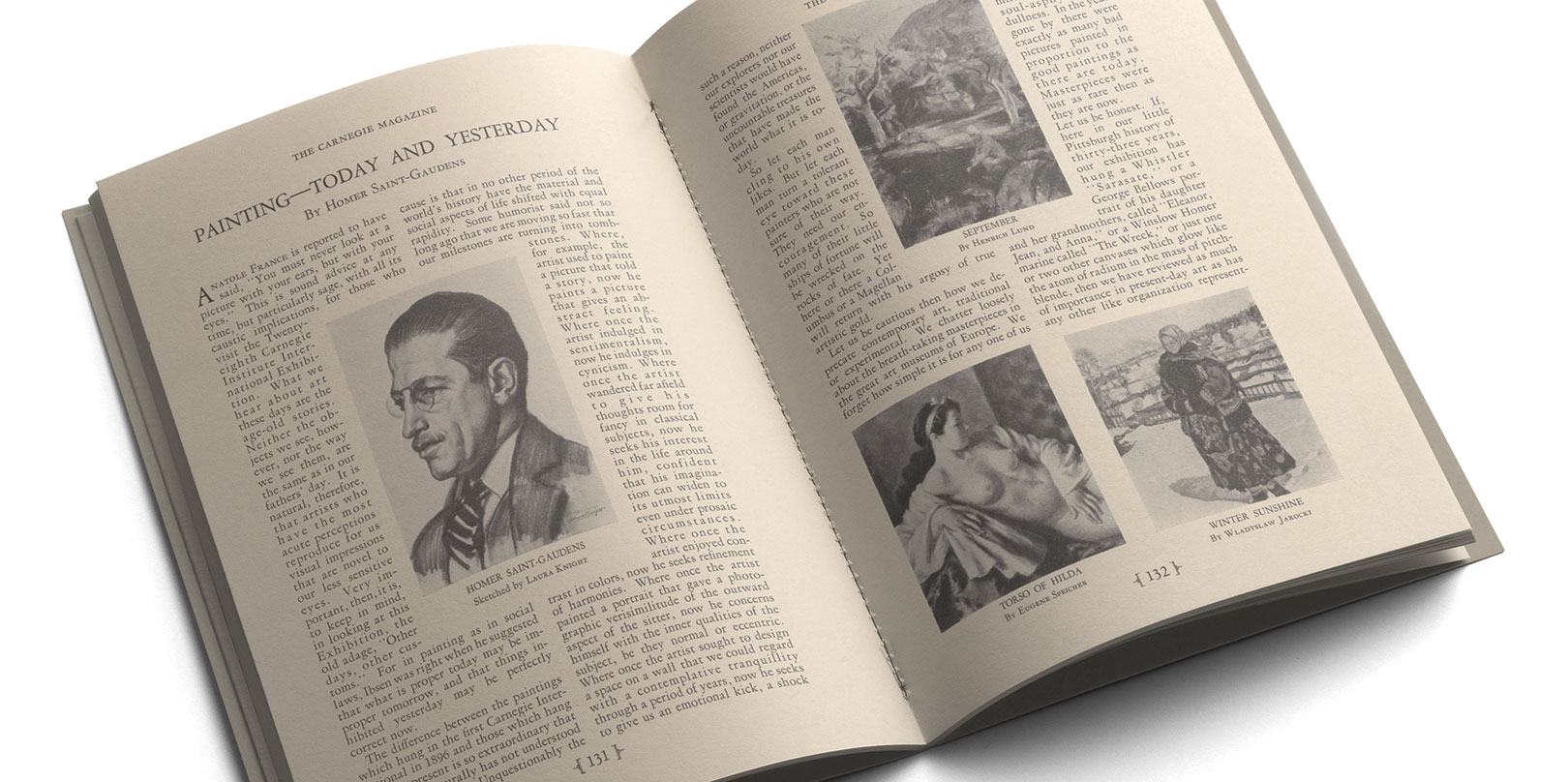
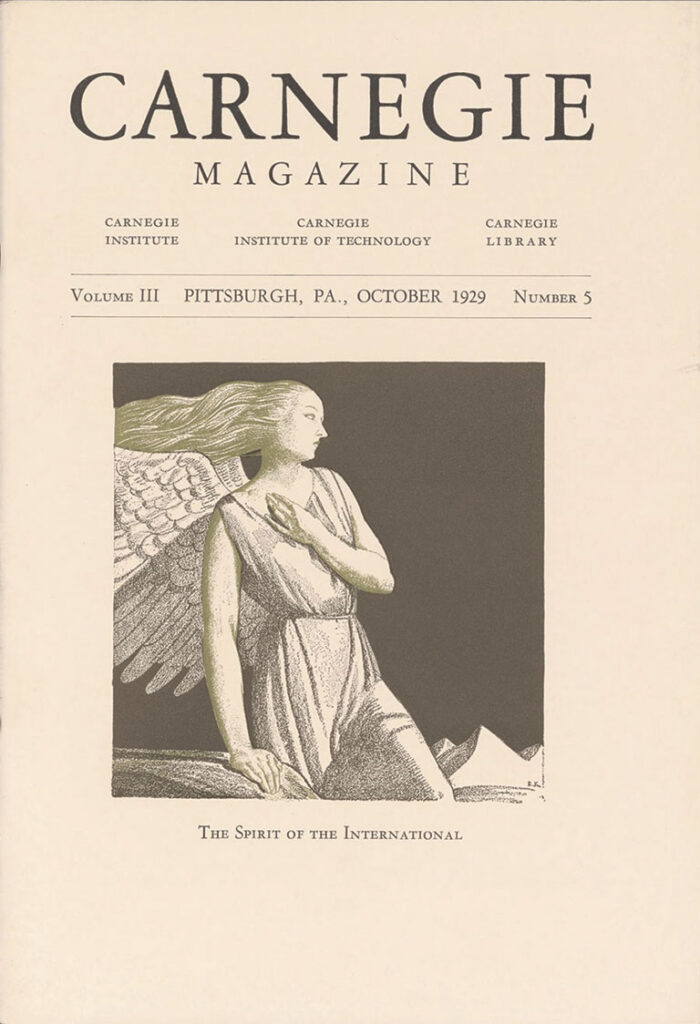
Editor’s note: The following excerpt appeared in the October 1929 issue of Carnegie magazine on the occasion of the Twenty-Eighth Annual International Exhibition of Paintings. It was written by Homer Saint-Gaudens, then director of Carnegie Museum of Art.
The difference between the paintings which hung in the first Carnegie International in 1896 and those which hang there at present is so extraordinary that the public naturally has not understood the reason for it. Unquestionably the cause is that in no other period of the world’s history have the material and social aspects of life shifted with equal rapidity. Some humorist said not so long ago that we are moving so fast that our milestones are turning into tombstones.
Where, for example, the artist used to paint a picture that told a story, now he paints a picture that gives an abstract feeling. Where once the artist indulged in sentimentalism, now he indulges in cynicism. Where once the artist wandered far afield to give his thoughts room for fancy in classical subjects, now he seeks his interest in the life around him, confident that his imagination can widen to its utmost limits even under prosaic circumstances.
Where once the artist enjoyed contrast in colors, now he seeks refinement of harmonies. Where once the artist painted a portrait that gave a photographic verisimilitude of the outward aspect of the sitter, now he concerns himself with the inner qualities of the subject, be they normal or eccentric. Where once the artist sought to design a space on a wall that we could regard with a contemplative tranquillity through a period of years, now he seeks to give us an emotional kick, a shock which, lamentable as the thought may be to him, he is able to deliver only once, for better or for worse, to an alert public fortunately already physically trained to cope with taxicabs and Pullman-car couplings.
All these reasons for painting have their right to existence. Let us counsel ourselves therefore neither to overdiscourage the old school, nor to overextol the young. We all should remember that just as, whether we wish it or not, we do have conventions that interfere with such commonplace things as the cut of our dinner jackets, or the shaving of our whiskers, so we also have the spirit of youth that has adventured from the bustle to the one-piece bathing suit. Life these days in the various so-called social planes of this world has its eccentricities; nor is art a bit behind the other aspects of existence in complicating matters for our bewildered minds.
Read the entire essay in the October 1929 issue of Carnegie magazine.