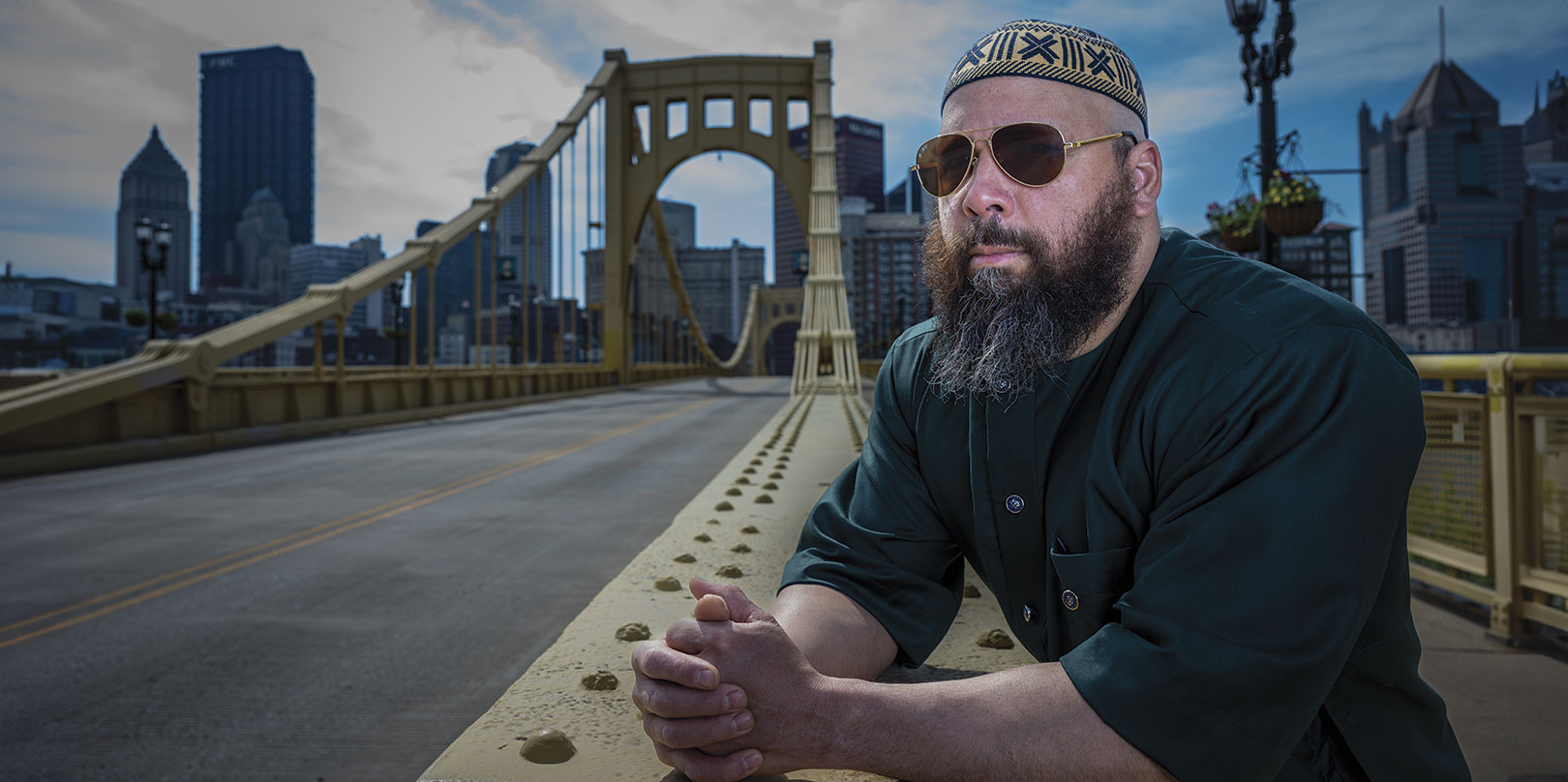
“Clay has always been a problematic material,” says Sharif Bey, the Pittsburgh-born ceramic artist and educator.
In Western art history, materials like marble and bronze have long been treated as fine art, while clay has been pushed into the category of craft. It is everywhere, Bey says, and you don’t need the endorsement of the high priests of culture to access it. Growing up in Beltzhoover, a working-class Pittsburgh neighborhood near the crest of Mount Washington, Bey says that “you could dig it out of the ground and fire it in your backyard.”
And that, paradoxically, is the problem with clay, Bey explains. The medium’s accessibility has made institutions wary of its artistic legitimacy. And yet, it’s among the oldest materials humans have shaped, for function and for art.
“In my world,” Bey says, “clay is the medium of the global majority.”
No matter where he happened to be creating his earthenware sculptures—including striking busts donning beaded headdresses, 6-foot-tall “guardian” figures, and abstractions of flightless fowl from New Zealand—Bey has been able to access his favorite medium of clay. This includes during his travels throughout Europe, South America, West Africa, and, of course, his upbringing in Pittsburgh.
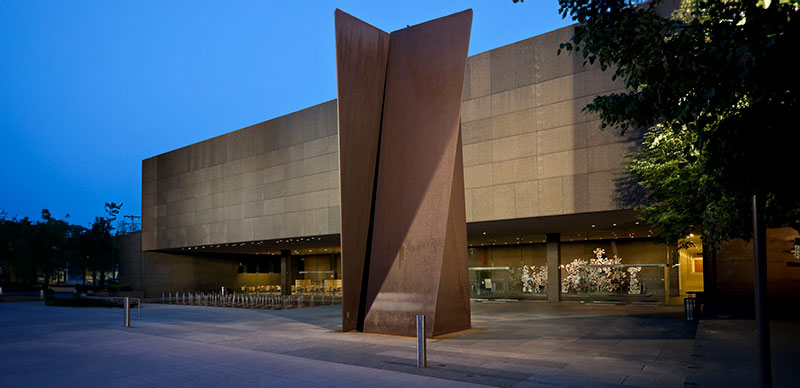
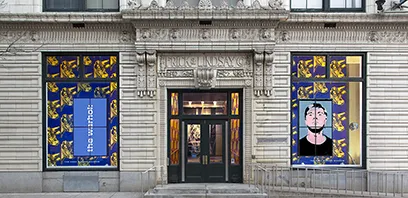
After spending decades traveling the globe and honing his craft, Bey has come home again to Pittsburgh to continue his artistic practice in the city that shaped him. Marking the occasion, an exhibition of his work, Sharif Bey: Homecoming, will be on view at The Andy Warhol Museum from June 26 through Oct. 12. It represents a full-circle moment—not only in the place, but also in Bey’s influences shaped across decades in studios, classrooms, factories, and residencies. The exhibition positions his monumental ceramic sculptures alongside works by another Pittsburgh native—Andy Warhol—and his Pop protege Jean-Michel Basquiat, placing them in conversation around identity, material, and cultural hierarchy.
In his return to Pittsburgh, Bey imagines a flexible studio practice for himself, and teaching not confined to a single institution. The return is also relational, a chance to reconnect with former students now working as artists.
“Coming back to Pittsburgh,” he says, “I feel like I’ll be joining multiple families.”
A Homecoming
In 2023, when Bey called Nicole Dezelon, senior director of learning and public engagement at The Andy Warhol Museum, to say he was moving back to Pittsburgh, she says the timing felt “almost magical” to her.
Dezelon had been considering ideas for a new exhibition at The Warhol, and she had recently encountered his work in New York. She was immediately drawn to the oxidized bases for his sculptures, which to her suggested a formal echo of Andy Warhol’s Oxidation paintings.
“The connection soon became less about visual parallels,” Dezelon says, “and more about what it means to bring a body of work like this back to the place that shaped it.”
Bey, 51, came of age as the collapse of the steel industry reshaped Pittsburgh in the 1970s and ’80s. Over decades, he watched the Steel City recalibrate, both economically and through a more expansive cultural infrastructure. He points to institutions like the Pittsburgh Glass Center, the Union Project, and the Society for Contemporary Craft as evidence of the city becoming more welcoming to artists.
“In my world, clay is the medium of the global majority.”
Sharif Bey
Over time, his visits back home shifted in meaning, pointing toward a renewed desire to be closer to family and to a city that had begun to feel newly viable for artists. Bey frames the move within a broader shift in perspective. Questions of mortality, purpose, and significance have come forward, displacing his earlier concerns about stability or recognition.
“For me, purpose has to include Pittsburgh,” Bey says.
A self-described “museum kid from Beltzhoover,” Bey walked through museum spaces with unusual autonomy as an elementary-age child, indulging his curiosity, and returning to the same works until they felt familiar.
That early access set off a chain of opportunities. He began with Saturday classes at Carnegie Museum of Art, which nurtured other world-renowned Pittsburgh-born artists like Warhol, Philip Pearlstein, and Raymond Saunders. From there came a scholarship to Carnegie Mellon University’s precollege program.
He eventually joined the apprenticeship program at Manchester Craftsmen’s Guild, a Pittsburgh-based arts center known for its rigorous youth programs and professional ceramics studio. Bey describes it as an “intergenerational making community,” where working artists such as Thaddeus Mosley and Ed Eberle were often present, making visible the possibility of a life in art. “Once I joined the Guild, they kept pushing me into their horizon, into new and exciting experiences,” Bey recounts.
It was also where ceramics became central to his practice. While many of his peers gravitated toward photography, Bey chose to create objects.
“I knew that if I spent time on the potter’s wheel and honed those skills, I could get a leg up,” he says. “And that’s exactly what happened.”
Dreaming Bigger
By the time he entered college at Slippery Rock University, Bey had already accumulated years of experience that set him apart. At home, he says, there was no pressure to abandon the work. Looking back, he recognizes how rare that support was.
“I’m doing exactly what I wanted to do 35 years ago,” he says. “I have achieved my wildest dreams. Now I’m learning how to dream bigger.”
Dezelon sees those early pathways as essential to understanding Bey’s work.
“Community arts education was such a huge part of helping to create Sharif Bey,” she says.
A turning point in Bey’s practice occurred two years ago when he made Domestic: Queen, a mixed media work of clay, glass, and metal.
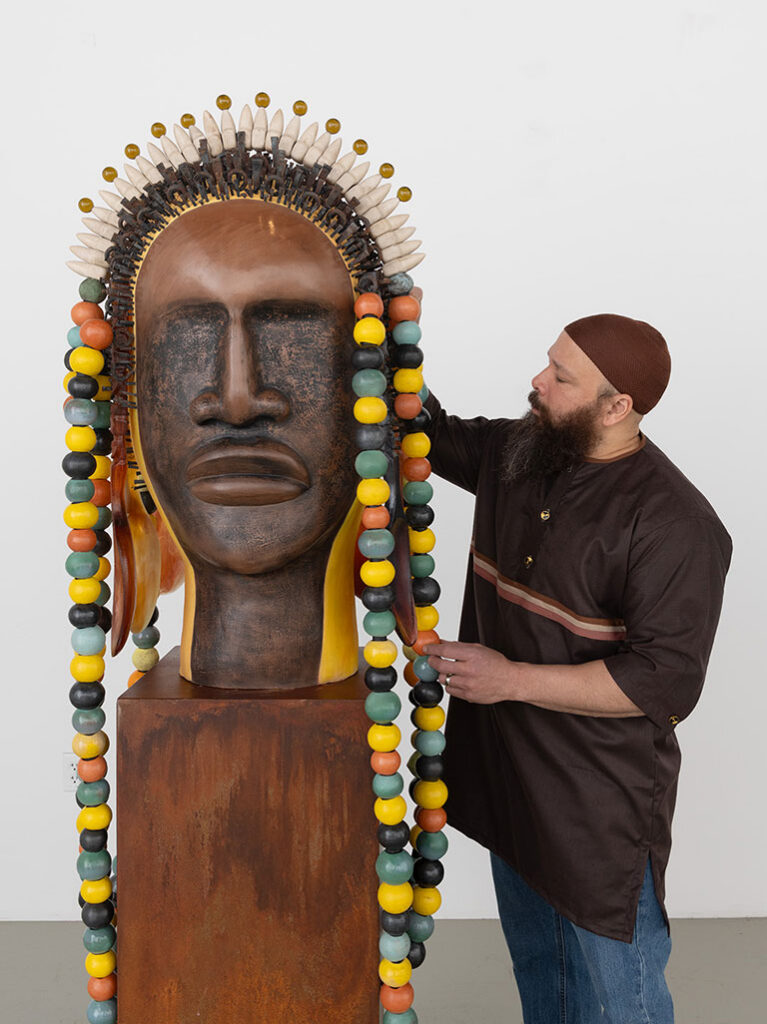
Bey describes it as the moment when several strands of his work converged. He introduced headdress forms and cascading beads that would later develop into the Crown Series.
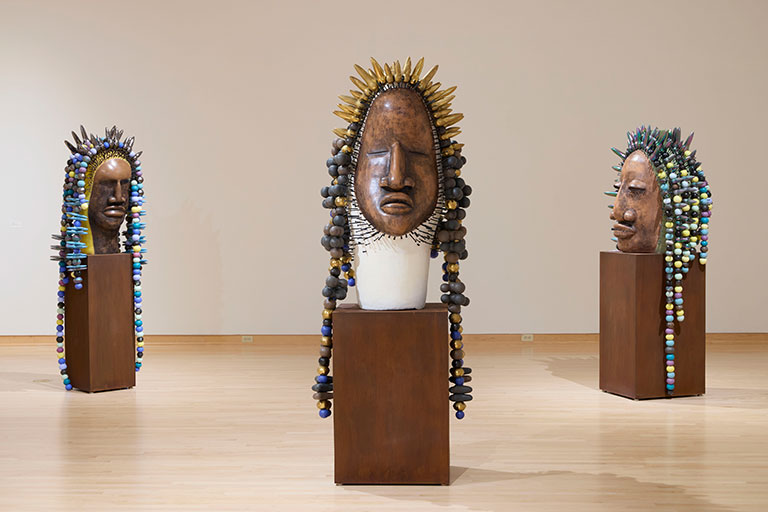 Photo: Kohler Co., courtesy of John Michael Kohler Arts Center
Strings of brightly colored spheres cascade across a monolithic ceramic head, atop which sits a crown that incorporates glass elements.
Large ceramic spoons drape from the temples and around the back of the head. For Bey, the spoons evoke the decorative kitchen objects common in African American homes in the 1970s—oversized utensils with carved handles, often mass-produced but widely present. “Some people might argue whether they’re art or kitsch,” Bey says. “The spoon, for me, is a symbol of domestic work.”
Bey grew up in a bustling, multigenerational household where making things was a part of life, and the kitchen was “a site of creativity, a space shaped by improvisation, proximity, and exchange.” Cooking, storytelling, and building were informal skills, most unrecognized as art.
In later life, Bey recalls being seen as out of place as a man in the kitchen.
“I was supposed to be in the room with the bourbon and cigars,” he says. “I’m trying to honor not only the kitchen, but domestic labor in general.”
Student Of The World
Bey estimates that about 90 percent of the work in the exhibition was made through artist residencies—10 in all, which took him around the United States and Europe over the past two decades.
“I consider myself a student of the world,” he says.
With access to large kilns at the Archie Bray Foundation for the Ceramic Arts in Montana, in 2021-2022, Bey was able to scale up the size of his sculptures. The brickyard setting allowed him to “think bigger—literally,” producing the monumental forms featured in the exhibition.
Bey created the cylindrical Boobah Jar there, towering at 6 feet tall, stretching upward into a head, hovering between container and figure. It was his first freestanding work at that size.
During his residency in 2024 at the John Michael Kohler Arts Center, Bey worked inside an active plumbing factory, where decades-old machinery operates alongside automated systems. “It’s literally man versus machine in the same building,” he says.
There, he began experimenting with physical vapor deposition, an industrial coating process that produces iridescent, gold, and platinum surfaces. Applied after firing, it transforms clay into something that appears both ornamental and engineered. In works like the Opal from his Crown Series, stacked ceramic forms rise into tiered, architectural structures, their surfaces shifting between matte clay and metallic sheen.
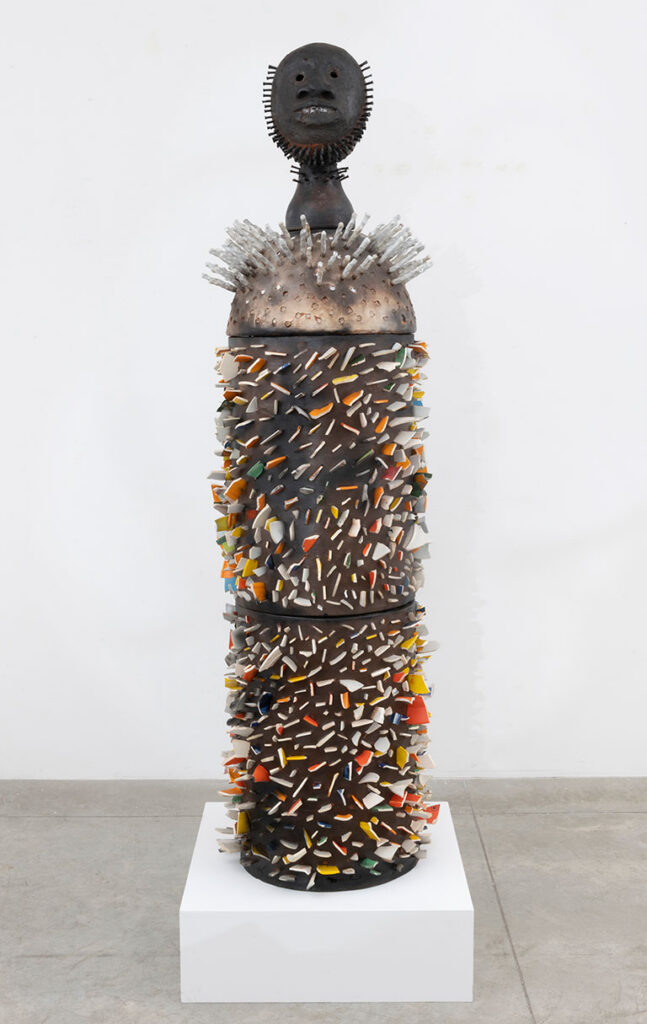 Photo: Adam Reich
Experimentation with materials has been a central theme.
Bey’s work with glass, developed through a 2017-2018 residency at the Pittsburgh Glass Center, evolved his practice. A 2021 exhibition at Carnegie Museum of Art showcased his early glass work, including a necklace of amber beads made from vertebrae casts of specimens in Carnegie Museum of Natural History’s paleontology collection.
Glass as a medium requires a team of technicians to translate his ideas into form, Bey says. That collaboration brings a different sense of authorship.
“It’s like, this is my project,” he says, “but I can’t really do it on my own. It was a humbling experience.”
Heather McElwee, executive director of the Pittsburgh Glass Center, encountered Bey through its Idea Furnace residency, which invites artists working outside glass to experiment with the material. Bey developed molds and casting systems to produce the bead elements central to the work.
Rather than handing off an idea, McElwee says, Bey went all in. “He wanted to be involved, to work side by side and see what was possible.”
“Unlike clay, glass is inherently finicky and can break, resist certain forms, or simply not cooperate,” McElwee adds. “Sharif took those moments in stride. Instead of getting stuck, he would ask, ‘OK, how do we pivot?’ That adaptability made the process really dynamic. It allowed the work to evolve in ways that felt responsive rather than forced. Honestly, that was one of the most rewarding parts of watching him work here.”
Objects and afterlives
Bey’s travels through Brazil, West Africa, and across Europe, along with spending time in museums like the Metropolitan Museum of Art and the British Museum, shaped how he thinks about objects—and how the ordinary can be extraordinary.
“A spoon, a toothbrush, a footstool,” he says. “These objects might be deeply aesthetic, but no one is commodifying them as art.”
That question of what gets called art runs through his work. Bey often returns to what happens when objects, especially from non-Western contexts, enter museums. Items with ritualistic or functional uses are recast as natural history and stripped of the traditions that produced them.
That tension carries into Homecoming, where Dezelon places Bey’s work alongside those of Andy Warhol and Jean-Michel Basquiat, grouping works to draw out shared themes.
At Kohler, Bey began working with industrial coatings that produce iridescent surfaces. In the exhibition, these clay beads are interspersed with beads of glass. In addition, one of Bey’s glass necklaces from his Nestle series is paired with Warhol’s Diamond Dust Shadow series, showcasing both artists’ commitment to experimentation, using unconventional methods and materials as engines of artistic innovation.
The mythology around Jean-Michel Basquiat begins on the street, Bey says. What it often leaves out is the rigor beneath it.
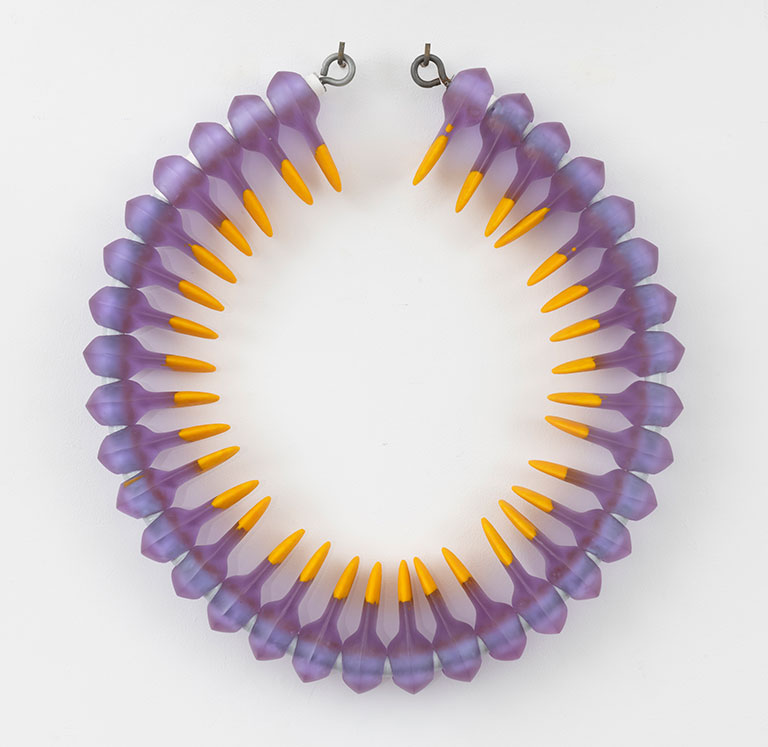 Photo: Adam Reich
“Basquiat’s work often looked like it came from the street, rather than through the depth of its references, from anatomy drawings to jazz and Black history,” says Bey. “Whether he embraced that or resisted that framing is a question we can’t really answer now. But certainly, his growing popularity at the time played into that perception.”
If Basquiat complicates assumptions about where art comes from, by contrast, Warhol complicates what counts as art in the first place, Bey says.
“With Warhol, there’s this idea of critiquing consumption,” he explains. “He takes an object we consume in one way and recontextualizes it. Take the Campbell’s soup cans. That was such an everyday object. He takes something from the commercial world and creates works of art about it, but he’s also pushing back on its status at the same time.”
“I’m doing exactly what I wanted to do 35 years ago. I have achieved my wildest dreams. Now I’m learning how to dream bigger.”
Sharif Bey
That act of recontextualization is part of Bey’s practice as well.
“Similarly,” he says, “I might take something like a handful of rusty nails and turn them into something that starts a completely different conversation.
“I’m a sculptor who thinks about pots,” he adds. “Jars, cups, teapots, these forms have deep histories.”
An Open Process
“I’m jazz, not classical,” says Bey, describing a process that resists planning. He does not sketch or begin with a fixed image. The work organically develops in response to material, gravity, and what he calls “viscosity,” or the physical parameters of clay.
A sculpture might begin as a loose idea—a figure, a head, something vessel-like—but it doesn’t always stay there. At times, Bey says, it may resemble something as ordinary as a green pepper before resolving into a head. Or a sculpture might have a larger forehead than Bey initially imagined, and that would become a defining part of its personality. That iterative approach allows multiple histories of form to coexist within a single object, according to Bey.
Discovery takes precedence over instruction in Bey’s classroom, too.
“I love seeing those lights turn on,” Bey says, describing the moment when students begin to grasp the process.
Alecia Dawn Young, a Pittsburgh-based artist and educator, first met Bey as a teenager at Manchester Craftsmen’s Guild, after being placed in a ceramics class by mistake. Young recalls resisting the class at first, but what changed her mind was the disarming, even playful environment Bey created.
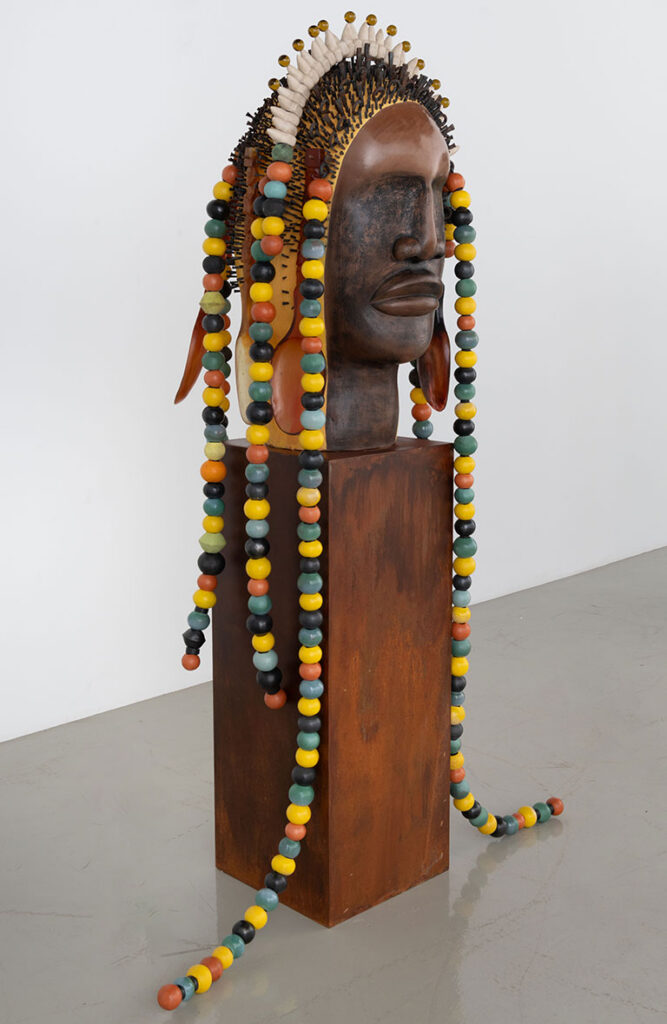 Photo: Adam Reich
“It was the beginning of not only a relationship with him as a mentor,” Young says, “but a relationship with ceramics as my primary practice.”
Young says Bey worked alongside his students, developing his own pieces as they worked on theirs. Together, they explored their processes and uncertainties, and worked through problems in real time.
“Learning something hard didn’t feel discouraging,” Young says. “It felt accessible.”
Dezelon says that the exhibition’s goal is to show people, especially young artists, the full trajectory of an artist and their art. “If it’s possible for someone like Sharif, or for Warhol growing up in the Depression era, it’s possible for others, too,” Dezelon says.
Bey is also attentive to who gets to imagine themselves in those spaces.
“I think about that fourth grader who might walk into the exhibition the same way I once walked into a museum,“ Bey says. “Maybe they were dragged there by a teacher or just curious, and got to see someone doing something on another level, in another chapter of life.”
The hope, Bey says, is not that the work will be fully understood, but that it opens something.
“To me, it’s important to share possibilities.”
Generous support of Sharif Bey: Homecoming is provided by Arts, Equity, & Education Fund™, Dawn and Chris Fleischner, Colleen and Henry Simonds, and The Fine Foundation. Additional support is provided by albertz benda NY/LA, Ellen and Jack J. Kessler, Karl W. Salatka, and Annabelle Javier-Wilburn and Jason Wilburn. The accompanying exhibition catalogue is funded by Arts, Equity, & Education Fund™, The Fine Foundation, and Concept Art Gallery.
The Warhol’s exhibition program is made possible in part through support provided by the Curatorial Vision Fund. Leadership support for the Curatorial Vision Fund is provided by Jim Spencer and Michael Lin. Generous support is provided by Trish and John Whitehill, and Brian Wongchaowart.