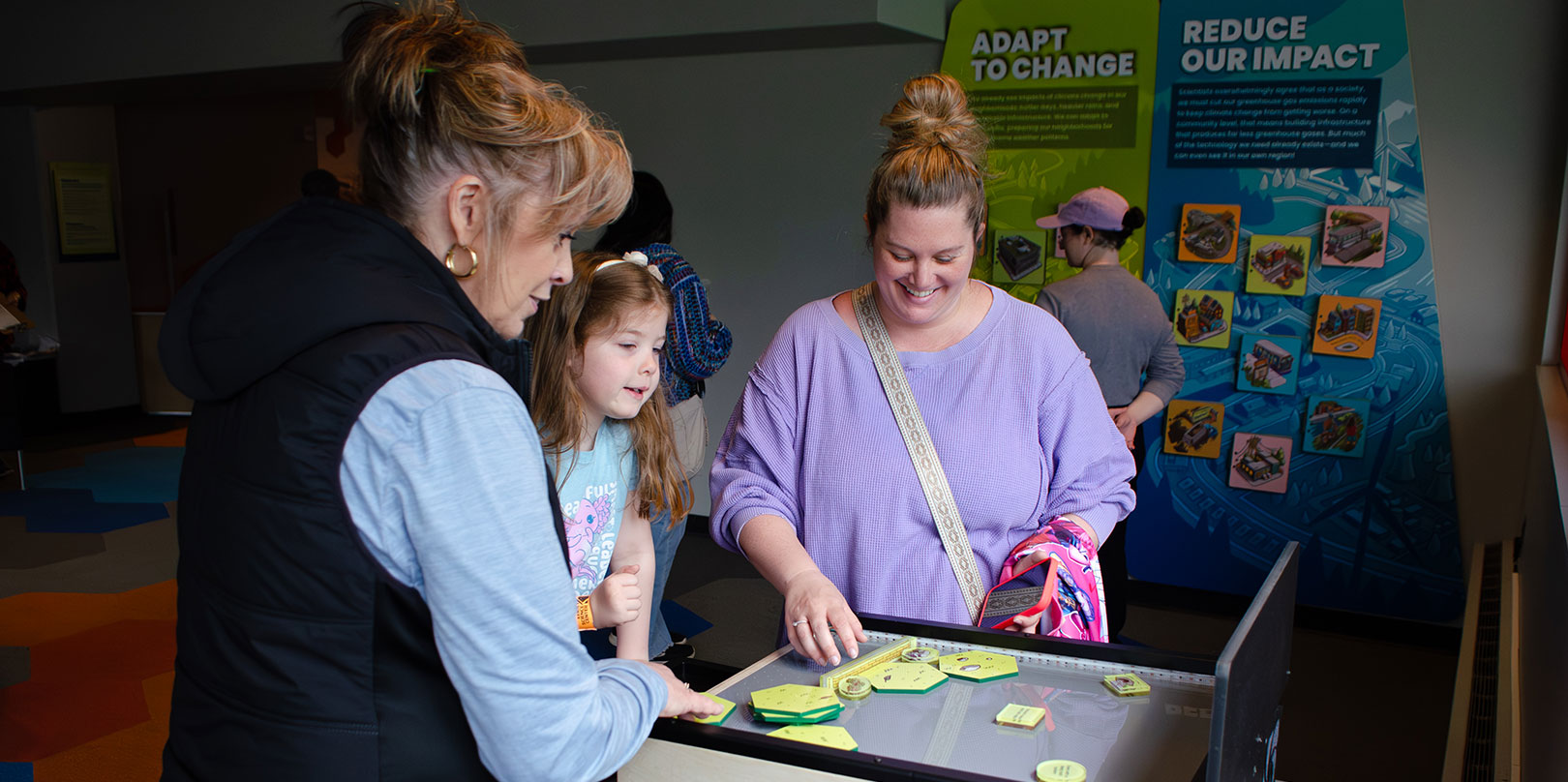
At first glance, it seems to be a tabletop game similar to air hockey: A tilted, smooth surface begins to blow air through pinholes at the press of a button. Flat, lightweight shapes that are sitting on top float and slide.
But this “game” is actually a simulation of how landslides happen. A strip of LED lights glows blue, signifying rain. As the air increases and the “storm” intensifies, pieces of “earth”— the flat shapes—start to tumble down the hillside.
Stabilizing “interventions”—objects representing vegetation, retaining walls, drainage systems—can be strategically placed on the table to steady the shifting terrain. This simulation is modeled on actual hillside interventions used across western Pennsylvania.
This is not climate change happening somewhere else; this represents what is happening right here, right now, in Pittsburgh.
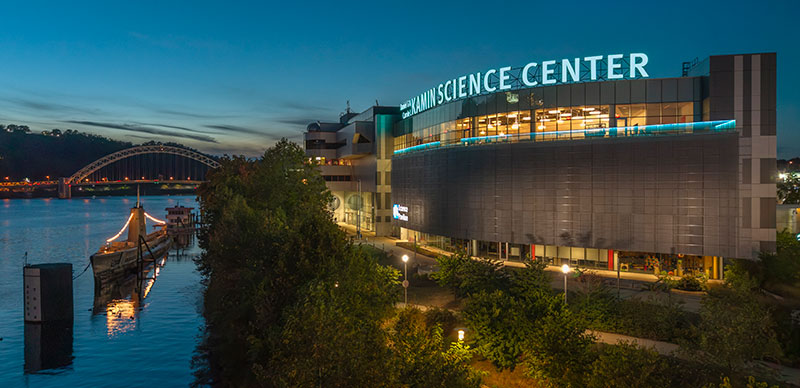
The pop-up-style exhibition, Our Place in a Changing Climate at Kamin Science Center, begins with a simple premise: Climate change is easier to understand when it looks like the place you live.
“If you show how it’s affecting our own communities—weather patterns, daily life—it brings it home,” explains Kim Amey, chief of staff at the Science Center. “It becomes more relevant.”
The climate change exhibition is proof of concept for the Science Center’s Rapid Science Engagement Initiative (RSEI)—a pilot program created to move the museum toward being more responsive to current science topics that affect daily life. It’s meant to tackle relevant and complex issues, in real time, but also be approachable and inviting. Surveys and discussions with visitors and community members identified climate change as the No. 1 science topic of interest, so the Science Center
chose it as the focus of the first RSEI exhibition, which occupies part of the third floor.
“It’s not a huge, open gallery,” says Jennifer Lawrence, director of exhibitions. “It feels more intimate, and we’re hoping people can have conversations there with friends, family, or even with strangers.”
The cozy living-room-like space is organized around a central table and uses poufs as seating, with kiosks, exhibit cabinets, and comfortable furniture placed around the perimeter.
“If you show how it’s affecting our own communities—weather patterns, daily life—it brings it home. It becomes more relevant.”
Kim Amey, chief of staff at Kamin Science Center
Atop the central table are vases with “stems.” Visitors are invited to pluck out a stem, each one modeled after a leaf from a local tree, printed with questions that elicit discussion: How are you seeing your local environment change? How does it feel to think about climate change? What have you noticed in your community? In what ways have people come together to respond?
The prompts, developed with input from a climate psychologist, are designed to help people reflect on the immediacy of climate issues and connect what they know with what they feel, explains Lawrence. “We want people to see that they have agency, that they can make a difference, individually and collectively.”
On one cabinet, 18 flip panels—nine on mitigation, nine on adaptation—are spread out across an illustrated western Pennsylvania landscape. Lift a panel to see an intervention. Permeable concrete, for example, is placed within that landscape, then explained in terms of how it absorbs stormwater in a region experiencing more intense rainfall.
“Everything in the illustrations is meant to have a Pittsburgh feel,” explains Eve Andrews, exhibit developer. “The imagery, the landscape treatment, the overall look. And we reference real examples of climate adaptation and mitigation that already exist in our region.”
A physical puzzle of a Pittsburgh house invites visitors to sit and piece together upgrades like insulation, materials, and systems—watching, as they build, how small changes accumulate.
There is also an auditory component. Through an interactive touchscreen, guests can select interviews with local residents to find out how climate change affects their everyday lives. A farmer speaks about adapting planting schedules and crop choices in response to increasingly unpredictable weather.
The exhibition is not only educating people about climate change; it’s also shaped by an awareness of its own material footprint, notes Lawrence.
Graphics are printed on recyclable cardboard, and cabinets are designed for future reuse. Scrap paper collected from around the institution is used for visitor reflections. At the end, visitors can write a climate pledge with what they hope to do going forward, then clip those pledges to a column in the gallery.
The exhibition will be on view through the end of the year. Then the Science Center hopes to roll out future temporary exhibitions next year. Designed to be iterative and self-contained, the model allows the team to adapt existing elements, test new ideas, and continuously refine the experience.
That’s the point of the initiative: to respond quickly to science-based news events when it’s most critical for the public to have reliable information.
“We are beginning to shift from being the authority to co-creating with our audiences,” Amey says. “Responding to what they find relevant: I think that is the future of science centers.”