“Do you want to see a moth designed by Keith Haring?”
Kevin Keegan utters the joke, referencing the late Pop art icon, as he pulls out a glass-topped specimen case inside Carnegie Museum of Natural History’s invertebrate zoology collection, where he is collection manager.
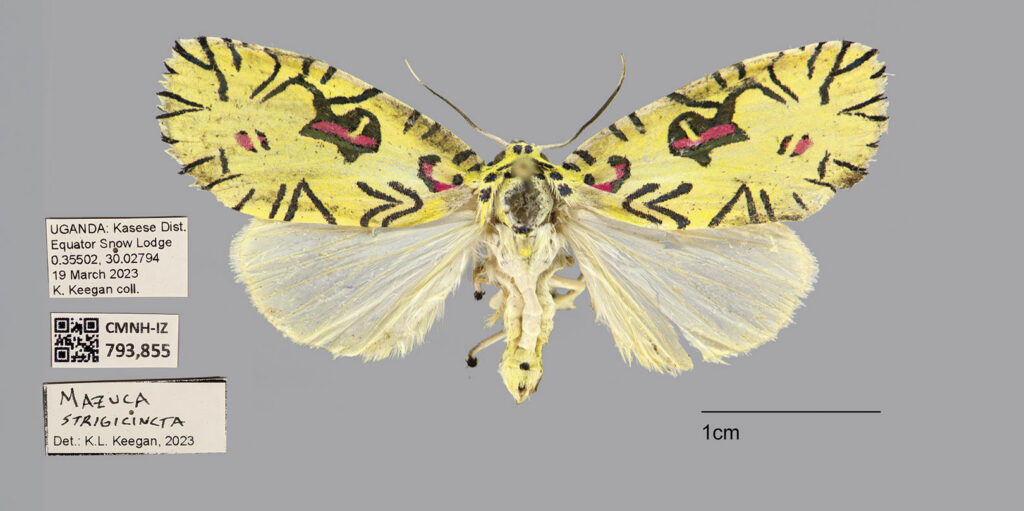
He then points to a paper-clip-sized moth, wings spread and pinned to a cloth backing, that uncannily matches Haring’s geometric art style—characterized by thick black outlines and contrasting primary hues. The moth—Mazuca strigicincta—has pastel-yellow top wings dashed with a few crimson streaks, their edges stamped with black geometric lines and arrows.
It may look like an intricate painting, Keegan says, but no artist designed this moth. Its striking appearance is actually a defense mechanism, a warning label for its predators. “High-contrast color combinations advertise that a creature is toxic,” he explains. “If something tries to eat you and is like, ‘Oh, man, that’s awful,’ that predator can then avoid your species.” Keegan is also researching how designs like those found on Mazuca strigicincta could have influenced the art of cultures in sub-Saharan Africa.
Keegan collected this specimen in 2023 during a research trip to Uganda, in which he spent two weeks getting up at odd hours of the night to set and check moth traps.
It’s a small miracle that this specimen is included in the museum’s collection at all, he notes.
Some confusion over customs paperwork on the return trip home meant that Keegan had to leave this and other specimens behind in Uganda while he returned home empty-handed. But after many calls between Keegan, his two colleagues, and his Ugandan correspondent, the proper documents were finalized and the Pop art moth flew to its new home in Pittsburgh