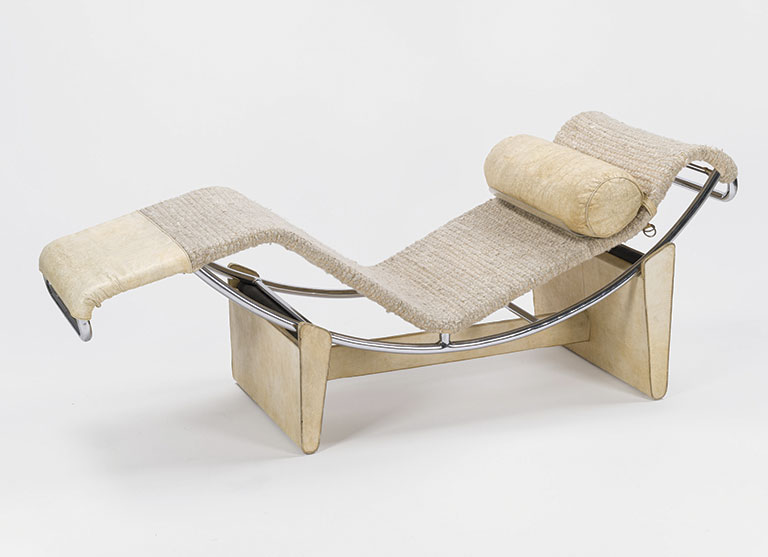
 Chaise longue, Designers, Charlotte Perriand, Le Corbusier, Pierre Jeanneret; Manufacturer, Thonet Frères, 1929 Women’s Committee Acquisition Fund, Copyright © artist or artist’s estate / Licensed by Artists Rights Society (ARS), New York / ADAGP, Paris
French designer Madeleine Vionnet was a fashion architect, building structures around and for the human body.
Vionnet is perhaps best known for inventing the bias cut—a method of cutting fabric that allows it to drape and flow around the body’s curves. This concern for the human form extended beyond clothes, and was evident in how she furnished her lavish 1930s Parisian apartment.
One of these furnishings was a customized variant of the LC4 Chaise Longue, now on view as part of the Extraordinary Ordinary Things exhibition inside Carnegie Museum of Art’s Bruce Galleries. Like the bias cut, the LC4 Chaise Longue in Vionnet’s apartment was known for its accentuation and fit to the body’s natural curves. Traditionally, the design of a chaise was similar to a non-reclining beach chair: a straight back with a space for the legs to lay in front of the body. By comparison, the LC4 Chaise’s innovative cradle offers the adaptability of a modern recliner that can be set in various positions—users slightly pick up the frame and adjust it to the desired position.
The model was originally referred to as the “relaxing machine” at its debut in the 1929 Salon d’Automne in Paris. The same year, Vionnet had one commissioned from furniture architect Le Corbusier to her specific taste.
“Unlike our other chaises, this one is particularly special because it is completely unique,” says Rachel Delphia, the Alan G. and Jane A. Lehman Curator of Decorative Arts and Design.
The LC4 Chaise would become mass-produced, but Vionnet’s piece was a one-of-one, tailored to complement the beige and metallic accents of her Parisian home. The white-parchment base supports a frame composed of curved, chromed tubular steel, forming a cradle that supports the swooping and arching seat wrapped around the metal frame in original Smyrna wool. The seat floats atop its metal structure, gently supporting the back and arched at the knees, with the head supported by a leather-wrapped tube pillow.
Vionnet’s attention to detail would lead British Vogue in 1925 to hail her as “perhaps the greatest geometrician among all French couturiers.” While both her bias cut and LC4 Chaise appear simple, the fashion world understood her to be a designer with elegant taste and masterful execution.