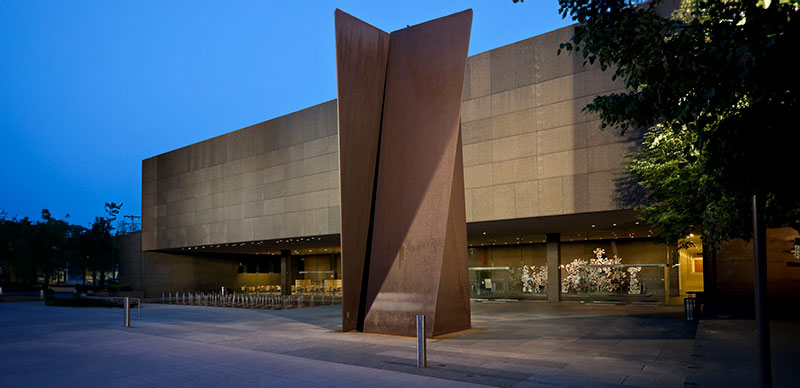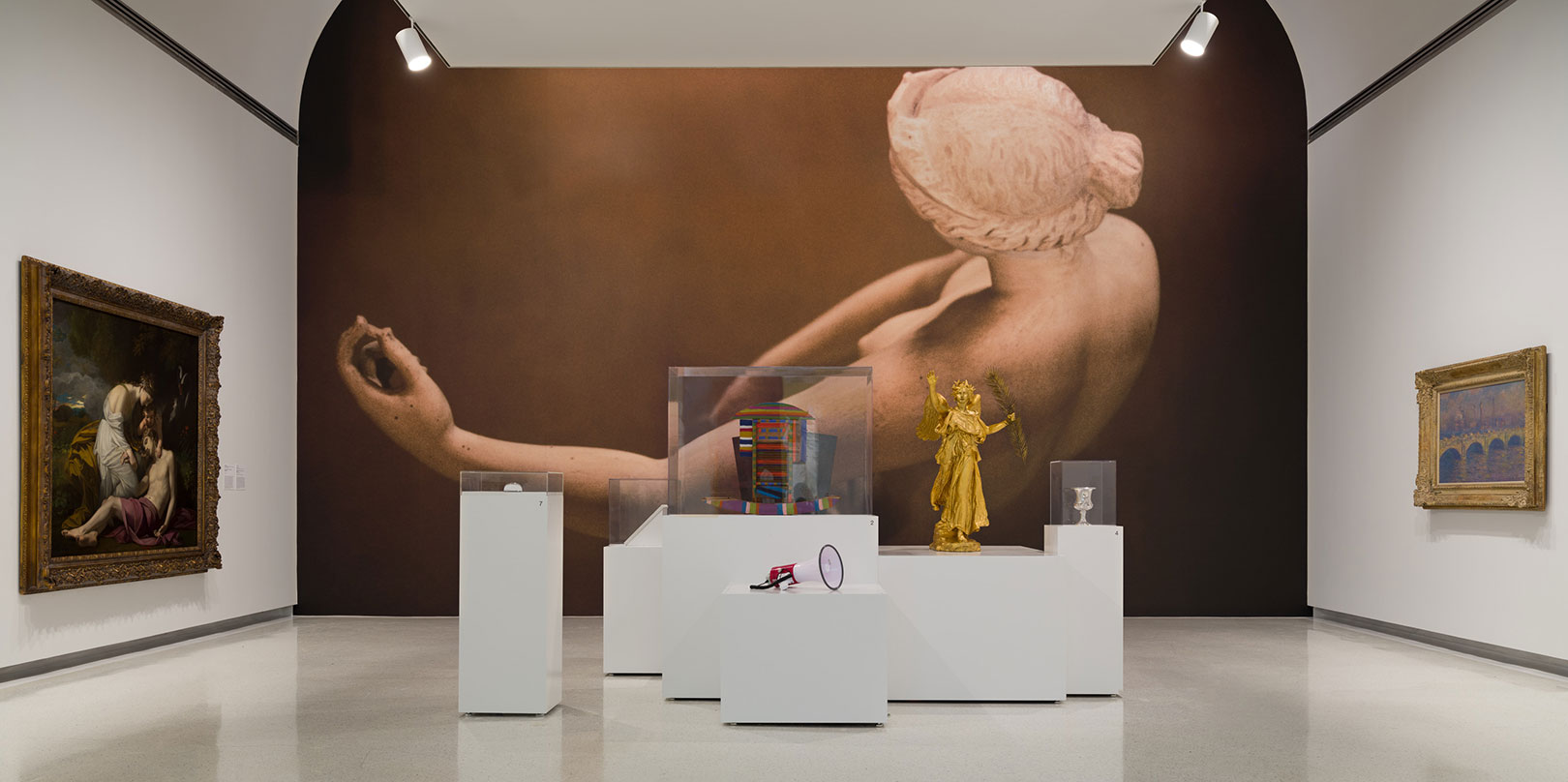
The next time you enter one of Carnegie Museum of Art’s newly reinstalled Scaife Galleries, consider setting aside conventional notions of how museums display and visitors view art.
What you’ll see instead: a conceptual encyclopedia by artist Tavares Strachan adjacent to an 18th-century painting of Virgil writing his epitaph by Angelica Kauffmann. A large-scale abstraction by MacArthur “Genius” Fellowship awardee Julie Mehretu shares a wall with an iconic work by Vincent Van Gogh, the Dutch post-impressionist who went unrecognized in his time. A towering sculpture of carved wood by Pittsburgh’s own Thaddeus Mosley is beside the museum’s pointillist masterpiece by Paul Signac.
Telling a linear history of art is not the central concern. Rather, each refreshed gallery poses questions to explore. What do we inherit? Where do we stand? What relationships do artists have with the marketplace? Who is and isn’t included in a prestigious art exhibition like the Carnegie International?
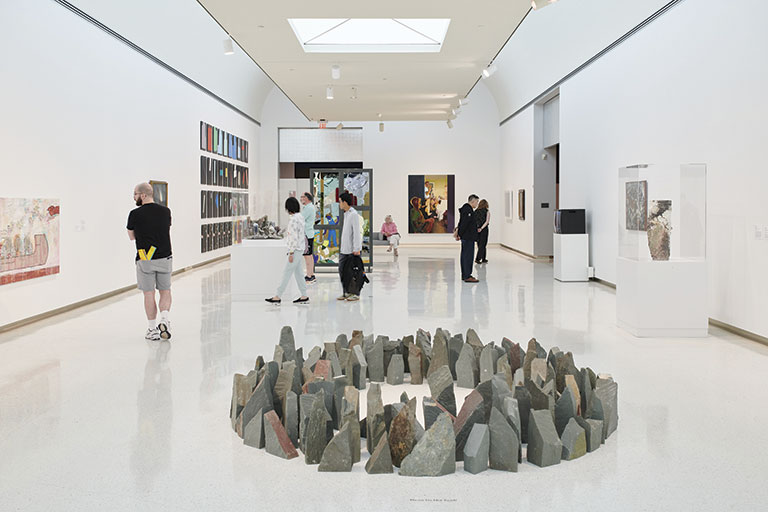 Photo: Zachary Riggleman
“We’re trying to amplify and expand the number of points of entry that are possible with a collection as diverse and idiosyncratic as ours,” says Eric Crosby, Henry J. Heinz II director of Carnegie Museum of Art and vice president of Carnegie Museums.
Inviting multiple perspectives is a core principle guiding the Museum of Art’s most ambitious project in two decades. Crosby and a team of curators and other museum staff are in the midst of a complete reimagining of the Scaife Galleries, which display artworks from the museum’s permanent collection. Four of the 17 Scaife Galleries have been transformed since the project began in 2023, and another two gallery reinstallations will be completed soon.
After passing through the Scaife Galleries’ main entrance, visitors now encounter a question on the wall: What Brings Us Here? “It’s just one way of examining how the museum engages with its many publics,” says Dana Bishop-Root, the museum’s director of education and public programs. “To ask what brings us here is to acknowledge a plurality of identities and experiences of the people who walk through the museum’s doors.”
“The presentation of a collection merely in chronological fashion is an inherited narrative, and it’s our responsibility to question inherited narratives and explore art’s many facets in a complex world.”
Eric Crosby, Henry J. Heinz II Director of Carnegie Museum of Art
Some galleries will explore concepts like abstraction and mass media while others will look into specific art histories. The abandonment of a strict chronology in favor of topics for inquiry is an acknowledgment that art is not static. Its meaning changes with context and the experiences of the viewer. This not only interrogates conventional ideas about how artworks should be presented, but also how art museums might engage with their publics in the 21st century.
“Our work with collections should be question-driven like any good form of research,” Crosby says. “The presentation of a collection merely in chronological fashion is an inherited narrative, and it’s our responsibility to question inherited narratives and explore art’s many facets in a complex world.”
Questions, Not Chronology
Crosby and his team—which includes curators Liz Park and Marie-Stéphanie Delamaire, research associate Emily Na, Bishop-Root, and museum staff from every department—are proceeding deliberately, with each gallery installation taking several months to complete. That work will be paused during next year’s Carnegie International and is planned to continue through 2027, Crosby says.
It will be a whole new experience for both longtime members and first-time visitors to the galleries. For instance, the museum’s forthcoming gallery dedicated to impressionism will celebrate masterworks and lesser-known pieces from the collection while also emphasizing the complex social and political forces that gave rise to the movement.
This winter, the museum will reopen Gallery 5, which is being reinstalled based on how artists engage with questions of economy and the marketplace. The works selected span four centuries, including a 19th-century still life by Edouard Manet and a recent media installation by Soun-Gui Kim featured in the 2022 Carnegie International.
It also features works by Claes Oldenburg and Andy Warhol—two Pop contemporaries with very different creative processes and approaches to the art market, Park notes.
Oldenburg labored away in a small studio while making sculptures of everyday objects and food—such as the plaster sculpture Big Sandwich—that literally could not be consumed. He was more interested in the artistic practice of creating sculptures of everyday objects, Park says, whereas Warhol was more interested in brand creation and developing a production process that he likened to a factory.
“There are many ways that artists engage with a subject as complex as the market, and not one way is the best or correct way,” Park notes.
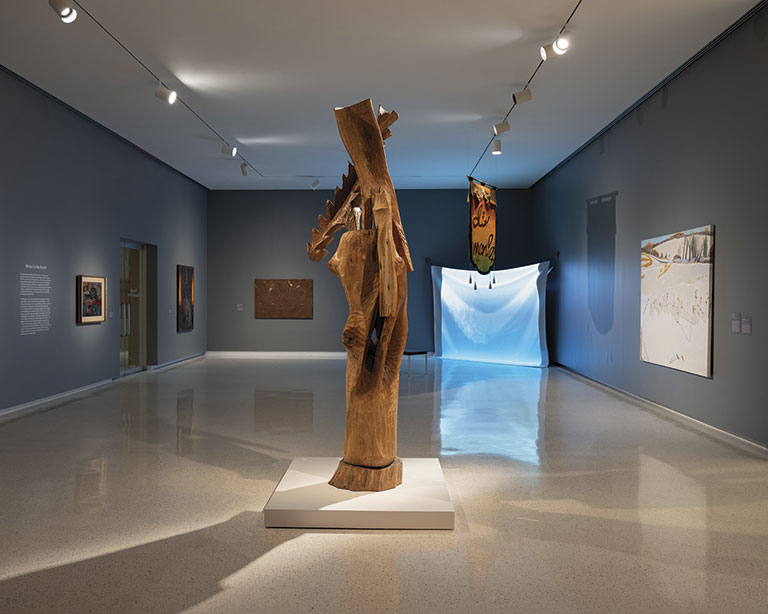 Photo: Zachary Riggleman
Late last year, the museum reinstalled Gallery 17 based on the question “Where Do We Stand?”
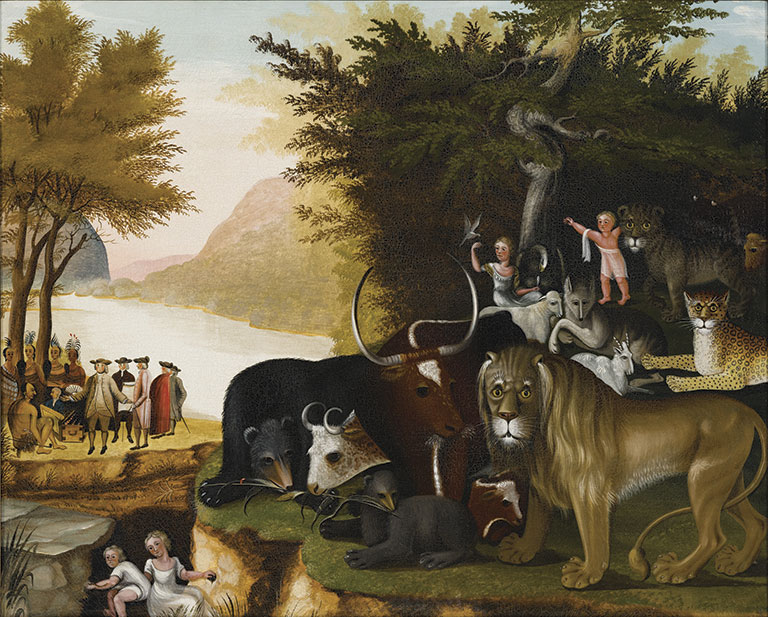
Many of the artworks reflect on the environment and humans’ place on Earth. One painting by Edward Hicks called The Peaceable Kingdom, from 1837, presents an idealized portrait of humans’ relationship with nature and each other. In the foreground are lions, cattle, and bears coexisting peacefully, while in the distance is an imagined scene of William Penn signing a treaty with the Indigenous peoples of present-day Pennsylvania.
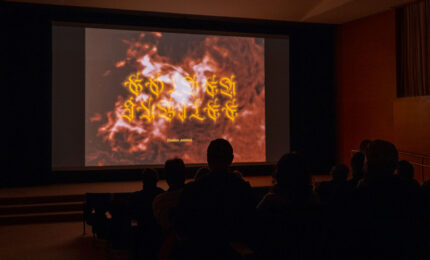
A nearby video installation made in 2022 by Cauleen Smith, My Caldera, projects a compilation of short videos showing volcanic eruptions, with moments set to a heavy metal soundtrack. Hanging from the ceiling is another Smith piece called dis’ mantle, a cloth banner displaying the titular word that plays on the word “mantle,” the layer of rock between the Earth’s crust and core.
Smith’s video offers a reflection on more violent creative forces of Earth that contrasts with the idealized world in the Hicks painting, putting the works in conversation with each other, says Na.
“I think they speak to land and proprietorship of land, as well as to established structures of power that make claims over that land,” she notes.
Institutional Exploration
The questions that the curatorial team are asking are not only directed at works of art—they also interrogate the museum itself as a collecting institution.
The reinstallation of Gallery 4, which opens in December, explores the history and significance of the Carnegie International. The room is more densely packed with artwork, with dozens of works hung in a salon style.
“The story of the Carnegie International is as much a story of inclusion as exclusion,” Park explains. “What gets shown, what doesn’t get shown? The factors are so numerous.”
One work by the activist collective Guerilla Girls makes the point explicitly. One of the group’s earliest protest works from 1985 is a poster that says, “Only 4 of the 42 Artists in the Carnegie International are Women.”
The breadth and long history of the exhibition—the longest-running exhibition of international art in North America, dating back to 1896—means there are many different stories that can be teased out. And this examination of it in Gallery 4 comes as the museum prepares for the 59th iteration of the show, opening in May 2026.
Also included in the gallery is work by Pittsburgh-born Johanna K.W. Hailman, who was the most frequently exhibited artist in the history of the Carnegie International. Her oil painting of industrial Pittsburgh from 1929 called The River hangs nearby a work by her self-taught Pittsburgh contemporary, John Kane, who was rejected many times from the International before his Scenes from the Scottish Highlands was finally accepted to the 26th iteration in 1927.
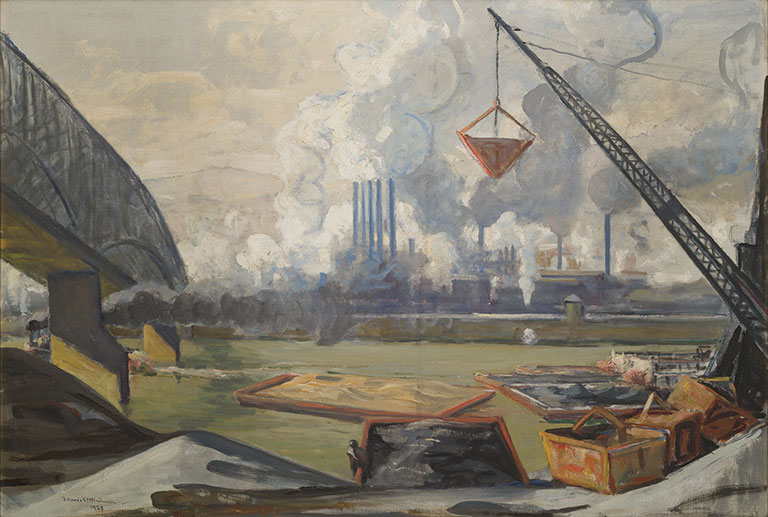
These artworks speak to the evolution and multiple histories of the exhibition.
“Carnegie International as an exhibition series with many different chapters will be represented,” Park says. “These histories are multiple, and you can follow different trajectories within the presentation. And part of the interest here is the multiplicity and the layers of all these things.”
The Scaife reinstallation project also builds on the museum’s relationship with Pittsburgh’s many communities.
The museum’s trove of over 70,000 images by famed photojournalist Charles “Teenie” Harris provided that opportunity with the reinstallation last year of Gallery 7 by a team including Charlene Foggie-Barnett, Charles “Teenie” Harris community archivist, and Dan Leers, curator of photography.
“Charles ‘Teenie’ Harris’ photographs
are living histories for people who are surrounding us, who are our neighbors,” Bishop-Root says. “We really asked ourselves with that gallery: How can the reinstallation best communicate this community archive?”
The reinstalled gallery, which opened in November 2024, offers an expansive opportunity to engage with the archive. The museum incorporated never-before-seen images—including many in color—into projections on the wall, while making prints and photographic negatives available for closer examination. Ample seating encourages people to take their time for personal study, and they also can listen to oral histories through individual speakers.
The space doesn’t tell a singular story of the communities that Harris documented but instead points to many individual experiences. Visitors bring to the images their own personal experiences as well.
“From the very beginning, we’re thinking about the relationship between people and artworks,” Bishop-Root says. “The people who are going to come and experience the work are going to engage with the work and are really integral to the installation itself.”
Narrating Conversations
This reinstallation has involved rethinking relationships—between art and people, between the museum and the communities that support it, and even between the individual artworks themselves.
“Works of art spark conversations,” Delamaire says. “We are hoping that the visitors will continue those conversations in many new directions.”
The reinstallation of the Scaife Galleries has prompted myriad conversations among the curators, and in ways that changed their own understanding of particular artworks.
When studying John Sloan’s The Coffee Line, which is included in Gallery 5, Delamaire says a conversation with Park informed her new perspective on the 120-year-old painting of laborers lining up for coffee in the snowy streets of New York. They discussed “the social agenda at stake.”
“The way that coffee is represented in that painting is as a commodity,” Park explains. “It’s represented as something people need in order to go about their day of work. And it’s being distributed to a long line of workers. So, the painting is also talking about labor and labor conditions.”
The lesson being learned in the museum’s massive reinstallation process: There are no finite conclusions to draw from art. In a world of fragmented realities, raising questions and having conversations is,
at the end, what an art museum aims to provide.
“I believe any good museum should be questioning the inherited narratives it receives,” Crosby says. “That is core to how a museum should function in relation to its community and how it might narrate the stories of art well into the future.”
Leadership support for the reinstallation is provided by the Drue and H.J. Heinz II Charitable Trust. Major support is provided by the Henry Luce Foundation.