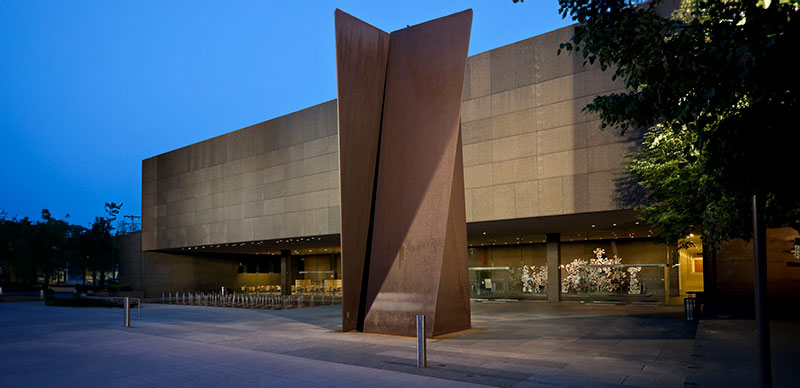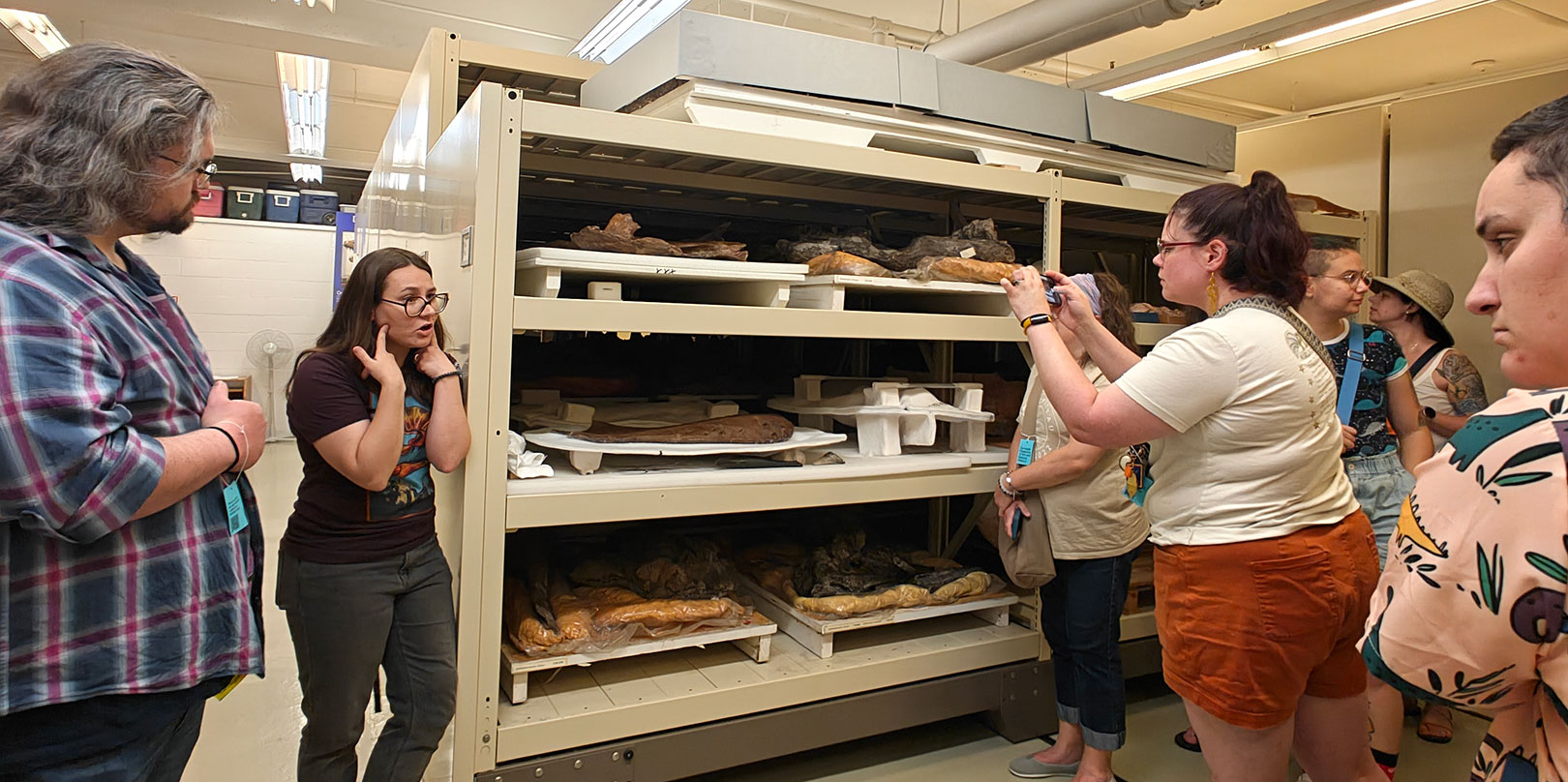
Whispers rippled through the group of 10 museumgoers as they followed Paleobiology Collections Manager Sarah Davis into the basement of Carnegie Museum of Natural History. They’re about to explore a part of the museum that few visitors ever get to see.
“This feels clandestine,” one visitor exclaims.
A heavy metal door swings shut, muffling the galleries above into near silence. Beyond it lies the Big Bone Room, where rows of compact shelving stretch into the distance, oversized dinosaur fossils rest on pallets, and worktables are outfitted with microscopes, cameras, and computers. Here and in the Little Bone Room across the hall (named for the size of the room, not the size of the specimens), almost everything in the museum’s vertebrate paleontology collection is stored—from dinosaurs and ancient reptiles to fossilized birds and mammals.
“I often think of the collections as a library of the history of life,” says Davis. But unlike most other libraries, this one isn’t traditionally open to the public.
Earlier this year, the museum began offering its adult visitors (age 18+) behind-the-scenes tours of spaces that include the vertebrate paleontology collection, the museum’s herbarium, and the historic “Alcohol House” where preserved amphibians and reptiles are kept. The response was overwhelmingly positive, says Sarah Crawford, the museum’s senior director of museum experience. The first four tours were offered to groups of 10 visitors this spring during NatureFest, the museum’s annual celebration of the natural world, and tickets sold out within 24 hours. A second round of tours offered during DinoFest, the museum’s summer paleontology festival, also sold out.
The museum is still working out details on the price, future content, and frequency of the tours. Beyond being a potential revenue stream, this program also is an opportunity for the museum to deepen its relationship with patrons, Crawford explains.
“In exhibitions, we’re often translators,” she says. “We’re the people standing between the public and the scientist. We thought if we could remove that barrier and bring the public directly to the scientists and the collections, it would hit home in a much more powerful way.”
Researchers, university classes, and donors have long visited the collections, Crawford says. But, for most visitors, the museum’s scientific work remains largely unseen.
“We thought if we could remove that barrier and bring the public directly to the scientists and the collections, it would hit home in a much more powerful way.”
Sarah Crawford, senior director of museum experience at Carnegie Museum of Natural History
The dinosaurs upstairs represent only a fraction of the collection, Davis says. The museum’s three paleontology collections combined contain close
to 1 million fossil specimens, from vertebrates and invertebrates to fossil plants.
Not every specimen belongs in an exhibition, Davis explains. Some are too fragile or scientifically important to display. Others consist of little more than a single vertebra or fragment of limb.
“The fossilized end of a bird’s ankle bone is incredibly exciting to me,” she says. “But it’s tiny, and might not look like much. It takes a lot more interpretation to explain why that’s important.”
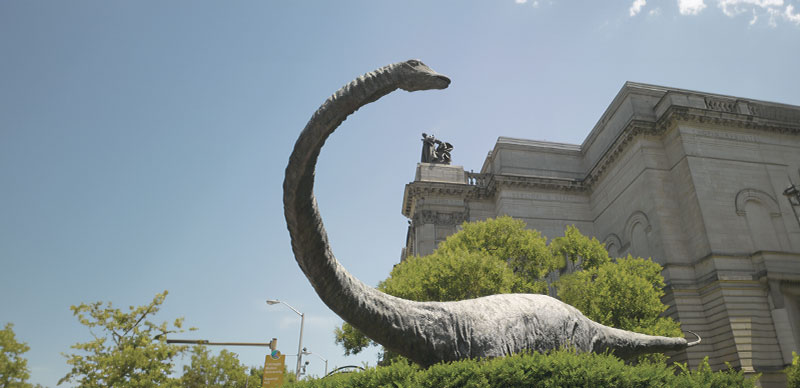
A few racks over, Davis shows the group several neck and back vertebrae from the original Diplodocus carnegii —aka “Dippy”—that aren’t part of the mounted specimen upstairs. She recounts how Andrew Carnegie, eager to create a world-class museum, sent an expedition west after reading an 1890s newspaper story about a giant dinosaur discovered in Wyoming. That search eventually led to the discovery of the famous specimen whose casts would travel the world while the original fossil became Pittsburgh’s crown jewel.
The museum also houses another celebrity: the holotype, or specimen first scientifically named, of Tyrannosaurus rex, purchased in 1941 for $7,000 after help from donors.
Standing before the T. rex fossil, Davis points to healed bite marks and signs of infection on its lower jaw. “It’s important to remember every specimen was once an individual animal that lived its own life,” she says. “It represents its species, but it also represents its own experiences.”
The behind-the-scenes tours extend well beyond paleontology. In the Alcohol House, visitors explore amphibian and reptile collections with Curator of Herpetology Jen Sheridan. In the herbarium, Curator of Botany Mason Heberling introduces tour groups to more than 550,000 preserved plant specimens, some collected in western Pennsylvania more than two centuries ago.
“People sometimes think museum collections are simply archives of old objects,” Heberling says. “In reality, they’re active research tools.”
Heberling and his college interns compare historical specimens with modern ones, documenting introduced species, shifting biodiversity, and plants flowering earlier due to warmer spring weather. Comparing two specimens collected a century apart helps make a conversation about climate change more tangible.
“Biodiversity is dynamic,” Heberling says. “Because we have these collections, we have a baseline. They aren’t just telling us about the past. They’re helping us understand our present and our future.”
The tours have become a source of discovery for Davis, too. Each group sees the collections through a different lens. Architecture students notice details biology students miss, while others gravitate toward unexpected specimens. “They remind me my job isn’t typical,” she says. “They make me see the collection differently.”