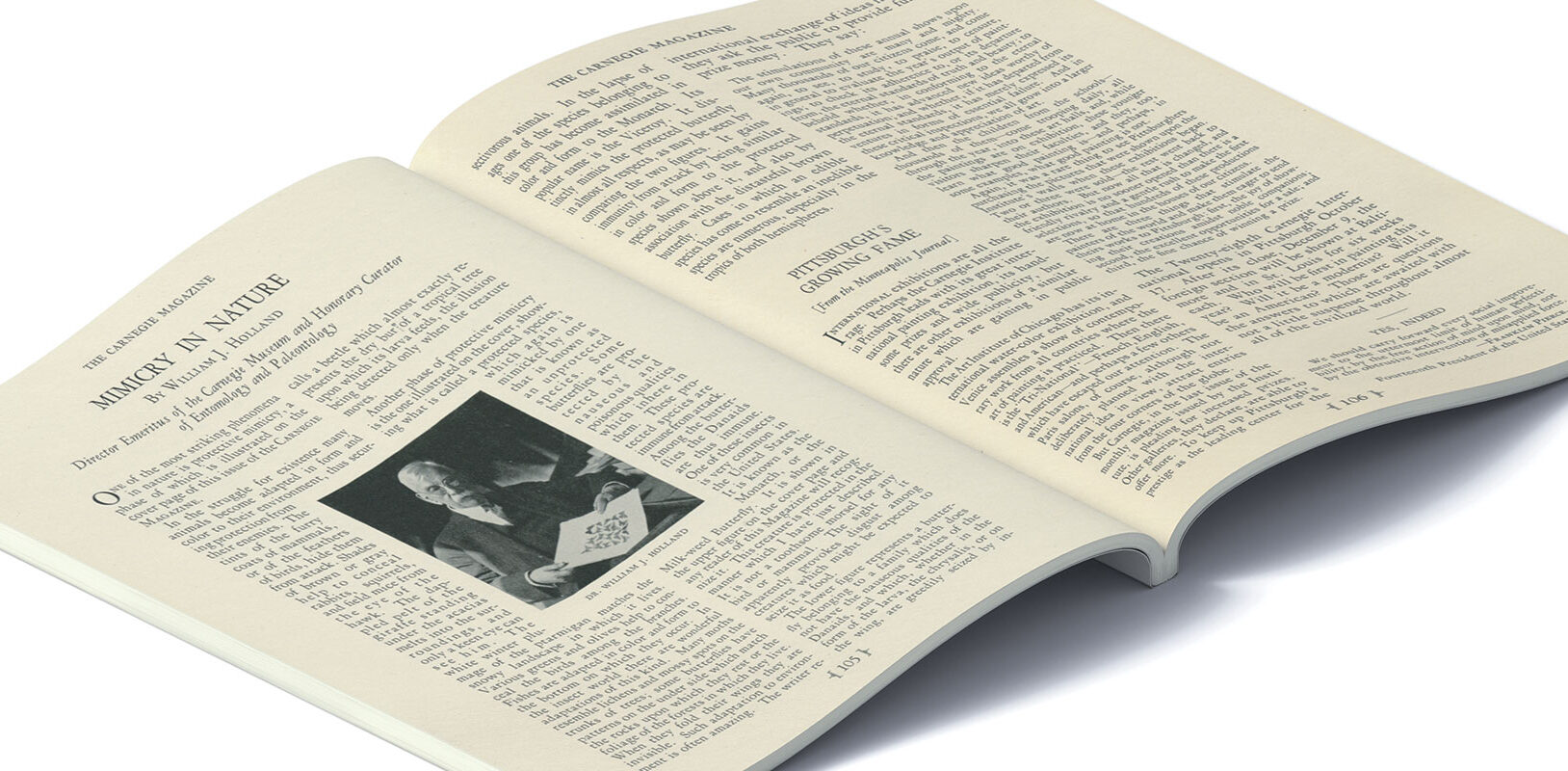
Editor’s note: This excerpt is from an article in the September 1929 issue of Carnegie magazine in which former Carnegie Museum Director William J. Holland explains the phenomenon of protective mimicry in nature. A scholar with wide-ranging interests, Holland was most passionate about lepidoptery and authored popular books on the subject, including The Butterfly Book (1898) and The Moth Book (1905).
One of the most striking phenomena in nature is protective mimicry, a phase of which is illustrated on the cover page of this issue of the Carnegie magazine.

In the struggle for existence many animals become adapted in form and color to their environment, thus securing protection from their enemies. The tints of the furry coats of mammals, or of the feathers of birds, hide them from attack. Shades of brown or gray help to conceal rabbits, squirrels, and field mice from the eye of the hawk. The dappled pelt of the giraffe standing under the acacias melts into the surroundings, and only a keen eye can see him. The white winter plumage of the ptarmigan matches the snowy landscape in which it lives. Various greens and olives help to conceal the birds among the branches. Fishes are adapted in color and form to the bottom on which they occur.
In the insect world there are wonderful adaptations of this kind. Many moths resemble lichens and mossy spots on the trunks of trees; some butterflies have patterns on the under side which match the rocks upon which they rest or the foliage of the forests in which they live. When they fold their wings they are invisible. Such adaptation to environment is often amazing. The writer recalls a beetle which almost exactly represents the dry bur of a tropical tree upon which its larva feeds, the illusion being detected only when the creature moves.
Another phase of protective mimicry is the one illustrated on the cover, showing what is called a protected species, which again is mimicked by one that is known as an unprotected species. Some butterflies are protected by the nauseous and poisonous qualities which inhere in them. These protected species are immune from attack. Among the butterflies the Danaids are thus immune. One of these insects is very common in the United States. It is known as the Monarch, or the Milk-weed Butterfly. It is shown in the upper figure on the cover page and any reader of this Magazine will recognize it. This creature is protected in the manner which I have just described. It is not a toothsome morsel for any bird or mammal. The sight of it apparently provokes disgust among creatures which might be expected to seize it as food.
Read the full story here to learn about the butterfly that mimics the monarch: