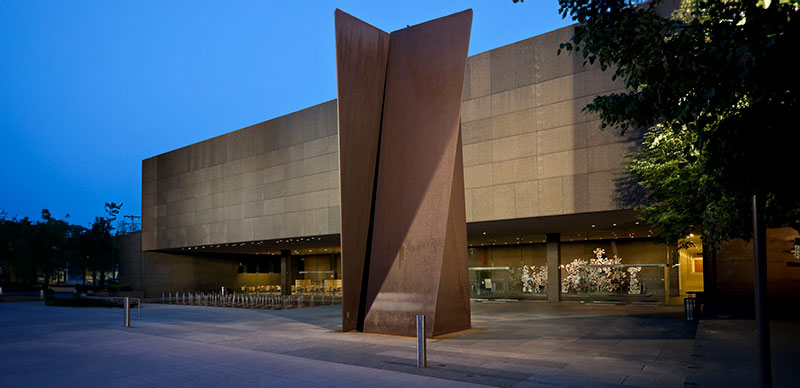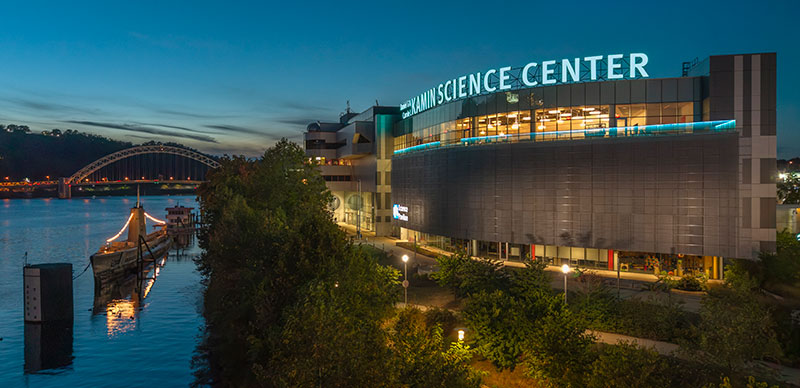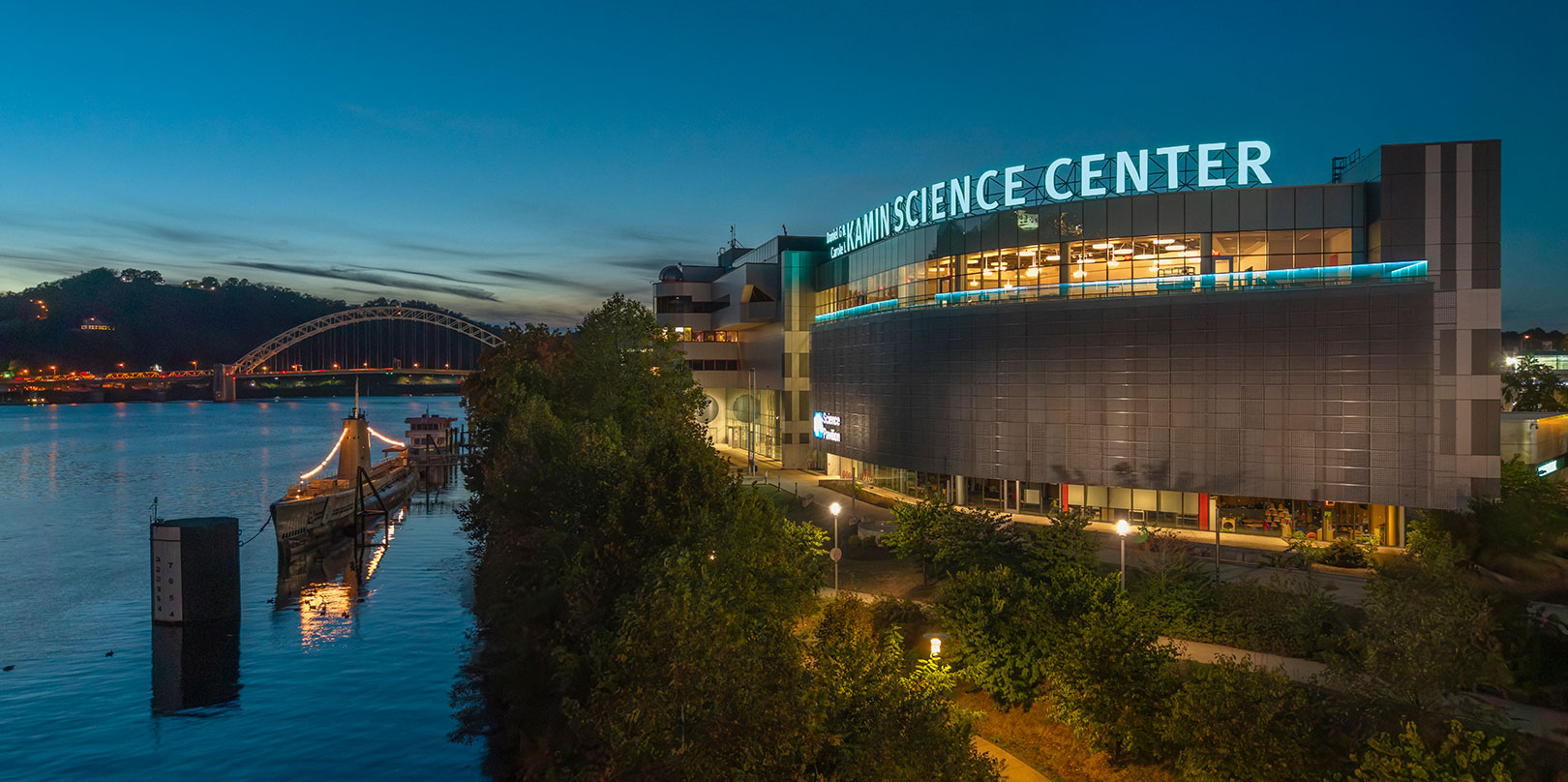
On a sunny Saturday afternoon in mid-September, hundreds of curious visitors gathered on the North Shore to witness the first glimpse of the largest transformation in the history of Pittsburgh’s most visited museum.
Some in the crowd had even traveled from out of state to the newly renamed Daniel G. and Carole L. Kamin Science Center. But it wasn’t just the updated logo and colorful signage they’d come to see.
Science Center leaders were unveiling their bold vision for Kamin Science Center, with an entirely new look and exciting lineup of upcoming exhibitions—all thanks to a $65 million gift from the Science Center’s new namesakes, Dan and Carole Kamin. It is the largest donation in Carnegie Museums’ 130-year history.
But on this “relaunch” day, Patti Bernhardy needed to take a moment. She stood in the remodeled entrance next to a new 25-foot digital media wall, watching as visitors enjoyed a newly planted pollinator-friendly garden outside.
“I’m just taking it all in—the warmth, the liveliness, the natural light streaming in,” says Bernhardy, senior director of museum operations at the Science Center. “We wanted to make sure people felt welcome, felt like they belonged as soon as they walked in.”
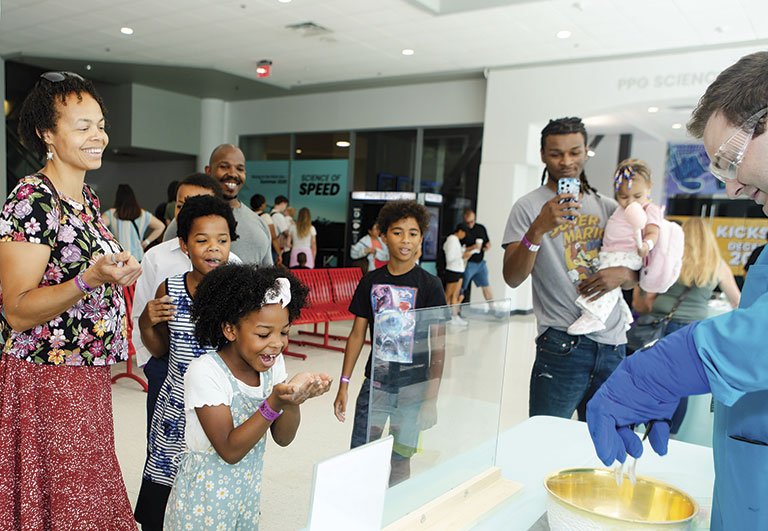 Photo: Christina Montemurro Photography
The Science Center has formally embarked on its journey to go where no science museum has gone before while enhancing its reputation as a national destination for science lovers. To that end, Sports360, an athletic-themed exhibition, will open this December in the Science Center’s main building. Highmark SportsWorks is permanently closed, making room for the Science of Speed experience—featuring a go-kart track for visitors of all ages, interactive displays, and a lounge with racing-themed food and drinks—set to open in the summer of 2026 in that location.
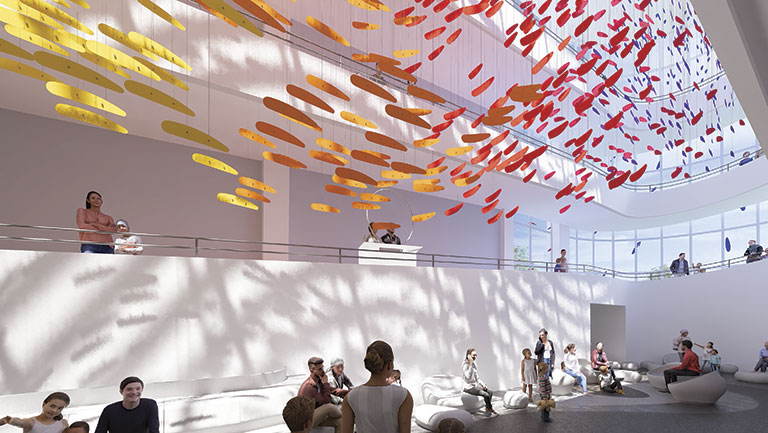
Over the next two years, additional changes will include a four-story interactive art installation in the Science Center’s Peirce Atrium; the Building Futures exhibition, which will highlight the science behind today’s most in-demand skilled trades, like plumbing, carpentry, and HVAC; a responsive science display focused on climate change; a first-floor gallery makeover; a new fourth-floor area dedicated to early learners; and a greening of the north parking lot.
By the end of 2027, more than 75 percent of the Science Center will have been reimagined, remodeled, or born anew.
“With the pace of advancements in science and technology, it’s hard to keep up,” says Jason Brown, Henry Buhl, Jr., director of Kamin Science Center and vice president of Carnegie Museums. “This [Kamin] gift puts us in a position where we can think creatively about how we go forward. It allows us to make sure that our visitors always have the newest and best experiences at the Science Center.”
Seeing Stars
Some signs of change are big and bold, like the signage across the Science Center’s entrance and the banner draping down the building’s front façade exclaiming the tagline—Ignite Your Curiosity. Other signs are more subtle, like the color scheme featuring Lunar Ice (a version of turquoise) and Martian Sand (on the red-orange spectrum). By the way, these colors were created specifically for the Science Center and are not available at your local hardware store.
“According to color theory, the turquoise denotes happiness and energy,” says Ned Schano, senior director of marketing and communications at Kamin Science Center. “But for us, it’s also a nod to our riverside location. And it’s unique—no other cultural organization across the region has this color.”
Lunar Ice also serves as the foundation for the redesigned website. But the greatest sense of happiness visitors may experience when exploring KaminScienceCenter.org can be attributed to its enhanced accessibility. The number of webpages has significantly decreased from 952 pages to 130, allowing visitors to find information in fewer clicks.
“We really wanted to call attention to our main and most exciting features,” Schano says. “It doesn’t matter if you’re a first-time visitor or if you stop by every month, you’ll be able to quickly see what’s going on in terms of exhibits, public programs, and events.”
The site is also the place to check out new photos and a video featuring the voice of actor and native Pittsburgher Jeff Goldblum encouraging visitors to “ignite their curiosity” at Kamin Science Center.
With the pace of advancements in science and technology, it’s hard to keep up. This [Kamin] gift puts us in a position where we can think creatively about how we go forward. It allows us to make sure that our visitors always have the newest and best experiences at the Science Center.
Jason Brown, Henry Buhl, Jr., director of Kamin Science Center
Then there’s the logo. Both literal and ethereal, the design features a “K” in the shape of a telescope looking up at a night sky ablaze in a field of stars. According to Schano, it’s all about connecting the past, present, and future.
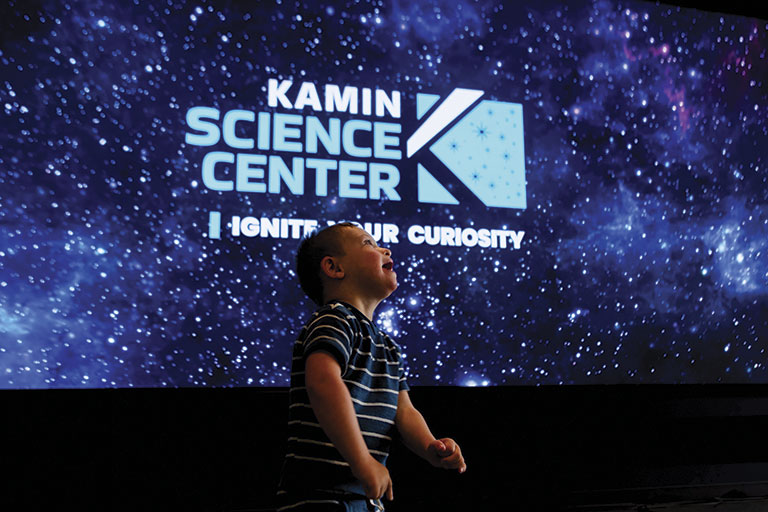 Photo: Christina Montemurro Photography
“Our logo intentionally points to the future, toward the possibilities that curiosity will bring,” he explains. “The stars represent infinite exploration and pay homage to
Buhl Planetarium’s legacy that dates back
to 1939.”
And the telescope? That’s an integral part of Dan Kamin’s origin story. It’s a story that may sound familiar to many Pittsburghers: A teenager goes on a field trip to Buhl Planetarium and then builds his own telescope. But here’s where things diverge from the typical: Young Dan grows up to expand the family business into a very successful real estate company, then establishes a charitable foundation—and, along the way, holds on to that telescope for some 60 years. That same telescope is now on permanent display in the Science Center’s main lobby.
Astronomy was always Kamin’s true passion. Now, he hopes his monetary gift will give future generations the opportunity to discover theirs. “I want to leave something more than my name, something that makes a difference,” he says. “This is the culmination—this is where everything comes together. Lives will be changed.”
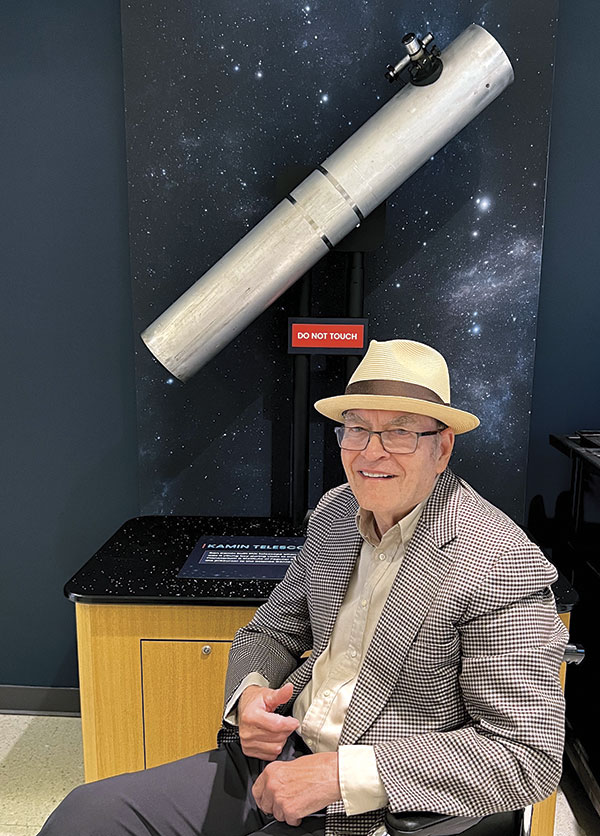 Photo: Christina Montemurro Photography
I want to leave something more than my name, something that makes a difference. This is the culmination—this is where everything comes together. Lives will be changed.
Dan Kamin
By any measure, $65 million is a big chunk of change. And by all accounts, meeting—or, better yet, exceeding—the demands of running a 21st-century museum is no small feat.
Refreshing a single exhibition space can take two to three years and cost up to $9 million, Brown says. Do the math. Kamin Science Center has 12 galleries, not to mention a planetarium, an aging submarine, parking lots, and some 200 employees. It’s a constant balancing act of setting and evaluating priorities.
“The Kamins’ gift allows us to disrupt the cycle, to have money up front to develop multiple concepts and exhibits concurrently rather than sequentially,” says Kim Amey, the Science Center’s chief of staff. “Right now, we’re in different stages of the design process and fundraising for a number of projects, but the pace for every single one has been accelerated.” She notes that a large part of the Kamin gift is a bequest, which means the Science Center will not receive those funds for years to come. So, most projects still require the generosity of additional donors to be fully realized.
“The real transformational power of this gift,” she continues, “is that it allows us to dream big and take risks.”
Going for the Gold
When Sports360 opens, its massive size—9,500 square feet—will make it the largest exhibition at the Science Center.
“This exhibition will be completely, 100-percent new. Nothing from SportsWorks will be included,” Schano says. “And because of its location on the first floor of our main building, it’s really going to be integrated into the Science Center experience.”
The space will be divided into four zones: Prepare, Practice, Participate, and GoPro; and its 25 interactive stations will draw from football, baseball, hockey, basketball, soccer, and Olympic sports.
For example, Sports360 will boast a mini-NFL Combine where visitors can run through similar drills, like the broad jump that prospective NFL players compete in during the annual weeklong scouting event. And its opening comes just a few months before the NFL Draft visits Pittsburgh in April. The new exhibition will also highlight the impact of fans and cheerleaders, what Olympic athletes need to eat to stay competitive, and the many non-player, sports-related career opportunities available.
 Jason Kelly Johnson & Nataly Gattegno
So, if you ever wondered if you had what it takes to be a Zamboni driver (the person who operates the ice-resurfacing machine between periods at hockey games), you’ll have a chance to find out. An interactive game will let you get behind the “wheel” to gauge your speed and accuracy in clearing the ice. It’s all part of discovering the science behind reaction time, biomechanics, balance, and technique.
Getting Up to Speed
With the finish line for the Science of Speed set for summer 2026, the former SportsWorks building will become the quintessential pit stop. Crews are working to install interactive exhibits and a two-story electric go-kart track, bring in contemporary and old-school racing cars for display, and establish a racing-themed lounge.
“If somebody learns the science and technology behind racing and then is able to actually experience the thrill of it,” Brown notes, “they’re much more likely to remember how it all fits together.”
Displays and interactive stations will focus on the science and tech piece of the puzzle. Auto racing involves aerodynamics (downforce and drag), the laws of motion (inertia, momentum, and forces), physics (tire friction, grip, and slip angles), and safety adaptations (helmets, harnesses, fire-resistant clothing, and chassis and crash structures).
Other factors include applying knowledge of material science to create strong, lightweight, and durable vehicles, and understanding human physiology to mitigate the physical and mental demands required of drivers to control a car while fighting g-forces.
Then there’s the thrill part; that’s where the go-karts comes into play. “If you’re thinking go-karts, like the ones at the beach that just go around in a circle, this is going to be a very different experience,” Schano says.
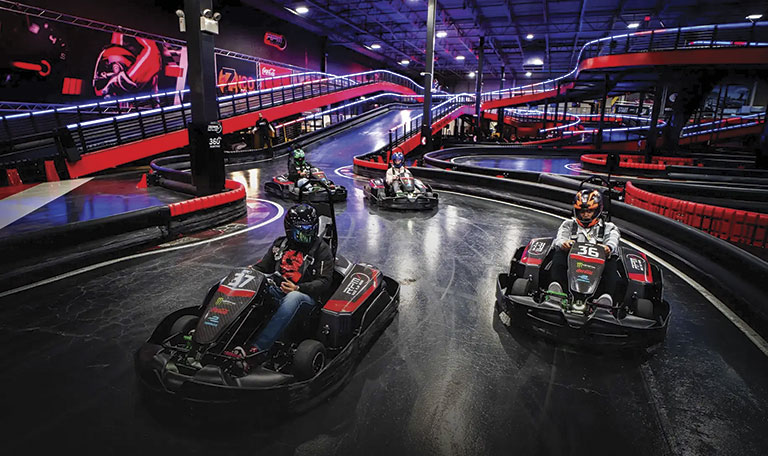
The track will feature multiple turns and two levels, while the electric karts will be able to go as fast as 35 mph. Science of Speed will not only be open during regular hours, it will also have extended evening hours for those grown-ups looking to hang out in the lounge and go for a spin on the track. To that end, the lounge will offer a limited food menu and serve cocktails and host racing leagues, facility rentals, and team-building experiences.
“We’re trying to do something no science museum has ever done before,” Amey says. “Everyone who hears about it is so excited. It appeals to a much wider audience than we traditionally do. We don’t want people to say, ‘I haven’t been to the Science Center in years, my kids are grown up.’ Instead, we want to hear, ‘I’m going to the Science Center tonight to race those go-karts.’”
Matthew Emmerich is one visitor who was happy to support the Science Center’s forward-thinking attitude. A Carnegie Museums member for three years, he traveled from Ohio with his daughter to see what was in store.
“I appreciate the Center’s efforts to preserve the past while also looking to the future,” Emmerich remarked at the relaunch day in September.
The future was also top of mind for Mt. Lebanon’s Melissa Knox, who brought her three kids, ages 4, 6, and 7. “We’re really excited about this new vision,” she said.
It had been two decades since Vince LaRosa, now 28, explored the environs of the Science Center. Today, he and four friends decided to experience everything—from the Miniature Railroad & Village® to Buhl Planetarium and Observatory. “Everyone remembers coming here for a field trip,” he said. “It’s great to see the Center continue to evolve.”
Asking Questions
The Science Center will continue to evolve dramatically over the next few years, with upgrades coming to three-quarters of its existing exhibit spaces.
A dynamic Responsive Science display that will explore the local impacts of climate change and a rotating range of other timely topics is launching in early 2026.
“We realized there’s a hunger in our community to understand the science that’s going on around us, to understand what’s true and what’s not,” Brown says. “There are just so many competing narratives.”
The real transformational power of this gift is that it allows us to dream big and take risks.
Kim Amey, Kamin Science Center’s chief of staff
Other changes that visitors can look forward to include beautifying the parking lot across Casino Drive with a community-focused installation that includes expanded green space and science displays. And, inside the main building, renovations will spruce up the first-floor gallery and the early learners space on the fourth floor.
Beyond these physical changes, however, Brown sees the role of the Science Center not as a place that has all the answers but rather the place that prompts people to expand their universe of understanding and allow their curiosity to guide them.
“We want people to walk out the door of Kamin Science Center with more questions than when they walked in,” he says. “We want them to continue the conversation, to go home and do a Google search and learn more about whatever it is that struck a nerve. We want people to become enthralled with science.”
The allure of science, Amey says, may very well be grounded in its sense of hope. “Back in 2022, we invited our entire team to help us define our vision and mission going forward,” she says. “More than 120 staff participated. And at the end of that process, I felt like the common thread was hope.
“We all felt hopeful that by being champions of science, we could make a positive change in the world.”