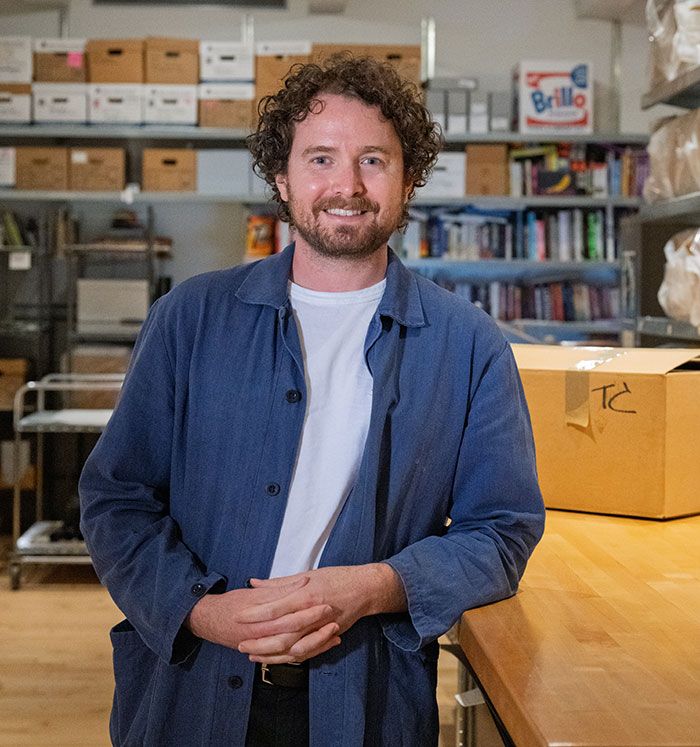
 Photo: Bryan Conley
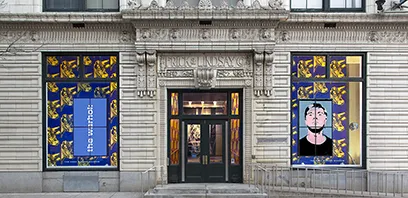
Matt Gray is happiest when he’s exploring the more than 8,000 cubic feet of archival material at The Andy Warhol Museum. From a stale slice of pizza to a place setting pilfered from a Concorde jet, there’s always something new for the museum’s director of archives to discover.
Gray was fresh out of art school at Pennsylvania Western University when he was hired at The Warhol in 2012 as a gallery attendant. He was immediately taken by The Warhol’s massive archive and took every opportunity to engage with it, eventually getting promoted to project cataloger while he pursued a master’s degree in library and information science at the University of Pittsburgh. He worked his way up to director of archives in 2023 shortly after making perhaps his most significant find—two quarter-inch reel-to-reel tapes of the original New York City recording sessions of The Velvet Underground’s landmark album The Velvet Underground & Nico. That discovery turned into a full-scale exhibition in 2023.
Gray spoke with Carnegie magazine in September as he and assistant director of archives Emily Rago worked in the museum’s Archive Study Center to prepare for the Andy Warhol: Vanitas exhibition. They had lined a long table with pieces of Warhol’s personal ephemera—including love letters from Warhol’s partner, Jon Gould, that preceded the couple’s breakup alongside tablets Warhol used for gallbladder-related stomach pains, the surgical complications from which led to his death.
“The collection is the line between art and archives, very blurred,” Gray muses. “It’s very unpredictable.”
Q: Can we start with the Time Capsules?
A: They’re the cornerstone collection of the archives, but not the entire collection. They began in 1974 as a practical method of moving from one studio to another. Warhol’s business partner had this idea of creating the boxes as their own objects. Warhol loved the idea and ran with it. Each box was made with the artistic guidance of Warhol, so we treat them as if they are artwork.
Q: Have you gone through all 610 boxes?
A: They’ve all been opened and indexed in some sort of way. I’ve gone through many of them, and I know some better than others because of the materials. TC522, the one with the shower cap and shoehorn from the Beverly Hills Hotel, is also a box that has original Jean-Michel Basquiat drawings, Keith Haring drawings, a textile Kenny Scharf drew on for Warhol. It also has his mother’s naturalization documents, her passport from when she emigrated, so it’s obviously a more requested one, and I know it very well.
Q: What made you want to work in The Warhol’s archives?
A: Working as a gallery attendant was where I began to understand Warhol. Up until that point, I knew what they taught you in art history class. I got to talk to some of the staff and learn about the diversity of the collection. I knew what an archive was, but I didn’t understand it could be this weird and impactful and mysterious.
Q: What’s the most interesting item you’ve found?
A: One of my favorite pieces is a baguette that was found in a Time Capsule, broken in half and painted blue. It was painted by the artist Man Ray, who Warhol had a kinship with and was very much influenced by.
I see that as a cautionary tale for everything in this collection. It looks like something that doesn’t need much of a second thought. But the more you look into it, you find out it also has a deeper meaning. It takes some more open-mindedness to consider what an object’s potential is.
Q: If you were going to make your dream exhibition from the archive, what would you put in it?
A: From the mid-’60s until he died, Warhol made about 3,500 discrete, distinct audio tapes. A lot of them are just snapshots of his daily life—dinners, walking to parties, conversations in the studio. But others are revealing and incredibly intimate. The estimated recording time is about 4,500 hours. It’s not all of Andy, but he’s on a lot of it. Interpreting that is a huge goal of mine.
Q: How has working in the archives changed your view of Warhol?
A: It’s much more humanistic, because I see a perspective of the entire picture. I think he was more sensitive than is understood. He had a lot of trauma in his life, and he created a distance between himself and the reality around him by documenting with his camera or his tape recorder or his paintings or the objects that created a safe space. Seeing that broader picture of the stuff that he kept—it wasn’t uncontrolled. It was this way of mediating everything. Understanding that helped me take more of a tender look at the collection.