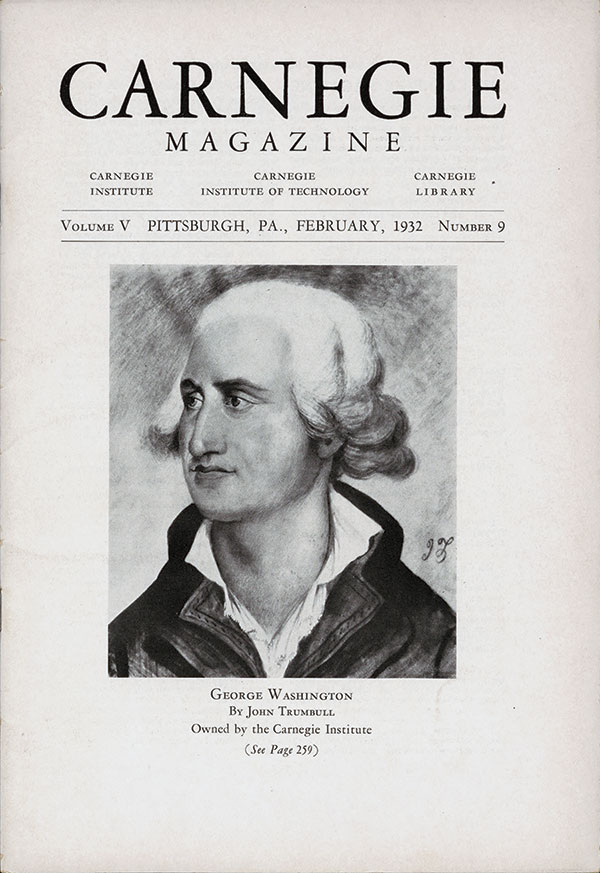
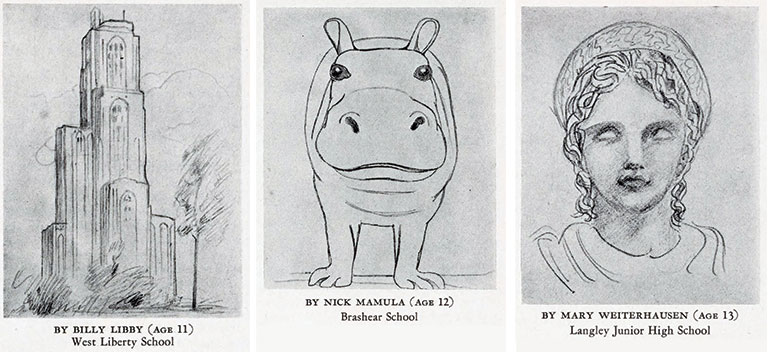
Editor’s note: The following excerpts appeared in the February 1932 issue of Carnegie magazine. Elmer Stephan was then the director of art for Pittsburgh Public Schools, writing about Carnegie Museum of Art’s Saturday morning art classes. One of the young artists featured in his article was 11-year-old “Billy Libby,” who sketched the Cathedral of Learning that was still under construction. William Charles Libby went on to become an accomplished artist, associate professor at Carnegie Institute of Technology (now Carnegie Mellon University), and president of the Associated Artists of Pittsburgh. Known mostly for his lithographs, Libby’s artwork is included in the collections of the National Gallery of Art, Metropolitan Museum of Art, and Carnegie Museum of Art, among others.
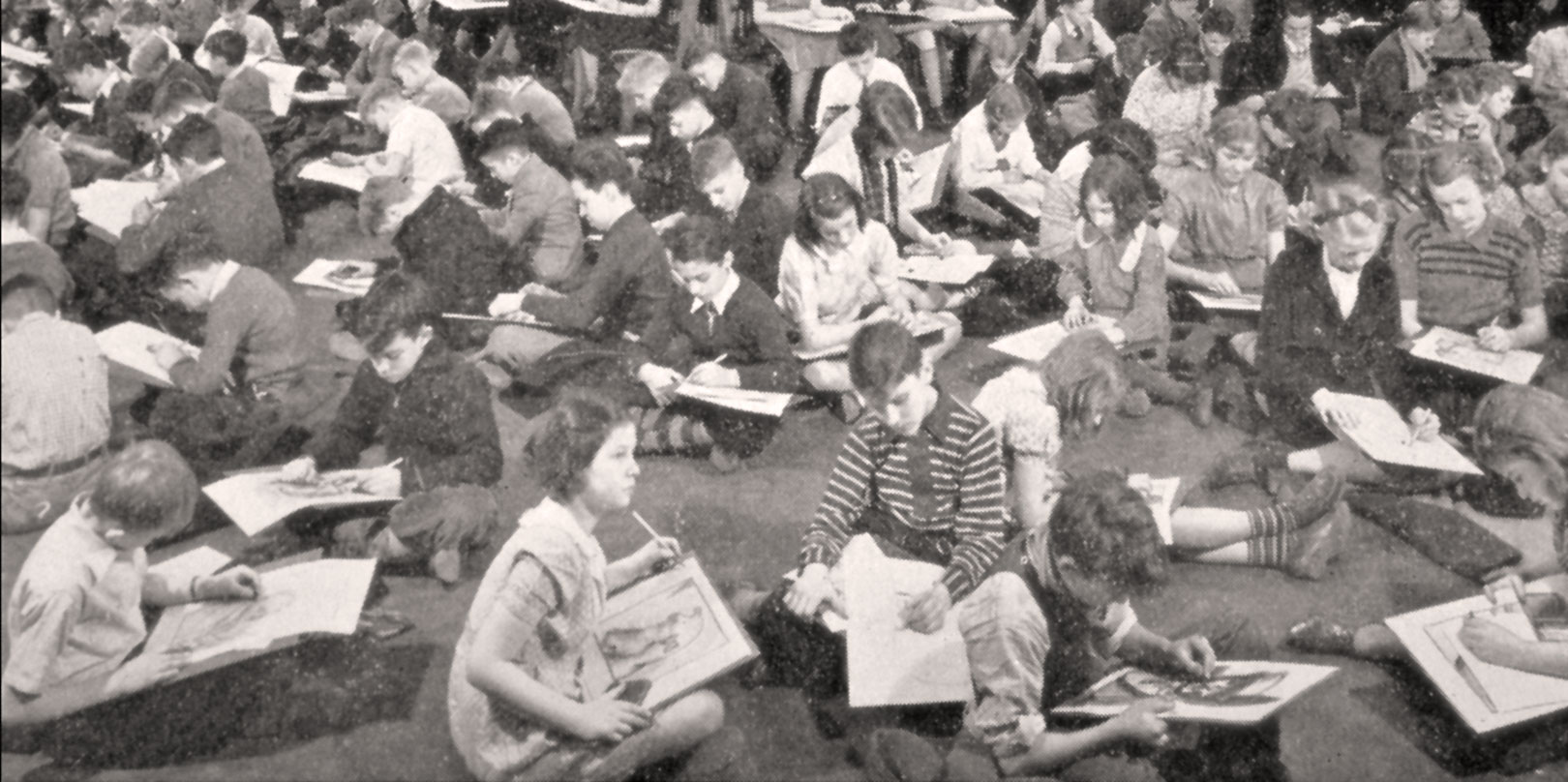
So it happened that on the opening day of the Saturday-morning art class, the teacher faced one hundred and sixty boys and girls in the lecture hall, each child at least more talented in drawing than the average. They represented al-most every school building in Pittsburgh. The breathless silence which pervaded the room when the teacher began to draw for them made his heart beat fast. Here they were, potential artists of Pittsburgh in the next generation, eager, anxious, bubbling over with a desire to learn more about the thing which was so much a part of their life. The teacher drew for them on a large blackboard, illustrating his points as he talked. He attempted to open the great secrets of the joy of self-expres-sion. Then he turned them loose in the art galleries and the museum. And with what results?
Has the reader ever tried to draw the front view of a hippopotamus? Has he ever noticed the exquisite hinges on the church of St. Gilles? Has he ever spent fifteen minutes looking over a collec-tion of fifty pictures in a gallery and then drawn one perfectly from memory?
Well, these were the astonishing results. The child is unafraid, the artist is undaunted by any difficulty.
“Here rests the hope for art in America, the proof that Pittsburgh is civilized. The talented few are always going to create for the masses to appreciate. Without fostering this desire in the hearts of these blessed little children, the future artistic production of the race may be lost.
We are looking forward to a time when we shall search out and find the potential artist. We shall nurture him, like the queen bee, on special artistic food. We shall provide materially for him, see that he gets proper instruction and funds if need be, so that a leader in this field shall not be lost. We shall waken up to our responsibility by pro-viding a children’s gallery, with in-struction and exhibition rooms where the craving for beauty may be satisfied. The time will come when the gifted child is advised to turn his eyes in the direction of his God-given talent and when his efforts are encouraged in this direction to produce, if possible, but at least to open his eyes to the beauty round about. Without vision, and without art, which is the outward ex-pression of vision, a people must perish.”
Read the entire February 1932 issue here.