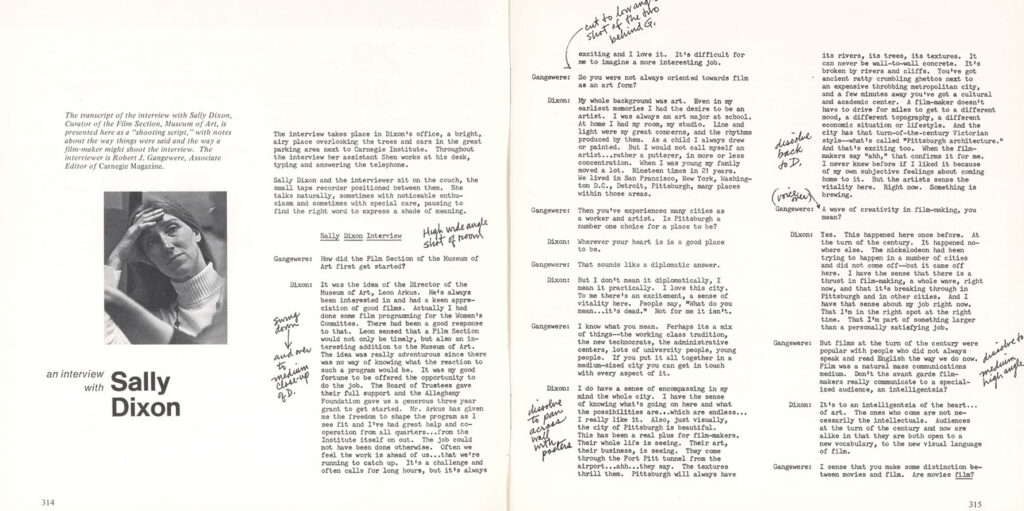
Editor’s note: The following exchange appeared in the October 1973 issue of Carnegie magazine, just a few years into the tenure of Sally Dixon, who founded the film department at Carnegie Museum of Art in 1970 and was its first curator. The interview was conducted by Robert J. Gangewere, longtime editor of the magazine. In the original publication, the interview was presented as a “shooting script,” with notes about how a filmmaker might film the interview. That layout can be seen in full on the magazine’s online archive page.
Robert J. Gangewere: So you were not always oriented towards film as an art form?
Sally Dixon: My whole background was art. Even in my earliest memories I had the desire to be an artist. I was always an art major at school. At home I had my room, my studio. Line and light were my great concerns, and the rhythms produced by them. As a child I always drew or painted. But I would not call myself an artist…rather a putterer, in more or less concentration. When I was young my family moved a lot. Nineteen times in 21 years. We lived in San Francisco, New York, Washington D.C., Detroit, Pittsburgh, many places within those areas.
Gangewere: Then you’ve experienced many cities as a worker and artist. Is Pittsburgh a number one choice for a place to be?
Dixon: Wherever your heart is is a good place to be.
Gangewere: That sounds like a diplomatic answer.
Dixon: But I don’t mean it diplomatically, I mean it practically. I love this city. To me there’s an excitement, a sense of vitality here. People say, “What do you mean…it’s dead.” Not for me it isn’t.
Gangewere: I know what you mean. Perhaps it’s a mix of things—the working class tradition, the new technocrats, the administrative centers, lots of university people, young people. If you put it all together in a medium-sized city you can get in touch with every aspect of it.
Dixon: I do have a sense of encompassing in my mind the whole city. I have the sense of knowing what’s going on here and what the possibilities are which are endless…I really like it. Also, just visually, the city of Pittsburgh is beautiful. This has been a real plus for filmmakers. Their whole life is seeing. Their art, their business, is seeing. They come through the Fort Pitt tunnel from the airport…ahh…they say. The textures thrill them. Pittsburgh will always have its rivers, its trees, its textures. It can never be wall-to-wall concrete. It’s broken by rivers and cliffs. You’ve got ancient ratty crumbling ghettos next to an expensive throbbing metropolitan city, and a few minutes away you’ve got a cultural and academic center. A filmmaker doesn’t have to drive for miles to get to a different mood, a different topography, a different economic situation or lifestyle. And the city has that tum-of-the-century Victorian style—what’s called “Pittsburgh architecture.” And that’s exciting too. When the filmmakers say “ahh,” that confirms it for me. I never knew before if I liked it because of my own subjective feelings about coming home to it. But the artists sense the vitality here. Right now. Something is brewing.
Gangewere: A wave of creativity in filmmaking, you mean?
Dixon: Yes. This happened here once before. At the turn of the century. It happened nowhere else. The nickelodeon had been trying to happen in a number of cities and did not come off—but it came off here. I have the sense that there is a thrust in filmmaking, a whole wave, right now, and that it’s breaking through in Pittsburgh and in other cities. And I have that sense about my job right now. That I’m in the right spot at the right time. That I’m part of something larger than a personally satisfying job.
Read the entire interview in the October 1973 issue of Carnegie magazine.