 Photo: John Schisler
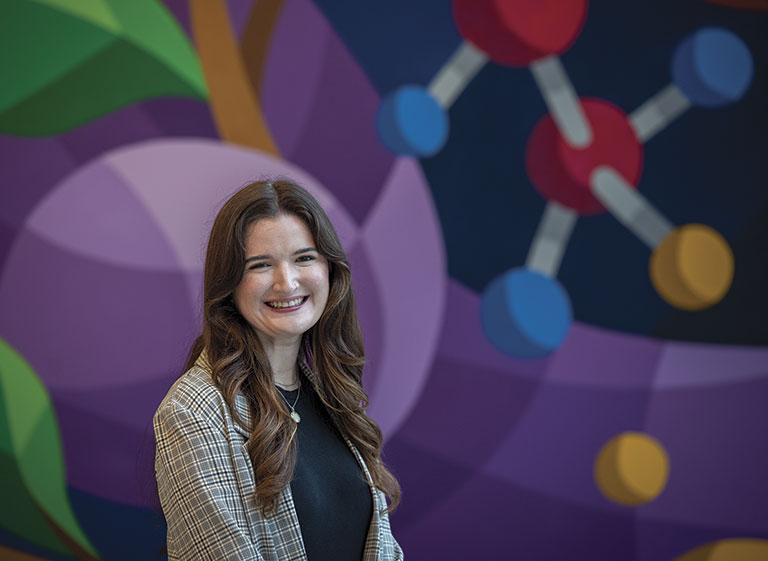
Growing up in Michigan, Shannon Gaussa split her time between devouring books and hiking trails, building a lifelong love of learning that would lead her to pursue a career in education. After she earned a degree in early childhood education from the University of Dayton, she took more traditional classroom jobs—teaching elementary school in Ohio before moving to Pittsburgh in 2018, where she worked as a substitute teacher. While exploring positions in Pittsburgh, Gaussa also took a part-time role with Carnegie Science Center’s education programs. She soon discovered that she loved the hands-on science lessons filled with creative problem-solving, which gave her the freedom to approach learning in ways that felt more student-driven and joyful. “I realized this is where my passion is,” she says. Gaussa joined the Science Center full time in 2021 and now leads learning and engagement at the museum, overseeing STEM-based learning strategy for programs from preschool to adult. She helped create Launch Your Future, a paid internship connecting teens with careers in space and health care. And she’s led teens in publishing illustrated books on gene editing and space travel, flown drones in gymnasiums, and delivered science kits to living rooms. At the heart of her approach is a simple question: What does it take for someone to feel like they belong in a learning space? Her answer begins with listening.
Q: What drew you to STEM education?
A: It’s funny, because I didn’t think of myself as a STEM person at all. When I was teaching, I was focused on English Language Arts. But when I started working at the Science Center, my mindset really shifted. I realized that STEM isn’t one thing. It’s problem-solving, creativity, and critical thinking. I started to understand that the divide between “STEM people” and “non-STEM people” is mostly a myth.
Q: What was the biggest challenge you didn’t expect, and how did it shape the educator you are today?
A: My first role at the Science Center was as a STEM Stars instructor, which meant leading after-school STEM programming for middle school girls at sites around the city. Learning the STEM concepts and working with the creative, curious, brilliant, and often hilarious middle schoolers was a dream.
The most challenging part was navigating all of the logistics behind the scenes. With programming in various schools and community centers, it took a lot of organization for all sites and educators to have the information and materials they needed.
Q: Some of your programs involve mentorship. What role do mentors play?
A: Mentors are so important, especially when we’re trying to increase representation in STEM. In the Launch Your Future program, students visited Astrobotic and met HVAC techs who were contributing to space projects, alongside scientists doing pharmaceutical research in space. That range helps students see themselves in different roles. Mentorship can open students up to futures they hadn’t even imagined.
Q: Can you share a memorable mentor story?
A: The Launch Your Future program works with many mentors, both locally and virtually, from around the world. My brother-in-law, an engineer at Blue Origin, offered to be a virtual mentor. As students talked with him over Zoom during a “speed-mentoring” session, one participant asked a hard-hitting question about the ethics of space exploration given the environmental challenges we have on Earth. This led to a great discussion about the ways he sees his work benefiting the world and how, to him, it’s not a question of being innovative in developing space technologies or taking care of our planet, but how both are important.
Q: How can STEM education better adapt to students’ lived experiences?
A: It starts with flipping the traditional mindset. Museums have been seen as institutions that hold knowledge and share it outward. But our communities already hold knowledge. They have strengths we can build from. We used to plan outreach events in communities that showed up on the Pittsburgh disadvantage map, but we didn’t always get great turnout. Then we realized these communities already had thriving events—block parties, festivals. So we shifted to being present at those, bringing our activities into what was already happening.
Q: What’s one big idea you’d love to see embraced in STEM education?
A: I would love for everyone in STEM education to embrace the idea that humans are a part of the larger ecosystem of living things. As a society, we’ve become more disconnected from what we refer to as “nature” or “natural resources,” as if nature is a separate entity to take from until we start seeing negative effects.
Once we internalize that we’re part of this interconnected system, I believe we’re more likely to treat the other parts of our ecosystem with care. Respect often grows through understanding, so science educators are perfectly primed to address this as we help students discover the wonder of the world.