It started with a thrifted dress hanging in her closet.
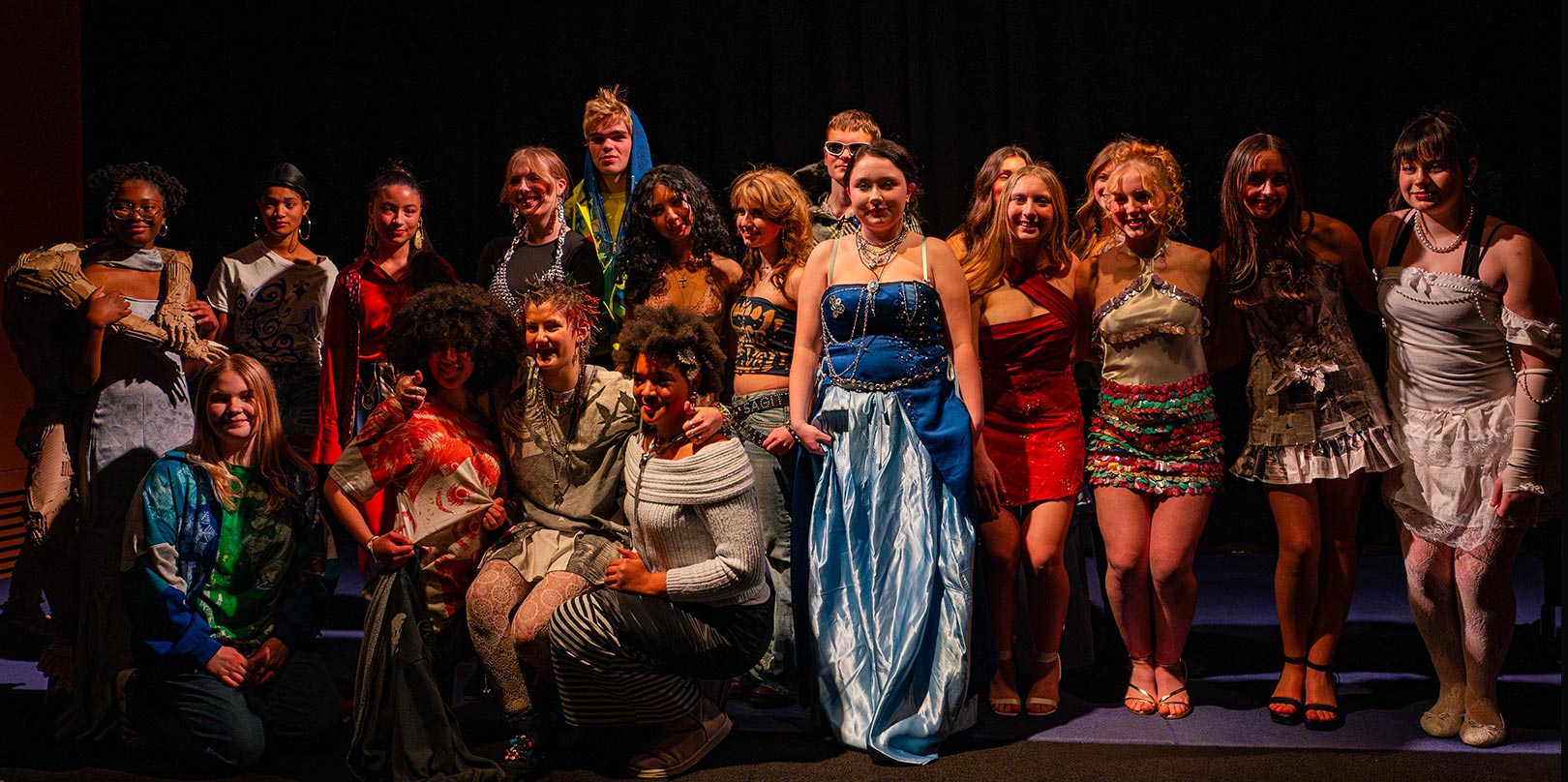
By the time Ria Rath walked the runway at The Andy Warhol Museum several weeks later, the garment had been cut apart and rebuilt into a floor-length, corseted dress, layered in shades of indigo and glacier blue, and threaded with chains.
Rath, a 15-year-old student at Pittsburgh’s arts magnet school CAPA, says the act of making and modeling the piece as part of The Warhol’s Youth Fashion Show was as important as the final look.
Rath had ideas about society she wanted to express through the garment, explaining that the metal referred to factories and labor, grounding the gown in the working class rather than luxury fashion.
“Fashion can be elitist,” says Rath, whose garment was the finale of the evening. “Through reusing and recycling, I wanted to push back against that. Making and modeling this garment felt like taking ownership of the process.”
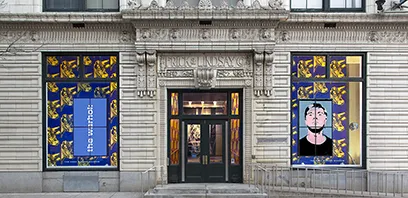
That sense of ownership is central to the Youth Fashion Show, an annual program at The Warhol that invites teens to create garments and see them modeled on a runway. Presented during Winter Teen Night in December, the show features works shaped through weeks of experimentation and problem-solving.
Most of the looks were developed through The Warhol’s youth fashion workshop series, which had 15 participants last year and has been running for two decades. Every outfit began with repurposed materials, but beyond that shared constraint, there was no single theme.
That openness is intentional, says Heather White, director of learning at The Warhol. “We want students to come in with their own ideas and figure out what they want to make.”
“It felt unreal. It wasn’t fashion week in Paris or New York, but I really felt like I’d accomplished something.”
Alayna Weller, Perry High School Student
Without a prescribed aesthetic, the runway accommodates wide-ranging interpretations.
A cotton dress layered with lace, ribbons, and beads began as three white T-shirts. Alayna Weller, a 16-year-old student at Perry High School, hurried to assemble the piece after learning about the show days before the deadline. Drawing from fashion magazines, online platforms, and historical style, she incorporated Victorian silhouettes without tipping into costume.
“I remember finishing just the top neckline and thinking, ‘Wow, this is really going to be a dress,’” Weller says. “It felt unreal. It wasn’t fashion week in Paris or New York, but I really felt like I’d accomplished something.”
Midway through the show, a model entered wearing couture created by 16-year-old Samara Kalyani, a student at CAPA. The conceptual garment incorporates a cardboard mannequin draped from the model’s back, its arms gently hugging the wearer around the neck. Kalyani assembled the figure using cardboard and hot glue before layering it over a white gown sewn by her mother decades earlier.
“I kept thinking about how many people carry the weight of others all the time,” Kalyani says.
Sewing is a skill she learned at the feet of her mother and grandmother. The garment was modeled by her sister. “Having my family involved made it all the more special,” she explains. “Seeing people understand and react to the piece was really validating.”
Much of that work took place in The Warhol’s Youth Open Studio, a drop-in program on Wednesday afternoons where teens can sew, screenprint, test ideas, and revise projects. White says the program adapts to each student rather than enforcing uniform results.
That adaptability was visible in the work of Tilly Quinlan, a senior at Taylor Allderdice High School. Quinlan’s screenprinted hoodie came together on a tight timeline. The front was printed off-site using vintage snowflake imagery; the back was completed just hours before the show using stencil designs inspired by an exhibition upstairs.
“Screenprinting is so accessible,” Quinlan remarks. “You can fine-tune things for speed and precision, and scale up as you gain experience.”
For Cara Murray, a student at Pine-Richland High School, the runway became a culmination of self-directed study. Murray presented four dresses made from different materials: thrifted curtains transformed into a homecoming gown, pop-can tabs handsewn into shimmering panels, newspaper shaped into a structured form, and a sculptural red piece featuring pleating and draping.
She worked at home through online tutorials, experimentation, and long hours in her basement. The pop-can dress alone required more than 50 hours of hand sewing.
“Each piece was about intentionally teaching myself something new,” she says.
While she doesn’t plan to pursue a career in fashion, Murray hopes to study engineering, where she sees a clear connection between design and structure. “Sewing involves math, design, discipline, perseverance, and so much more,” she notes.
For White, the most meaningful outcomes extend beyond the museum. She has watched students altering their own clothing, cutting, resewing, and reimagining garments as part of everyday life. Many return every year, sometimes starting as models before stepping into design roles, or observing one year before committing fully.
“We see the runway not as a one-night performance, but as part of an ongoing creative relationship,” White says. “You can see that continuity and confidence building over time.”
Rath’s confidence was unmistakable as her creation closed the show.
“Making the dress and modeling it myself on the runway showed me I can make something and stand by it,” Rath exclaimed.
The teen fashion program is supported by the Keith Haring Foundation.