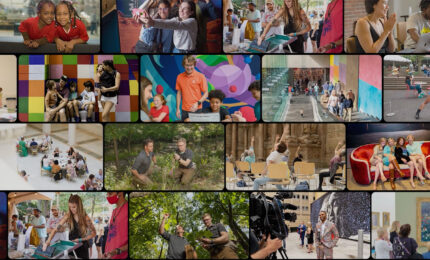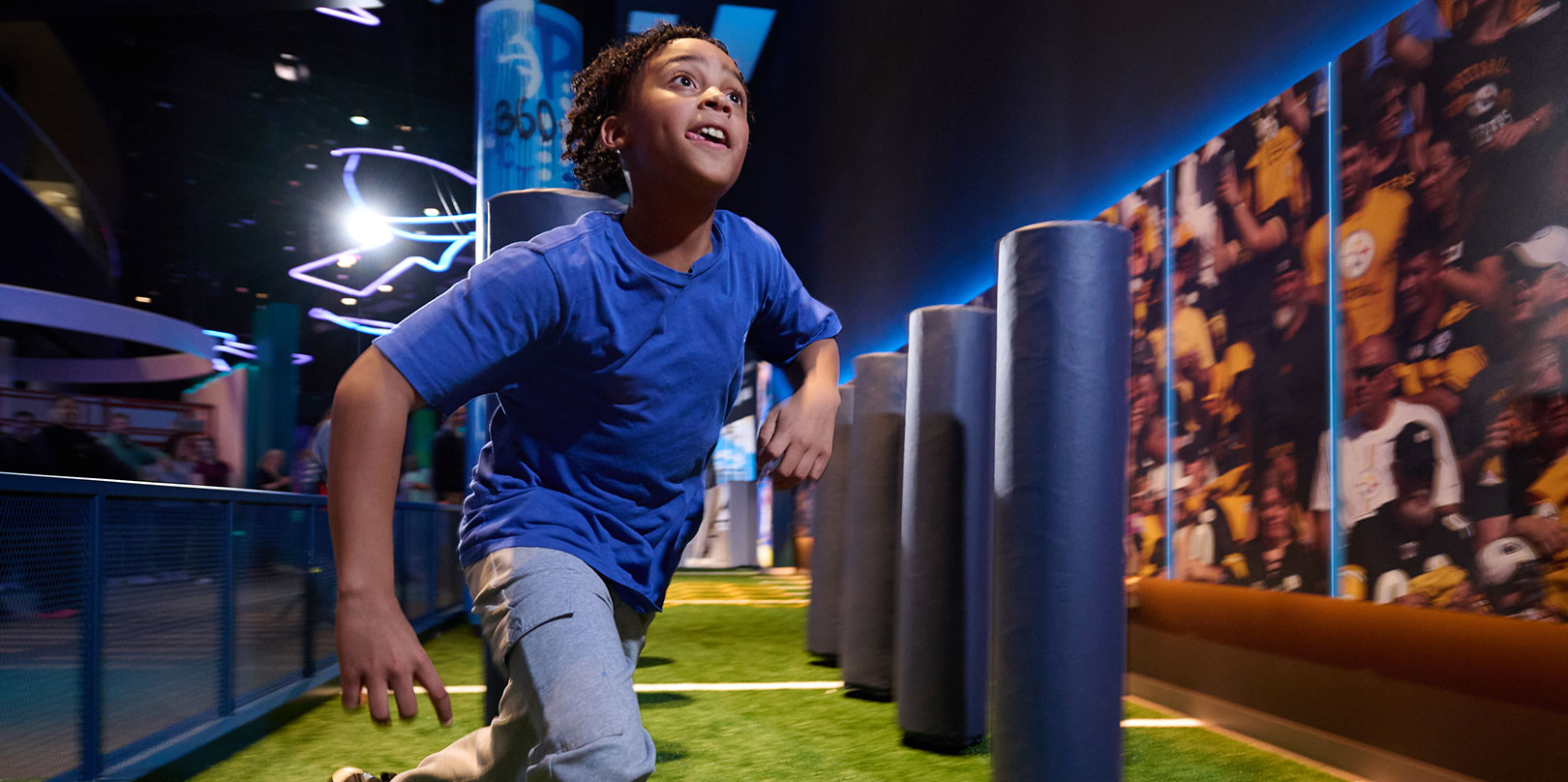
Wander past the massive video collage featuring athletes of all abilities, basket-tossing cheerleaders, and BMX bikers at the entrance of Kamin Science Center’s newest exhibition, Sports360, and you’re likely to be met with screaming—the good kind!
With two dozen interactive experiences challenging visitors to test their athletic skill, reflexes, team spirit, and more, Kamin Science Center’s new permanent exhibition elicits a cacophony of cheers and sporting taunts. Even a nutrition-themed exhibit about how fats, carbohydrates, and protein power our bodies taps into a playful and competitive energy that permeates the 9,500-square-foot gallery on the museum’s first floor.
“More protein! More protein! Just more protein,” screeched Nicole Ulloa, a middle schooler from Pittsburgh Schiller STEAM Academy, to her two classmates as she fed “Greek yogurt” discs into the Eat for Energy station.
The game calculates the nutrients that people need to prepare for different activities—a rowing race, throwing shot put, a ninth grade algebra final, etc.—then tasks players with selecting the foods that meet those demands.
 Photos: Becky Thurner
The exhibition ushers in a period of renovation and reimagining that will see more than 75 percent of Pittsburgh’s most-visited museum revamped with new content over the next two years. Sports360 debuted in December as the largest permanent exhibition inside the main Science Center building.
The exhibition builds on the passion for sports ingrained in Pittsburgh’s psyche and the popularity of the former SportsWorks exhibition, which closed last year after engaging guests for more than a quarter century.
“There’s so much science in sports. We thought, ‘Let’s look at sports through a new angle of science and bring a more cutting-edge technology side to it,’” says Jason Brown, Henry Buhl, Jr., Director of Kamin Science Center and vice president of Carnegie Museums.
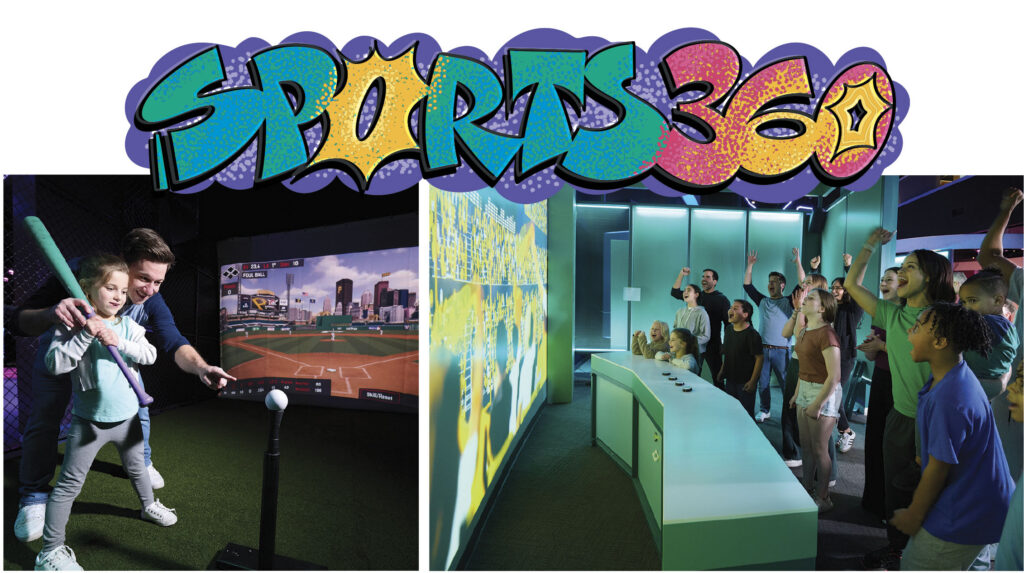
Sports360 gives visitors their shot at swinging for the fences in a virtual PNC Park, maneuvering a hockey puck to outsmart a goalie, and battling a friend to see who can shoot the most baskets in a basketball competition.
More interested in science than scoreboards? Sports360 has something for you, too, as the exhibition is filled with activities that explore the physics, biology, neuroscience, and psychology of sport.
“It’s not something that’s just for athletes,” Brown says. “Whether you’re on the field, whether you’re in the stands, or whether you’re a bandwagoner, there’s something for everybody.”
‘Sneaky Science’
Tae’vion Gilbert weaved through padded pillars, testing his speed, agility, and power against other eighth graders from Pittsburgh Schiller STEAM Academy in an NFL Combine-inspired obstacle course. After navigating through the pylons and a short sprint, he leapt up to touch light-up buttons on the wall measuring his vertical reach.
“It’s cool—like an actual practice and stuff,” he says. “You have to coordinate your movements and use all your jump power just to get up there. I don’t know how anyone would reach the top.”
Director of Exhibitions Jennifer Lawrence and her team surveyed guests to get a feel for the types of sports they were most interested in experiencing and learning about. Then they worked with a third-party exhibition consultant as well as some of the city’s professional sports franchises to develop activities that investigate the relationship between sports and science.
“We are hearing from people that Sports360 is new and imaginative, and it’s not like a typical science center exhibit—but they mean that in a good way,” Lawrence says.
“There’s so much science in sports.We thought, ‘Let’s look at sports through a new angle of science and bring a more cutting-edge technology side to it.'”
Jason Brown, director of Kamin Science Center
Featuring hands-on stations across four zones—Prepare, Practice, Participate, and Go Pro—visitors like Nicole and Tae’vion investigate biomechanics, physics, and the mind-body connection—sometimes, without even knowing it—through football, baseball, hockey, soccer, basketball, and Olympic sports challenges.
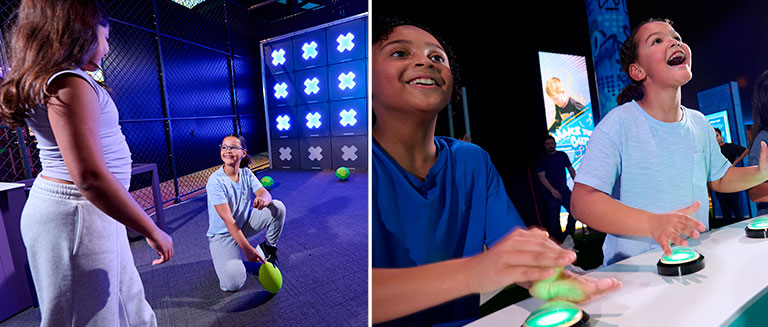
Most stations incorporate what Lawrence dubs “sneaky science.” The baseball simulator explains how hitters use the power in their legs to crush the ball. Cleaning ice with a virtual Zamboni provides lessons in friction, physics, and motion. A football/soccer simulator in which guests fire balls at glowing targets on a wall teaches that muscle memory is a misnomer—it’s actually neural patterns formed in the brain that help us perform better with practice.
“The exhibition doesn’t feel didactic,” Lawrence explains. “It feels like you’re having a fun time and then you’re going to take away some science with you.”
Visitors also get a feel for the mental aspect of sport in a relaxation station that encourages them to close their eyes, breathe deeply, and see if various sounds—like chirping crickets, guided meditations, murmuring voices, and the musical tones of Himalayan singing bowls—can help them focus and block out distractions the way athletes are trained to do.
Another activity challenges visitors to trace a course while a crowd cheers or boos, illustrating the impact fans can have on a player’s performance and the power of home-field advantage.
The Pick A Side challenge explores the social psychology related to teamwork. The game pits two groups of visitors against each other in a rowdy battle to see which team can illuminate a series of lights on a board first by working together to press buttons the fastest.
“It shows how being on a team forms an instantaneous bond,” Lawrence says. “Two minutes ago, you may not have had any relationship with the person beside you, and then all of a sudden you’re united to beat the other team.”
Reaching New Fans
Creating even more welcoming and engaging experiences for a broad swath of museumgoers was part of the game plan for Sports360. It’s the latest in a series of nine planned exhibitions opening over the next few years that are intended to grow the Science Center’s appeal beyond mostly young families, Brown notes.
“We have a lot of room to grow in the areas of college students, seniors, empty nesters—because science really is for everyone,” Brown says. “We really felt it was imperative for us to broaden our audience, and we want to make sure there is content and a way to ignite the curiosity of anyone, regardless of age.”
Museum leaders say adults get just as excited as kids and teens when taking part in the exhibition’s physical challenges and competitive games.
 Photos: Becky Thurner
“It is a space to get up, to get moving, to get active,” says Ned Schano, senior director of marketing and communications at Kamin Science Center. “It’s a very active space for the young ones, and also adults. We’ve seen adults with sweaty brows.”
It was also important to make the sports-centric content broadly appealing to non-sports visitors as well as the city’s rabid fan base, explains Lawrence. The exhibit team wanted to create a whimsical environment with “Pittsburgh-y” vibes, she says, leaving room for bright colors to go along with Pittsburgh’s iconic black and gold.
Lawrence says she found inspiration in a graffiti class she took at the Carrie Blast Furnaces. The teacher of the course, Scott Brozovich, connected her with Wicked Pittsburgh, a collective of artists from across the city. The Science Center commissioned several local graffiti artists to bring authentic street art and visual interest to the gallery. The artists worked on-site to transform the gallery space through spray-painted images and sports-themed words.
“We wanted the graffiti to be authentic, not AI-generated or purchased stock images,” Lawrence recounts. “I think that bringing in Pittsburgh artists gives the exhibition a really special flavor.”
Opportunities in Sports
Sports360 places a special emphasis on what happens behind the scenes of popular athletic pursuits.
A locker room showcases the equipment needed for suiting up as a goalkeeper for the Pittsburgh Riveters—the city’s new women’s soccer franchise—as well as rock-climbing gear loaned by the University of Pittsburgh climbing team. An interactive console shows users the protective gear they’d need to wear for a variety of sports, then dresses their virtual avatar for competition.
Stations like a CPR instructional simulator and a logo design console help visitors learn about different industries that lend support to athletes and sports teams.
Pittsburgh Schiller STEAM Academy student Loch Cameron-White says she isn’t much of a sports fan, but she enjoyed spending time designing a team logo.
“It lets you be creative and is still really fun,” she says, as a machine digitally spray- paints her fuchsia and black logo with a bold star motif on a large screen for everyone to admire.
“We are hearing from people that Sports360 is new and imaginative, and it’s not like a typical science center exhibit—but they mean that in a good way.”
Jennifer Lawrence, Director of Exhibitions at Kamin Science Center
Lawrence says career education and exploration are important aspects of curriculum, both in the region’s schools and for the Science Center; so Kamin Science Center staff wanted to spur students to consider the wide range of careers tied to sports and delve into the skill sets required for those jobs.
Sports360 concludes with an entire wall highlighting jobs that keep professional sports running, including marketing professionals, stadium architects, statisticians, turf managers, prosthetics designers, athletic trainers, and team chefs.
“We want to help people understand that there are jobs in athletics that don’t require you to be a professional athlete,” Brown says. “Obviously, they’re the ones who get all the accolades, but for every athlete, there are hundreds of people behind the scenes who are making the machine run.”
Whether it’s part of a job, a love of competing, or the camaraderie of watching your favorite team with fellow fans, Sports360 demonstrates the holistic nature of sports and the way science helps athletes prepare, practice, participate, and, sometimes, even go pro.
“I love how immersed people get in it and how it brings out competition, but in a good way,” Lawrence says. “I just love the authentic joy that I see from people in this space.”
Major support for Sports360 is provided by the Ray and Joneen Betler Family, The Pittsburgh Pirates, Pittsburgh Penguins Foundation, PPG, Highmark, Giant Eagle Foundation, Peoples, Chuck Noll Foundation for Brain Injury Research, The Cheung Family, and The Werner Family.