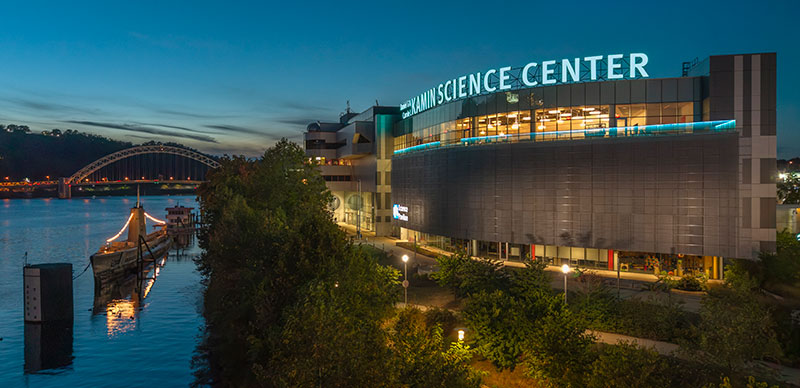
From the outset, planetariums were designed to depict the night sky—the drama of the cosmos projected onto a large, dome-shaped screen. But what if you could feel and hear the universe, too? The latest show at the Daniel G. and Carole L. Kamin Science Center’s Buhl Planetarium, Touch the Stars, invites audiences to experience space in a new way.
“Planetariums are a place for wonder; the visuals fully encapsulate you,” says Kayla Waugaman, producer and observatory coordinator for Buhl Planetarium. “But it’s limiting, because you have to be able to see to experience it to its fullest.
“Space is multidimensional, and we should experience it with all of our senses,” she adds. “That’s the way we’re going to understand the vastness of our cosmos.”
This year, Touch the Stars became the planetarium’s first multisensory show specifically designed for an audience with visual impairments. The show’s live narrator, known as a sky pilot, gives a tour of the wintertime sky over Pittsburgh that includes detailed image descriptions of the visuals projected on the planetarium’s screen. Touch the Stars also relies on several tactile and auditory elements, prompting the audience to use their sense of touch and sound to interact with the show.
“Space is multidimensional, and we should experience it with all of our senses. That’s the way we’re going to understand the vastness of our cosmos.”
Kayla Waugaman, producer and observatory coordinator for Buhl Planetarium
Waugaman’s primary focus as a producer is developing new content. Nationally, most planetariums present content produced by external partners, she says, but the majority of Buhl Planetarium’s daily shows are created in-house, including Touch the Stars.
She notes that there’s an ongoing push in the professional planetarium community to learn how to better serve guests with visual impairments, so Waugaman made sure the script she wrote for Touch the Stars was informed by members of the visual impairment community.
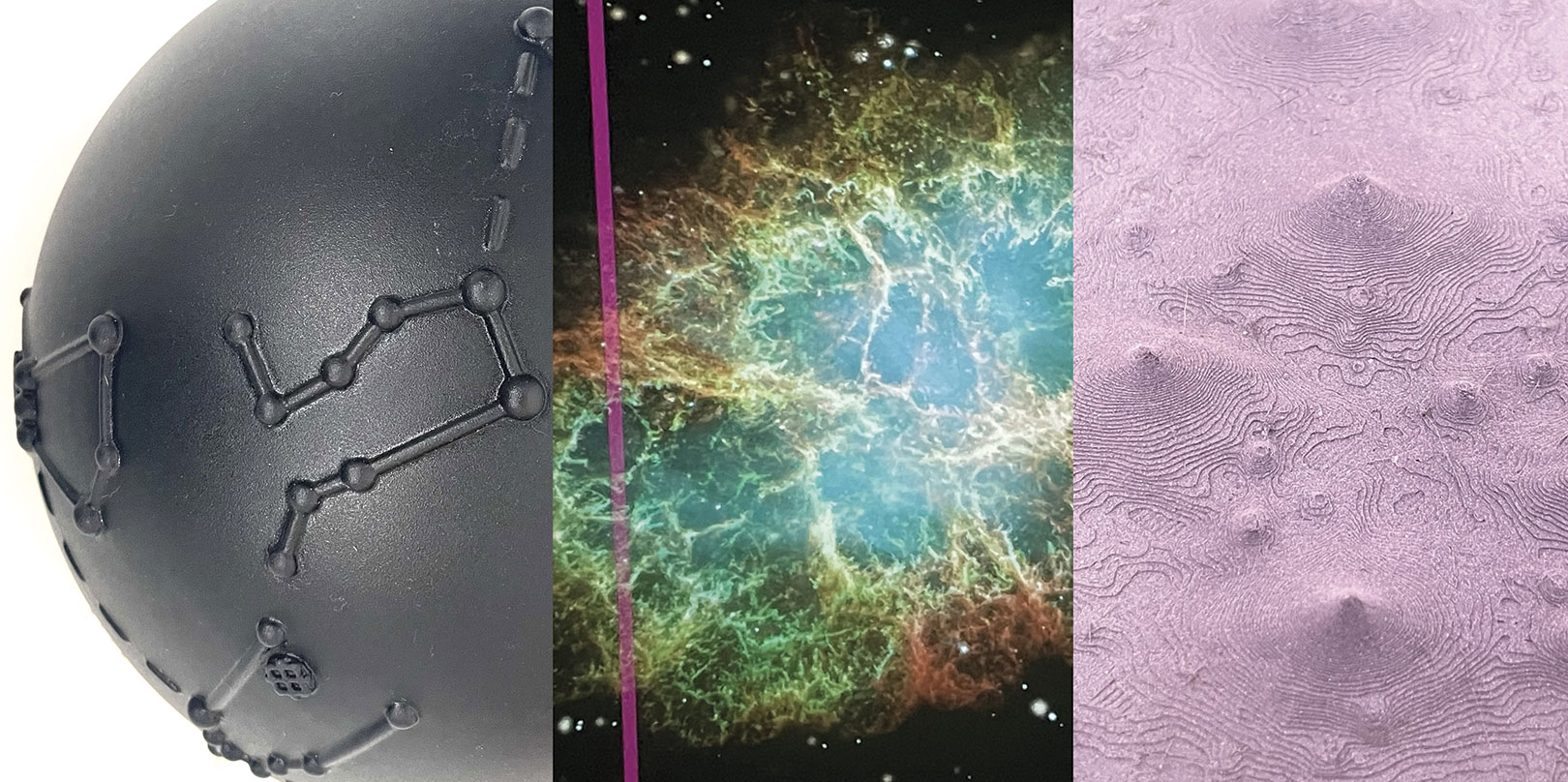
Before the show begins, audience members receive a “sky globe” the width of a basketball to hold. The plastic half dome is rendered with celestial bodies, including the Pleiades, Crab Nebula, and the constellation Orion. The stars on the globe are depicted as raised circles; the brighter the star appears in the night sky, the larger it’s rendered. Serving as routes between the stars are raised dashed lines that guide participants across the sky. Nebulae, which are large collections of gas and dust, are represented as textured ovals.
To create the sound element of Touch the Stars, Waugaman used a process called sonification, which translates data into sound. This allowed her to make a soundscape representative of the distance and brightness of cosmological objects depicted in Touch the Stars. After a week of testing sounds, she landed on using a piano note to indicate the location of a star and a bell-synthesizer note to indicate areas of gas and dust that make up nebulae—the higher the note, the brighter the star or the denser the gas and dust clouds.
Listening to the stars and nebulae, the audience is treated to a concert of sounds, as the tinny tones of stars and the bell-synthesizer reverberations of the nebulae open a new avenue of engaging with the cosmos. “Your ears can pick up very subtle changes that can’t be captured in a photograph,” Waugaman explains.
This summer, young people enrolled in the Western Pennsylvania School for Blind Children’s STEAM In Motion summer camp were the first to take in Touch the Stars. The show was a revelation for Maryjane of Mars, Pennsylvania, a fourth grader at the school.
“I learned that there are so many stars,” she says. “I didn’t really know what stars were, and now I know they are lights in the sky.”
For Holly Russell, the school’s director of outreach, witnessing the campers’ enthusiasm for the show emphasized the importance of building accessibility into museum exhibitions.
“It is truly amazing to see the students experience the planetarium, and even more exciting to watch them begin to grasp the visual concepts being presented,” Russell says. “The tactile representations created by the Science Center bring these abstract ideas into their hands, making the learning tangible and meaningful.”