“Having these experts as a resource in our community is just huge.”
Brandon McCracken, Pittsburgh Parks Conservancy
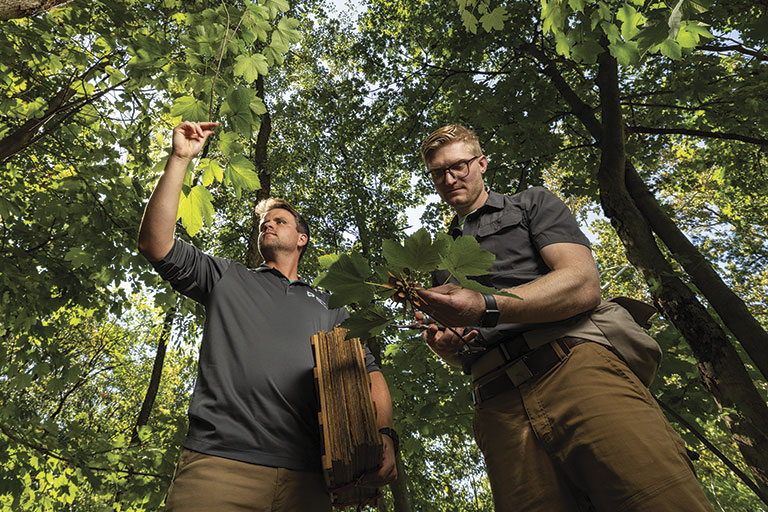
It started with a single plant specimen that BRANDON MCCRACKEN, ecological restoration manager with Pittsburgh Parks Conservancy, discovered and submitted to Carnegie Museum of Natural History a few years ago. The plant had no known records in Allegheny County. When the museum’s associate curator of botany, MASON HEBERLING, confirmed it as a naturalized species in the region, it marked the beginning of something bigger—a collaboration that would transform how Pittsburgh approaches invasive species management.
“I would call our role stewardship,” Brandon says. “We take on this role and love to work with researchers—like Mason from Carnegie Museums — to observe different plant responses that help us take steps to increase native plant biodiversity and promote healthy ecosystems in the parks. These people are on another level. Having these experts as a resource in our community is just huge.”
Cut to Mason working side by side with Brandon and other regional partners, combining field expertise with collection-based research to create Uprooted: Plants Out of Place, an exhibition on invasive plant species in the Pittsburgh region that bridges the gap between complex academic findings and practical community solutions. “When we started this Uprooted project, Brandon was our first call,” Mason says. “How do we talk about invasive species and stewardship as scientists, and as people? That’s the question we worked together to answer.”
“It was fun to be in an exhibit!” Brandon says. “In the Uprooted video, we talk about the way that we interface with invasive plants and what that means for stewardship.” Brandon also published an educational resource, a new edition of Invasive Plants of Pittsburgh, a field guide that’s available at Uprooted. “Remaining in this regional collective conversation about invasive plant awareness, communication, and management is essential,” Brandon says. “Both of us — the museum and the Parks Conservancy — are big players in
that conversation.”
Uprooted also led to Carnegie Museum of Natural History’s first NatureFest, a lively, collaborative, full-day event where researchers and nearly 3,000 visitors connected through panel discussions and hands-on learning about environmental stewardship.
“This collaboration shows how research can have real-world applications,” Mason reflects. “We have a shared mission. … We lift each other up. We’re not just studying invasive species, we’re helping communities understand and protect their unique natural heritage.”