Editor’s note: The following appeared in the April 1978 issue of Carnegie magazine. It was written by John E. Guilday, a renowned expert on Ice Age fossils who was associate curator of vertebrate fossils at Carnegie Museum of Natural History. In 1952, Guilday was a young man in his mid-20s who’d just begun working for the museum when he contracted polio. And still he persevered, building a distinguished career at the museum that spanned four decades while he lived with the disabling disease. Guilday also was a frequent contributor to Carnegie magazine. “He wrote beautifully, in a remarkable poetic way, and that was the only thing the general public may have known about him,” former magazine editor Robert Gangewere wrote in Guilday’s obituary. “But those who knew him personally knew immediately that he was unforgettable, and his story was one that would be with them for life.” Guilday died in November 1982 at the age of 57.
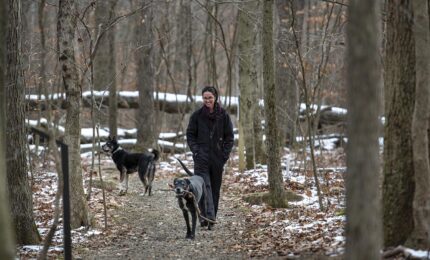
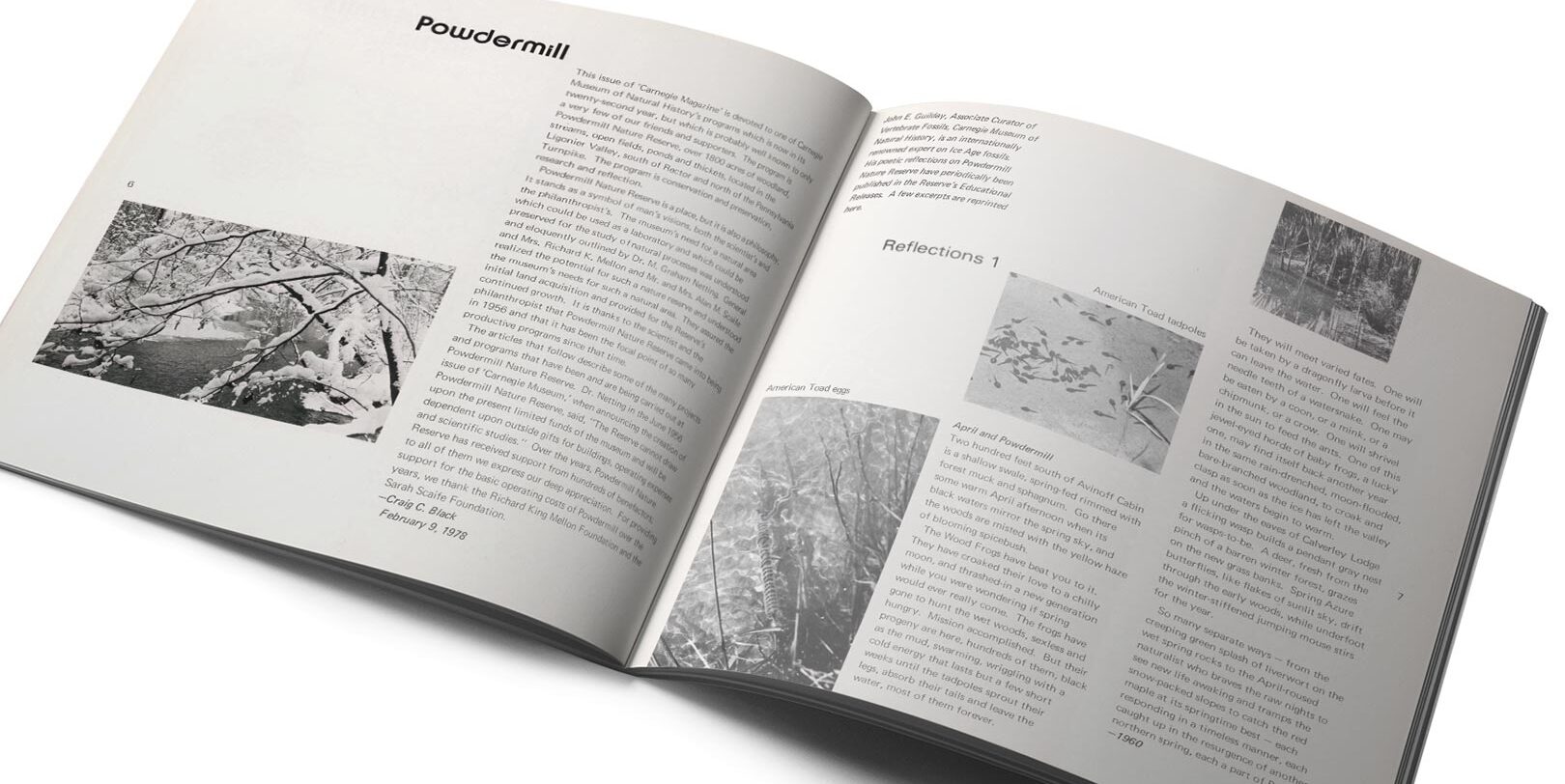
Two hundred feet south of Avinoff Cabin is a shallow swale, spring-fed rimmed with forest muck and sphagnum. Go there some warm April afternoon when its black waters mirror the spring sky, and the woods are misted with the yellow haze of blooming spicebush.
The Wood Frogs have beat you to it. They have croaked their love to a chilly moon, and thrashed-in a new generation while you were wondering if spring would ever really come. The frogs have gone to hunt the wet woods, sexless and hungry. Mission accomplished. But their progeny are here, hundreds of them, black as the mud, swarming, wriggling with a cold energy that lasts but a few short weeks until the tadpoles sprout their legs, absorb their tails and leave the water, most of them forever.
They will meet varied fates. One will be taken by a dragonfly larva before it can leave the water. One will feel the needle teeth of a watersnake. One maybe eaten by a coon, or a mink, or a chipmunk, or a crow. One will shrivel in the sun to feed the ants. One of this jewel-eyed horde of baby frogs, a lucky one, may find itself back another year in the same rain-drenched, moon-flooded, bare-branched woodland, to croak and clasp as soon as the ice has left the valley and the waters begin to warm.
Up under the eaves of Calverley Lodge a flicking wasp builds a pendant gray nest for wasps-to-be. A deer, fresh from the pinch of a barren winter forest, grazes on the new grass banks. Spring Azure butterflies, like flakes of sunlit sky, drift through the early woods, while underfoot the winter-stiffened jumping mouse stirs for the year.
So many separate ways—from the creeping green splash of liverwort on the wet spring rocks to the April-roused naturalist who braves the raw nights to see new life awaking and tramps the snow-packed slopes to catch the red maple at its springtime best—each responding in a timeless manner, each caught up in the resurgence of another northern spring, each a part of Powdermill.
Read the entire April 1978 issue here.