Above left: Known as the AIDS
logo, this knock off of the famous LOVE painting by
Robert Indiana was created in 1987 by Canada-based General
Idea.
Above center: One day of AZT and One
Year of AZT, which visualize
the massive amounts of AZT pills once required to treat AIDS
and HIV, is
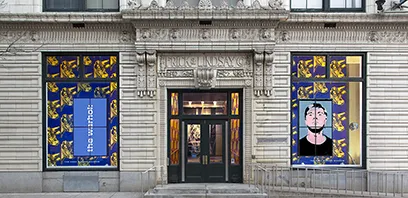
part of the General Idea exhibition now on view at The Warhol.
Above right: Each year for the
past 10 years, Visual AIDS has produced a poster for distribution
across the United States. In many instances, the pinning
up of the poster was a statement in and of itself.
An Artist Finds His Core
“ AIDS
has totally colored my art and my life,” says Dennis
Bergevin.
The
enormity of General Idea’s AZT installations
stands in sharp contrast to a more inward, personal art
done by 54-year-old Dennis Bergevin in his Mexican
War Streets
studio in Pittsburgh. As
a man who has lived with full-blown AIDS for 14 years,
Bergevin’s teapots embody his
struggle to come to terms with his disease early on. While
the pots
have feet and faces,
they have no core. But since his diagnosis in 1991, the
New York native has gradually replenished his own core
through
a mixture of talk therapy, art, and support from the Pittsburgh
AIDS community.
“
AIDS has totally colored my art and my life,” Bergevin
says. “First, it did it in a negative way because
it shut me down. But then through therapy, I took my
AIDS and,
instead of it being a black veil over me, I put it behind
me.” Literally and figuratively. Bergevin points
proudly to a black “plus” sign, symbolizing
an AIDS-positive diagnosis, tattooed on his lower back.
Bergevin’s art has evolved as well, now dominated
by human figures, mostly women—large and lusty
and full of life.
A
few blocks down the street, Dr. David Piontkowsky,
medical director of Allegheny
General Hospital’s Positive Health
Clinic, displays canvases used by HIV/AIDS patients
during art therapy sessions. One canvas shows a Red
Ribbon and the
words: “Can You Feel a Brand New Day? 1 People
+ 1 Cause = 2 Cure.”
Piontkowsky
notes the lack of anger and despair in many of the
pieces, a change
he’s seen in AIDS-related art
that he attributes to a huge societal shift in the
United States. A shift in the way we think about
AIDS, the gay community
that it still affects in disproportionate numbers,
and gay rights in general.
Interestingly,
he says, “Now
the question in society isn’t should we criminalize
gay sex but should we legalize gay marriage?”
Photos: Lisa Kyle
Back
AIDS AND ART:
A history of a disease and the arts campaign to stop it.
By Jane-Ellen Robinet
Twenty years
ago, in the spring of 1985, Thomas Sokolowski, now director
of The Andy Warhol
Museum and then head of New
York University’s Grey Art Gallery, was showing the work
of a promising 29-year-old artist. A few months later, a mutual
friend called to tell him the artist had died. “I asked, ‘of
what?’” Sokolowski recounts. “Of AIDS,” his
friend said. “While I was not unaware of the pandemic,” Sokolowski
says, “it still was not the first thing you thought of
at that time.”
That was all about to change. In fact,
without anyone really knowing, life had already changed dramatically
for Sokolowski,
the New York arts community, the United States, and the entire
world. In response, the U.S. arts community
would do what it does best: use its powerful, creative voice
to get people to think, learn, and take action.
In 1981—often referred to as the birth of AIDS—a
deadly disease with no name was first identified by physicians.
About 300 people were diagnosed with the ailment that year,
and 130 people died from it. One year later, researchers knew
enough to understand that it was sexually transmitted (although,
at the time, they thought only gay men were susceptible) and
transmitted through the blood, which called the safety of America’s
blood supply into question. And they gave it a name: Acquired
Immune Deficiency Syndrome, or AIDS.
By 1985, the numbers were
shockingly higher: 12,000 Americans were known to have AIDS
and 7,000 died from it that year.
“
I remember it just sort of started from there,” Sokolowski
says. “There started to be articles in the paper
about AIDS. I was living in the Village and, being a gay
person and
being involved in the art world, I’d read about this
dancer or that singer dying of AIDS. And then, in 1989
and 1990, two of my dear friends died.”
Sokolowski’s
friends were among the 60,000 people to die from the disease
in 1989 and 1990. By then, the U.S. government
had launched a national education campaign to inform the
public about AIDS and researchers had pinpointed the virus
that leads to full-blown AIDS—the
HIV virus. They had also developed the first drug known
to temper the disease, AZT.
But the public was still afraid
to shake hands with AIDS
patients. Kids infected with the disease—mostly hemophiliacs,
such as 13-year-old Ryan White, who made national news—were
still being barred from schools. And, because gay men were
the most affected by the disease and the arts communities
of California and New York had many gay members, the art
world
was still reeling from the loss of so many of its own.
The Cycle of Art
One night, at Sokolowski’s Manhattan apartment, a group
of arts-community friends sat around a table for dinner and
asked ‘what can we do?’ to bring AIDS
into the general public’s consciousness. “We felt
strongly that we had clout in the art world,” Sokolowski
recalls.
The result of that dinner—and the monthly meetings
that followed for years—was the 1989 formation of Visual
AIDS, a group dedicated to using the arts to bring public
attention to the AIDS crisis. The group would go on to found “Day
Without Art.” And it would create perhaps the most
universally recognizable symbol—the red ribbon—which
stood for the clarity, unity, compassion, and determination
that
soon took over the fight against AIDS.
Visual AIDS’ first
nationwide effort was a December 1st “Day
Without Art,” when some of the nation’s museums
shut their doors—symbolizing what would happen if
AIDS wiped out the arts community—while others remained
open but addressed the AIDS issue in other ways. The event,
which
would eventually foster World AIDS Day, received national
media coverage, including calls to Sokolowski from network
anchors
Peter Jennings and Dan Rather. The next year, Visual AIDS
came up with the idea of a “Night Without Light,” when
27 of New York City’s major skyscrapers, bridges,
and many of the theater district’s marquees went
dark.
But the culmination of Visual AIDS’ efforts
was the creation of the little red ribbon on a gold safety
pin. Sokolowski and his group managed to get presenters
and awardees
at the 1991 Tony Awards ceremony to wear them on national
television throughout the evening. The rest is history.
The ribbons are
now a global symbol of the commitment to fight AIDS, which
today is killing Third World populations of men, women,
and children at the staggering rate of three
million annually.
“
Looking back on those years, I am so proud of what a group
of committed young people could do,” Sokolowski says. “We
never gave in; and, as a result, things got better. Now, the
times require new blood infused with a new vigilence.”
A Year of AZT
About the same time the New York arts community began collaborating
en masse to
give its own AIDS crisis a voice, a group of three artists
who had been collaborating since 1969 came up with what would
soon be known as the “AIDS logo.”
General Idea,
a Canada-based art team formed by Jorge Zontal, Felix Partz,
and AA Bronson, gained international attention
in the ’70s for its contemporary work in video, photography,
performance art, and installations. The three artists were
pioneers of the alternative community, and the products of
their personal and professional union became almost legendary,
especially among young artists. In 1987, they created their
most famous work,
known as the AIDS logo, by transforming Pop artist Robert
Indiana’s
famous LOVE painting into AIDS.
Their prolific
partnership ended in 1994, when both Zontal and Partz died
of AIDS.
General Idea Editions: 1967-1995, showing at The
Warhol through December 31, is the first complete retrospective
of General
Idea’s mass-produced articles. It features more
than 200 prints, postcards, posters, photo-based projects,
series
publications, flags, and crests produced by General Idea
between 1967 and 1995. Created and first exhibited by
the Blackwood
Gallery of the University of Toronto, the exhibition
at The Warhol was doubled in size to include the group’s
two AIDS-related installations from 1991: One Day
of AZT and One
Year of AZT.
The first features five giant-sized pills
on the floor, representing the daily dose of AZT medication
taken early
on by people
with HIV. The companion installation features 1,825 oversized
pills
stuck, in calendar form, on the room’s four walls,
representing the annual dose of AZT that people with
HIV had to take in
the ’80s to ward off full-blown AIDS.
“
They have an enormous physical presence as well as an enormous
historical and emotional presence,” says John Smith,
assistant director for collections and research at The Warhol,
of the AZT installations. They also represent the chilling
tone of much of the AIDS-related art in the early days of the
epidemic.
“
Much of that art work was made by people who are dead now from
AIDS—and a lot of the art was in response to the sheer
quantity of people dying in the arts community,” says
AA Bronson.
“
Now that the death rate is lower (in the United States),
I think there’s a much less visceral response,” he
notes. “I also think there’s the burnout
factor from fighting so hard for so many years. It’s
sort of hard to keep that going.”
The year of his
partners’ deaths, 52,000 people died
of AIDS. That would prove to be the peak of the death
rate in the United States, and in the years that followed,
the number
of people diagnosed with AIDS and HIV began to level
off. Today, about 18,000 people still die of AIDS annually
in the United
States.
Following the deaths of his partners, says Bronson, “it
took me five years before I could make anything again.” To
this day, Bronson adds, he finds it emotionally difficult
to help re-install General Idea’s works at museums
around the world.
A Continental Divide
In the 25 years since AIDS whispered its way into the national
psyche, the entire epidemic, how it’s treated, and
how it’s portrayed has changed. For starters, AIDS
began in the United States as a crisis affecting predominantly
white, middle-class gay men and intravenous drug users. And
in the beginning, an HIV or AIDS diagnosis was a death sentence
because the daily mix of hundreds of pills wasn’t enough
to stave off death.
But with the introduction in 1996 of
anti-retroviral drugs, HIV and AIDS can now essentially
be managed—assuming
a person can afford them. And therein lies the crux: the
inequitable access to those life-prolonging drugs is one
reason the AIDS epidemic in the United States is expanding
disproportionately to the African-American community and
the poor. Similarly, the disease is decimating the populations
of many countries in Africa, Southeast Asia, and parts
of China.
Since HIV and AIDS are now survivable in the United
States,
activists worry that complacency could set in.
Los Angeles-based
art/activist group Ultra-red is working to make sure that
doesn’t
happen.
The group brought its anti-complacency “SILENT/LISTEN” presentation
to The Andy Warhol Museum on November 30, in honor
of this year’s World AIDS Day. The event invited local
AIDS activists, service providers, people living with HIV/AIDS,
and all members of the community
to help the group build an audio record of AIDS in
North America.
Ultra-red, General Idea, and The Warhol
are among the artists and arts organizations still giving
voice to
AIDS in the
new millennium. Their mission, says The Warhol’s
John Smith, is to make sure the message of General
Idea’s
AZT installation isn’t lost on a U.S. population
no longer
panicked by the disease.
Of the General Idea AIDS installations,
Smith notes that they should have as much meaning today
as they
did when
they were created 14 years ago.
“
Retroviral drugs changed the life expectancy and whole
face of the disease (in the United States), but I don’t
think the work in the show is anachronistic because
of that,” he says. “The
focus has perhaps shifted, but the AIDS epidemic
hasn’t
diminished.
“
I hope that people leave the show not with a sense of having
seen a historical representation of something, but perhaps
still angry that, 20 years after this imagery was created,
we’re still in an AIDS crisis.”
General
Idea Editions: 1967-1995 has received generous financial assistance from the Ontario Arts
Council, the Canada Council
for the Arts, The Andy Warhol Foundation for the Visual Arts
and the support of Foreign Affairs Canada. Additional support
was provided by the Canadian Consulate General. The exhibition
is organized and circulated by the Blackwood Gallery, University
of Toronto at Mississauga. This exhibition and related programs
are presented in remembrance of the late Dr. Samuel W. Golden.
Back | Top
Home | NewsWorthy | Now
Showing | Face Time | About
Town | Family Matters | Artistic
License
Science & Nature | Another
Look | Then & Now
Copyright (c)
2005 CARNEGIE Magazine. All rights reserved.