Home
Museums
Back Issues
Membership
September 30, 2000 — January 7, 2001
The thrill of the ride results from a perfect
package of fear and illusion
A heavy, padded bar falls across your lap,
locking you into the tiny seat. There is no escape. You’re propelled forward–transfixed
by the seemingly endless track rising before you. Your stomach clenches.
Clacking noises reverberate around you. The ascent goes on, and on–teasing
you, testing you. And then, almost without warning, you’re plummeting to
Earth at such a dizzying speed you feel airborne. Your body is whipped
to the left and then to the right. You’re upside down. You’re upright.
Are you coming or going? A scream rips from the depths of your soul. You
are on a roller coaster and having the time of your life.
An estimated 290 million people flock to
amusement parks annually to experience this sensation. Last year, Pittsburgh’s
Kennywood Park hosted ore than a million people with 1,800 of them riding
the Steel Phantom, the park’s largest coaster, every hour.
“People like to experience fear…as in
horror movies and haunted houses, says Bill Linkenheimer, a Pittsburgh
resident and president of the American Coaster Enthusiasts. “Just as in
those things, you know you aren’t REALLY putting yourself in danger, but
it’s a way of going out of control at crazy speeds without risking your
life.”
Adds Mary Lou Rosemeyer, Kennywood Park’s
publicity director, “[Roller coasters] get the adrenaline going and there’s
a challenge in it–overcoming your fear.”
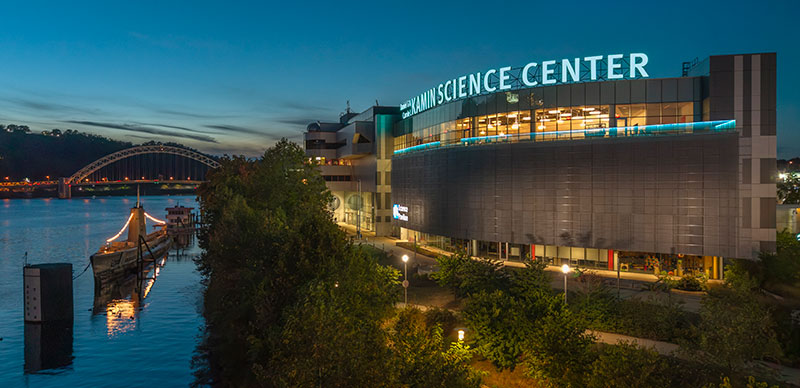
Explore this love/fear relationship at
Carnegie Science Center’s new exhibit, Scream Machines: The Science of
Roller Coasters. This 6,000-square-foot exhibit, with 11 multi-station
interactive components, has all the heart-pounding, stomach-churning, and
head-spinning experience of any roller coaster ride.
What exactly does happen to you, scientifically
speaking, on a roller coaster? For one thing, you are subject to new effects
of the laws of gravity. Right now you are experiencing a 1-G force–the
normal gravitational pull that holds you to that couch. But if you go fast
enough, in a car or a roller coaster, you’re pushed with a force equal
to the weight you normally feel due to Earth’s gravity. Ever felt as if
you were being thrown sideways in a car that was turning too fast? Then
you’ve experienced greater than 1 G-force. Once your body begins moving
it will continues in a straight line until something forces it to change–such
as a roller coaster curve or loop. Your body resists the change, so you
feel thrown outward. That’s centrifugal force, G-force or, as astronauts
say, “pulling Gs.”
The Revolution roller coaster at Six Flags,
Magic Mountain in Valencia, California, gives you a whopping 4.9 Gs–1.5
more than a shuttle launch–double that and jet pilots begin to black out.
Confused by all these Gs? Climb on Scream
Machines G-Force!, a bicycle ride that circles an 18-foot loop, and
feel high and low G forces as well as free-fall–that weightless sensation
(negative Gs) of going over a thrill ride hill–when the G force upward
cancels gravity’s normal one G downward.
Roller coasters create thrills primarily
through a sense of illusion and the psychology of fear. Think about it.
The average duration of a coaster ride is only two and a half minutes,
and the roller coaster begins losing momentum once it hits the bottom of
a hill. So you’re never going faster than you go after the roller coaster’s
biggest drop. But while shooting through the ride it seems like you’ve
been going faster than the speed of light forever. That’s illusion. As
you nervously prepare for take-off in any typical-sized roller coaster,
such as Kennywood Park’s Steel Phantom, the track is about 3,000
to 4,000 feet long–but add loops and
turns, and it seems like miles. That’s
fear. Inverted roller coasters, where seats dangle below the track, add
an even deeper sense of fear because they produce the illusion that you
are whizzing through space attached to nothing but the chair–try it at
FACE/OFF at Paramount’s King’s Island in Cincinnati, Ohio.
A good roller coaster designer creates
this fear and speed illusion by making the ride’s turns tighter. The Steel
Phantom, which ranks in the top five of all roller coasters for speed,
only reaches 80 miles per hour–and you know you’ve topped that on the
Turnpike. But add loops, corkscrews, tight turns, incredibly steep hills,
whipping wind, the open car, and the scenery whizzing by, and comparing
it to a highway drive is like comparing riding an elevator to skydiving.
The perceptual phenomenon created as objects
race and twirl by coaster riders is demonstrated at Scream Machines Tumble-Vision
display. Tumble-Vision features a stationary bridge and rotating walls–you
aren’t moving, but you feel as if you are. A similar apparatus is used
by NASA to train astronauts.
Albert Einstein noted in his book The Evolution
of Physics that roller coasters are a perfect example of energy conservation
in a mechanical system. From the potential energy that exists on
the top of the first hill to the conversion of kinetic energy as it plunges
down the drop, the roller coaster uses only gravity and momentum to perform.
In fact roller coasters are such a good
place to learn about physics that for the past 13 years Kennywood Park
has hosted an annual physics test. Thousands of students from Pennsylvania,
Ohio, Maryland, and West Virginia climb aboard roller coasters to learn
about G forces and hop on the 251-foot tall Pittfall, which plunges to
Earth at 100-feet per second, to experience free-fall first-hand.
“Every ride works as a lab,” says Rosemeyer.
“[The test] is very serious work, but the kids have a ball. It’s a great
way to apply the classroom to the real world.”
The same goes for Scream Machines, but
without the exam it’s all a ball. There’s the Revolver display where visitors
bowl in a rotating room to see how the physics of a simple motion can react
in weird ways–the weird ways that push and pull your body when it hits
a coaster curve and your body wants to go straight while the seat it’s
strapped to goes in another direction. Or check out the Black Plague. Built
by Mike Graham, it’s one of the most detailed working models of a roller
coaster anywhere. Inspired? Build your own coaster at Computer Coaster
and see if you’d engineer the best thrill-ride ever–or create a ride of
chaos and
doom.
Speaking of doom, there’s no need to fear
a thrill ride. Roller coasters are exceptionally safe–just ask Linkenheimer,
who’s climbed aboard more than 400 coasters (he can’t name a favorite).
The mortality rate for coasters is one in 90 million–and of the 34 people
who have died in roller coaster-related accident in the last 26 years,
the majority were not exactly practicing the safety rules. Yep, there’s
a reason you’re not supposed to stand up on the Steel Phantom.
Even so, some people would rather be eaten
alive by chipmunks than strap themselves into a whirling dervish. But if
you’ve wondered if an Evel Knievel lurks beneath your Casper Milquetoast
exterior, take Scream Machines Thrill-Seeker Test and find out if you
are a closet Type-T–a thrill seeker.
For those out there who need a good dose
of Pepto Bismol just seeing a roller coaster, Scream Machines has exhibits
explaining how the brain and fluids in the inner ear can turn a stomach
of steel into a heaving mass.
End the day with a coaster ride. Okay,
not a real ride–Carnegie Science Center isn’t that big–but viewing five
of the world’s greatest coasters on an enormous video screen is so close,
you’ll feel the wind in your hair.
And remember: keep your arms and legs in
the car at all times.
Want more? Check out these Web sites:
www.rollercoaster.com
Features a list of the top 10 coasters and theme parks, with Ohio’s Cedar
Point ranking as the number one park (Kennywood
Park comes in at number 9), and Cedar
Point’s The Raptor the number one coaster. There is also information about
roller coaster clubs and
organizations, and a glossary of roller
coaster terms.
www.thrillride.com
Features links to sites such as Six Flags, Florida Theme Parks, Theme Parks
of New England, Kennywood, Cedar Point, and the
Great Ohio Coaster Club.
www.rcdb.com
Features a database of more than 600 roller coasters in North America.
It also has pictures, coaster statistics (height, length, drop, speed,
and duration), and coaster demographics (age, builder, and type–wood or
steel).
www.coasterquest.com
Answers questions from how a coaster is built to how lap bars stay locked.
Roller Coaster Timeline
While roller coasters usually conjure up images
of summer fun and high-tech wizardry, they have a surprisingly long–and
cold–past. Here’s
a timeline:
15th century: The Russian Ice Slides, the
roller coaster’s great-great grandfather, premieres in St. Petersburg.
People would ride blocks of ice down icy wooden ramps–some as high as
70 feet with a 50-degree angle.
Late 1700s: The first wheeled coaster, consisting
of gentle slopes, appears in St. Petersburg.
1827: The United States gets it first taste
of the fun with the Mauch Chunk Railroad in Pennsylvania. A railway system
developed to bring coal from the bottom of a mountain, it was turned into
a 30-minute thrill ride with speeds topping 100 miles per hour. It still
ranks as the longest coaster ride ever.
1846: The first loop, the Chemin de Centrifuge,
is built in Paris.
1884: The first United States coaster is built
at Coney Island, New York. Designed by LaMarcus Thompson, the gentle, six-mile-per-hour
ride was
called the Gravity Pleasure Switchback Railway.
Later that year the first continuous track coaster–ending where it began–was
built.
1885: The mechanical hoist is invented; cars
are no longer manually towed to the top of the first hill.
1907: The first high-speed coaster, Drop the
Dip, opens in New Jersey. It is also the first coaster to use lap bars.
1910-12: The safety ratchet, or safety chain
dog, that keeps cars from rolling backwards while going up a hill, and
the underfriction safety wheels are invented by John A. Miller, the designer
of more than 100 coasters including Kennywood Park’s Jack Rabbit and Racer.
1920s: The golden age of coasters. More than
1,500 roller coasters were operating in the U.S. alone.
1930s and 1940s: The dark age of coasters
begins as the Depression takes a toll on entertainment income and WWII
makes building materials scarce. Hundreds of coasters would be torn
down during this era.
1955: Disneyland opens and a new era for amusement
parks begins. In 1959, the park’s Matterhorn would be the first coaster
to use tubular steel tracks, polyurethane wheels and lightweight fiberglass
cars.
1975: The first Corkscrew debuts in Cedar
Point, Ohio.
1992: The first inverted roller coaster, where
the track is above the rider, opens in at Six Flags Great America, Illinois.
1996: Paramounts King’s Dominion, Virginia,
introduces the first liner induction motor, which eliminates the need for
a lift hill.
And what’s the fastest coaster? Although
Cedar Point’s new Millennium Force claims to be “tallest and fastest roller
coaster on the planet Earth,” its 300-foot drop and top speed of 92 miles
per hour can’t compete with Superman, the Escape at Six Flags Magic Mountain,
California, which reaches speeds of 100 mph and has a 415-foot drop.
Home
Museums
Back Issues
Membership
Copyright (c) 2000 CARNEGIE magazine
All rights reserved.
E-mail: carnegiemag@carnegiemuseums.org